
Gandhi: An Autobiography
Watch Prashant Sir break down the key ideas, satyagraha, and the philosophical depth of Gandhi’s extraordinary account of his experiments with truth.
Why Read Gandhi: An Autobiography?
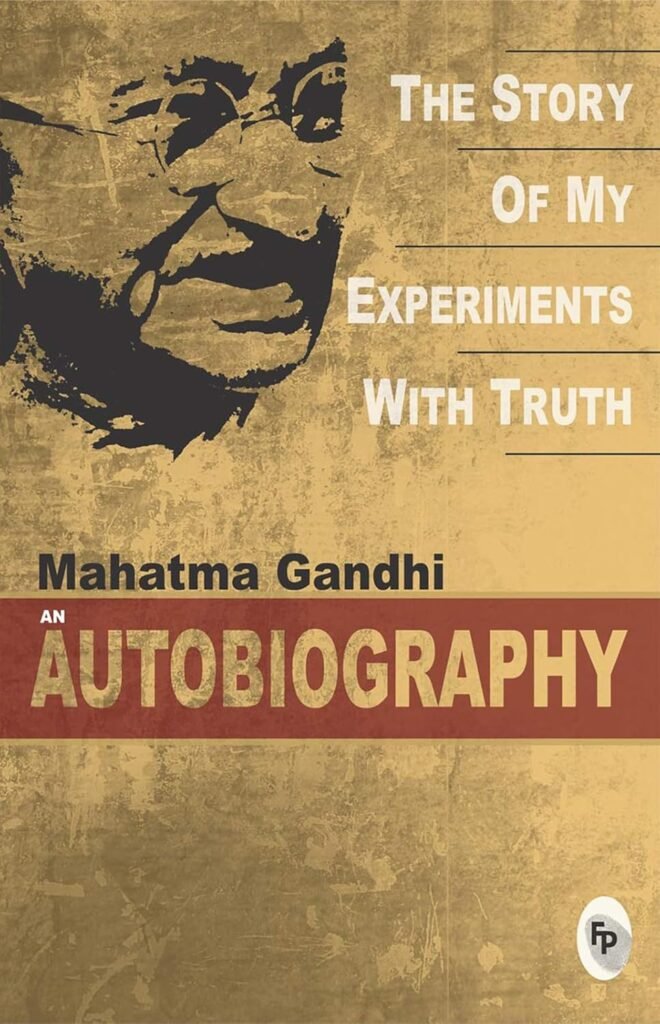
Gandhi: An Autobiography — The Story of My Experiments with Truth is unlike any other political autobiography in this database or in the broader literature. It is not, in any conventional sense, a story of triumph. It is the record of a man’s sustained attempt to bring his conduct — in diet, in sexuality, in economics, in politics, in personal relationships — into alignment with his conception of truth. The autobiography is titled “experiments with truth” for a specific reason: Gandhi presents his life not as the progressive realisation of a vision already formed but as a series of tests, many of which he failed, through which the vision was slowly, painfully constructed.
The autobiography covers Gandhi’s life from his childhood in Porbandar and Rajkot through his education in England, his humiliating early years as a lawyer in India, his transformative twenty-one years in South Africa where he first developed satyagraha (truth-force) as a political method, and up to 1921 — stopping well before his most famous campaigns. Gandhi left the story unfinished, explaining that he was not writing a political history but a spiritual account, and that the spiritual experiments he wanted to document were complete enough in the period he had covered.
The book is as much about diet, brahmacharya (celibacy), and the specific disciplines of personal conduct as it is about politics. His argument is that political non-violence is not a strategy available to anyone; it is the outer expression of an inner discipline that must be cultivated through sustained, deliberate practice over a lifetime. The personal experiments and the political experiments are the same experiment, conducted at different scales.
Who Should Read This
This is essential reading for every Indian student, professional, and citizen — not because Gandhi is uncontested but because understanding his actual thinking, in his own words, is the prerequisite for either endorsing or intelligently criticising his legacy. CAT and MBA candidates preparing for discussions about Indian history, political philosophy, leadership, and non-violence will find in the autobiography a depth and specificity that secondary accounts cannot provide. Beyond preparation, it belongs on the reading list of anyone interested in the development of political philosophy through practice and in the question of what it means to attempt to live one’s convictions without compromise.
Key Takeaways from Gandhi: An Autobiography
Truth is not a destination but a method — a continuous process of testing your convictions against the full consequences of acting on them. This is not relativism — Gandhi believed deeply in absolute truth. It is the specific humility of a person who believes that absolute truth exists and that no human being has yet fully apprehended it.
Non-violence (ahimsa) is not the absence of conflict — it is the insistence on engaging conflict through means that do not reproduce the dehumanisation you are fighting against. The specific means you use to fight injustice determine the specific kind of justice you are capable of building. The method and the goal are not separable.
The inner and the outer life are not separable. Political courage — the courage to face imprisonment and violence without responding in kind — requires an inner resource that only sustained personal discipline can build. You cannot be non-violent in public if you are violent in private.
The most powerful political act available to the colonised is the withdrawal of consent. Colonial power ultimately rests on the colonised population’s cooperation with its own administration. This is not passivity; it is the most demanding form of active resistance, requiring the courage to absorb violence without retaliating.
Key Ideas in Gandhi: An Autobiography
The autobiography’s most distinctive quality is Gandhi’s consistent willingness to document his own failures and embarrassments alongside his achievements — the specific shyness that made him a failure as a lawyer in his early years, the moral confusion of his adolescence, the failures of particular satyagraha campaigns, and the episodes of personal conduct that fell short of his own standards. This honesty is not self-flagellation; it is the specific intellectual discipline of a person who genuinely believes that truth cannot be approached except through the full acknowledgment of where you have fallen short of it.
The South Africa sections — covering more than half the autobiography — are its most politically consequential. Gandhi arrived in South Africa in 1893 as an inexperienced lawyer and discovered a racial hierarchy of such systematic cruelty that it catalysed the specific political thinking the rest of his life expressed. The famous incident in Pietermaritzburg — Gandhi thrown off a first-class train despite holding a valid ticket — is the autobiography’s most mythologised moment. What the autobiography makes clear is that the incident did not produce an immediate political awakening; it produced a night of specific deliberation about whether to fight or to accept — and that deliberation, not the incident itself, was the beginning of satyagraha.
The development of satyagraha in South Africa is the autobiography’s most intellectually rich section. Gandhi worked out the method through a series of campaigns against specific discriminatory legislation — the Asiatic Registration Act, restrictions on Indian migration, the invalidation of Indian marriages. The specific lessons of each campaign are documented with a politician’s attention to strategy and a philosopher’s attention to principle, which is what makes this section the most instructive for anyone thinking seriously about political leadership.
The personal discipline sections — the dietary experiments, the brahmacharya vow, the development of the spinning wheel and the simplicity economy — are the autobiography’s most misunderstood and most important. Gandhi’s argument is not that everyone should live as he did. His argument is that the specific content of the personal discipline matters less than the practice of bringing one’s personal life into alignment with one’s convictions — that the person who says they believe in equality while living a life of material privilege has not yet fully understood what their belief requires.
Key Themes in Gandhi: An Autobiography
Five interlocking themes run through the autobiography, each examining a different dimension of the relationship between truth, non-violence, self-discipline, and political action.
Core Arguments
Four arguments distinguish the autobiography as a work of political philosophy, not merely personal memoir.
Gandhi’s most important political contribution is the systematic working-out of satyagraha as a complete political philosophy rather than merely a tactical method. Satyagraha rests on three specific philosophical claims: that non-violence has a structural advantage over violence in any sustained conflict; that the willingness to absorb suffering without retaliating is both a demonstration of moral superiority and a specific means of converting opponents rather than defeating them; and that the withdrawal of cooperation from an unjust system is more powerful than any direct attack on that system, because systems ultimately rest on the cooperation of those they govern. Together these claims constitute a complete and internally consistent political philosophy that the autobiography documents being built, tested, and revised through twenty-one years of practice.
One of the autobiography’s most sustained arguments is Gandhi’s critique of Western civilisation — not as alien or inferior but as specifically deficient in the qualities that sustainable human flourishing requires. Gandhi’s critique is not romantic primitivism; it is a specific argument about the relationship between material prosperity, moral development, and political freedom. A civilisation that defines progress primarily in terms of material accumulation and industrial production is simultaneously developing the capacity to produce more and atrophying the capacity to live well — and the colonial project was imposing this specific impoverishment on India alongside the political and economic extraction.
The autobiography’s most demanding and most frequently resisted argument is that political transformation is impossible without personal transformation — that the people who seek to build a just society while themselves living unjustly are engaged in a contradiction that will ultimately defeat their political aims. Gandhi’s argument is not that everyone must become an ascetic — it is that every person engaged in political struggle for justice must ask what their own life expresses about the justice they claim to seek, and must bring their personal conduct into progressive alignment with their political convictions.
Gandhi’s most intellectually honest moment is his preface, in which he acknowledges that the autobiography cannot demonstrate the truth of the methods it describes — it can only document the experiments honestly and leave readers to draw their own conclusions. This is an extraordinarily rare admission in political autobiography: the acknowledgment that the record of a life, however honest, cannot constitute proof of the correctness of the convictions the life expressed, and that each reader must conduct their own experiments. It is also the autobiography’s deepest expression of its central argument — that truth is a method, not a destination.
Critical Analysis
A balanced assessment of a foundational text — its extraordinary intellectual achievements and the genuine limitations that Indian and global readers must engage with honestly.
The autobiography’s most important quality is Gandhi’s consistent willingness to document his own failures, confusions, and revisions of position — the shyness that made him a poor lawyer, the dietary experiments that failed, the campaigns he called off, the personal disciplines that collapsed. This honesty is functionally rare in political autobiography, and it is what gives the autobiography its authority as a genuine account of how moral and political philosophy is actually developed through practice rather than received as a completed system.
The South Africa chapters are the most politically specific in the autobiography — detailed accounts of specific campaigns, specific negotiations, specific decisions and their specific consequences. They constitute one of the most instructive available primary accounts of how non-violent political resistance actually works in practice, including its failures and its limits. For anyone thinking seriously about political leadership under conditions of structural injustice, these chapters are the autobiography’s most valuable section.
The autobiography’s most unusual quality is its refusal to separate the personal and the political — its insistence that dietary choices, sexual conduct, economic practice, and political method are all expressions of the same underlying moral orientation and must be understood together. This integration is both the autobiography’s most difficult quality for contemporary readers and its most important contribution: it insists on a wholeness of moral commitment that the standard contemporary separation of public and private life makes impossible.
The autobiography’s most significant and most contested omission is its treatment of caste. Gandhi’s position on caste — which evolved over his lifetime from acceptance to opposition to abolition, under pressure from Ambedkar and others — is not adequately addressed in the autobiography. For Indian readers, this omission is not merely historical but politically active: Gandhi’s legacy on caste remains deeply contested, and the autobiography’s silence on the question is itself a historical datum that requires acknowledgment.
Gandhi’s account of his celibacy vow and his later brahmacharya experiments raises serious ethical questions that the autobiography does not adequately address. His treatment of his wife Kasturba — whose consent to his experiments is documented more as an assumption than as a genuine negotiation — is one of the autobiography’s most uncomfortable dimensions for contemporary readers, not resolved by Gandhi’s evident love for her or his acknowledgment of specific failures in their relationship.
The autobiography was originally written in Gujarati for a Gujarati-speaking audience in a specifically Indian cultural context. Mahadev Desai’s English translation, while generally considered reliable, necessarily flattens some of the cultural and linguistic specificity of the original. Readers encountering the autobiography in English are encountering a translation of a text written in a specific cultural register for a specific audience, and the texture of Gandhi’s moral language — particularly the specific resonances of satyagraha, ahimsa, and swaraj — is more available to readers who encounter them in their original context.
Impact & Influence
A Primary Source for One of the Most Consequential Ideas of the Twentieth Century: Gandhi: An Autobiography was originally serialised in Gandhi’s own journal Navajivan in Gujarati between 1925 and 1929, then translated into English by Mahadev Desai. It has since been published in virtually every major language, sold tens of millions of copies worldwide, and been recognised as one of the most important political and spiritual texts of the twentieth century. It is required reading in Indian schools and universities and cited as a primary influence by political leaders across the globe — from Nelson Mandela and Martin Luther King Jr. to César Chávez and Aung San Suu Kyi.
Impact on Political Thought: Gandhi’s working-out of satyagraha became the foundational text for every significant non-violent political movement of the twentieth century. The American Civil Rights Movement, the anti-apartheid movement, the Solidarity movement in Poland, the Velvet Revolution in Czechoslovakia — all drew explicitly on the framework the autobiography documents being developed. The autobiography is therefore not merely a personal document but the primary source for one of the most politically consequential ideas of the twentieth century.
Impact on the Genre: The autobiography established a model of political autobiography that was simultaneously more personally honest and more philosophically serious than the genre had previously produced, influencing subsequent political memoirists — including Mandela, whose Long Walk to Freedom explicitly acknowledges Gandhi’s influence on early ANC strategy — to engage with the personal dimensions of political commitment with a depth that purely political memoir does not require.
The Ambedkar Dimension: The autobiography’s relationship with B. R. Ambedkar — who is not a figure in the autobiography itself but whose critiques of Gandhi’s positions on caste are among the most important challenges to his legacy — represents its most politically active contemporary dimension. Reading the autobiography in the context of Ambedkar’s critiques — particularly Annihilation of Caste (1936) — is the most complete available engagement with both the autobiography’s contributions and its limits.
Indian Educational and Professional Context: The autobiography occupies a specific and contested position in India — simultaneously the foundational text of the national tradition and a text whose specific positions on caste, gender, and economic organisation are deeply contested. For MBA and CAT candidates, the ability to engage with this complexity — to hold the autobiography’s genuine contributions and its genuine limitations in simultaneous view — is itself a demonstration of the analytical maturity that the best personal interviews reward.
Love This Book? Master Every Book.
Stop struggling with reading comprehension. Our proven system transforms how you read—whether for CAT, GRE, GMAT, SAT, or personal growth.
Best Quotes from Gandhi: An Autobiography
There is no such thing as ‘Gandhism,’ and I do not want to leave any sect after me. I have simply tried in my own way to apply the eternal truths to our daily life and problems.
Man’s only safety lies in a life of truth and nonviolence.
Satisfaction lies in the effort, not in the attainment. Full effort is full victory.
My uniform experience has convinced me that there is no other God than Truth.
I have also seen children successfully surmounting the effects of an evil inheritance. That is due to purity being an inherent attribute of the soul.
If You Liked This, Try…
No books found.
Test Your Understanding
Think you’ve mastered Gandhi’s Autobiography? Challenge yourself with 15 questions on satyagraha, key themes, and Gandhi’s core arguments. Score 80%+ to prove your mastery.
Gandhi’s Autobiography FAQ
What is Gandhi: An Autobiography about?
It is Gandhi’s account of his life from childhood through 1921 — covering his upbringing in Porbandar, his education in England, his humiliating early years as a lawyer in India, his transformative twenty-one years in South Africa where he developed satyagraha, and his return to India and early political work. The autobiography is subtitled “The Story of My Experiments with Truth” because Gandhi presents it not as a record of achievement but as an honest account of the tests — in diet, sexuality, economics, and politics — through which his convictions were slowly and painfully developed.
Is it useful for MBA and CAT preparation?
Directly and specifically — particularly for GD/PI discussions about Indian history, political leadership, non-violence, the ethics of resistance, and the relationship between personal conduct and public action. The ability to engage with Gandhi’s actual arguments — the means-ends inseparability argument, the withdrawal of consent as political method, the relationship between personal discipline and political courage — rather than with the sanitised public image, signals the kind of intellectual engagement with primary sources that MBA selectors reward.
What is satyagraha and how did Gandhi develop it?
Satyagraha — literally “truth-force” or “holding fast to truth” — is the specific method of non-violent political resistance that Gandhi developed through twenty-one years of campaigns in South Africa against discriminatory legislation. It rests on three specific claims: that non-violence has a structural advantage over violence in sustained conflict; that the willingness to absorb suffering without retaliation both demonstrates moral superiority and creates the conditions for converting opponents; and that the withdrawal of cooperation from an unjust system is more powerful than any direct attack on it. Gandhi distinguished satyagraha from passive resistance — which he considered a strategy of the weak — by insisting that it required the active, disciplined, courageous embrace of suffering in the service of truth.
Why does the autobiography spend so much time on diet and personal conduct?
Because Gandhi’s argument is that personal conduct and political action are expressions of the same discipline — that you cannot be non-violent in public if you are violent in private, and that the capacity for political courage requires an inner resource that only sustained personal discipline can build. The dietary experiments, the brahmacharya vow, and the simplicity economy are not eccentricities attached to an otherwise political text; they are the autobiography’s argument that political transformation is impossible without personal transformation. Gandhi is making the case that how you eat, how you relate to your own desires, and how you relate to material possessions are political questions with political consequences.
How does Gandhi’s autobiography compare to Mandela’s Long Walk to Freedom as an account of political resistance?
The two are the most important political autobiographies in this section and together constitute a complete account of the foundational tradition of non-violent political resistance and its specific practice. Gandhi’s autobiography documents the philosophical development of satyagraha — the foundational method from which Mandela and King explicitly drew. Mandela’s autobiography documents the specific practice of that method in the South African context, including the specific compromises and negotiations that implementation required. Reading both together is the most complete available education in the specific tradition and debates of twentieth-century non-violent political resistance — their agreements, their disagreements, and the specific historical contexts that shaped their different conclusions.








