
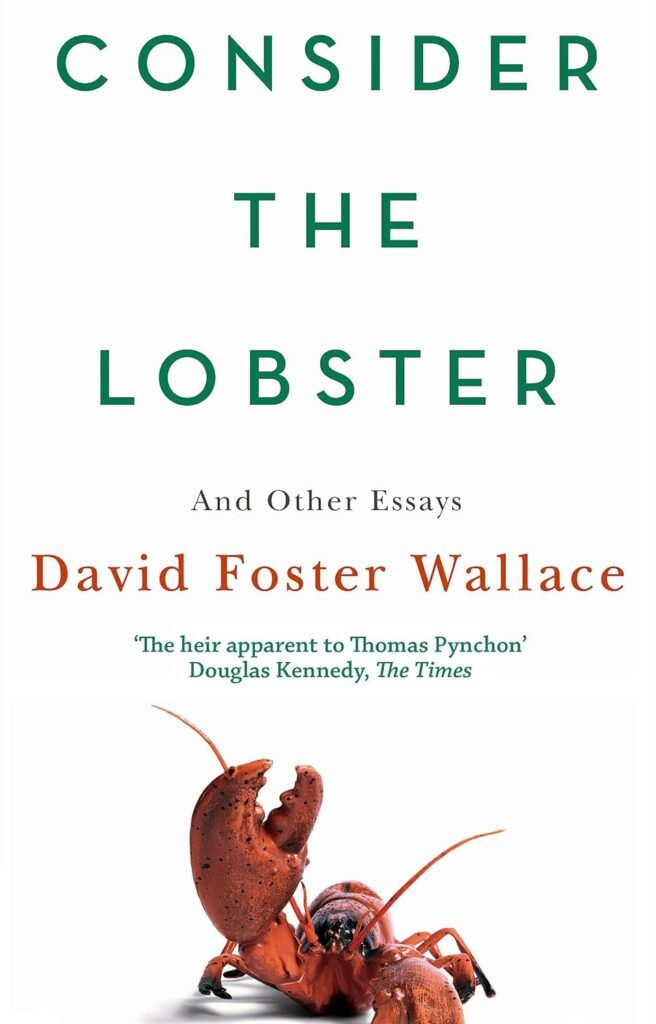
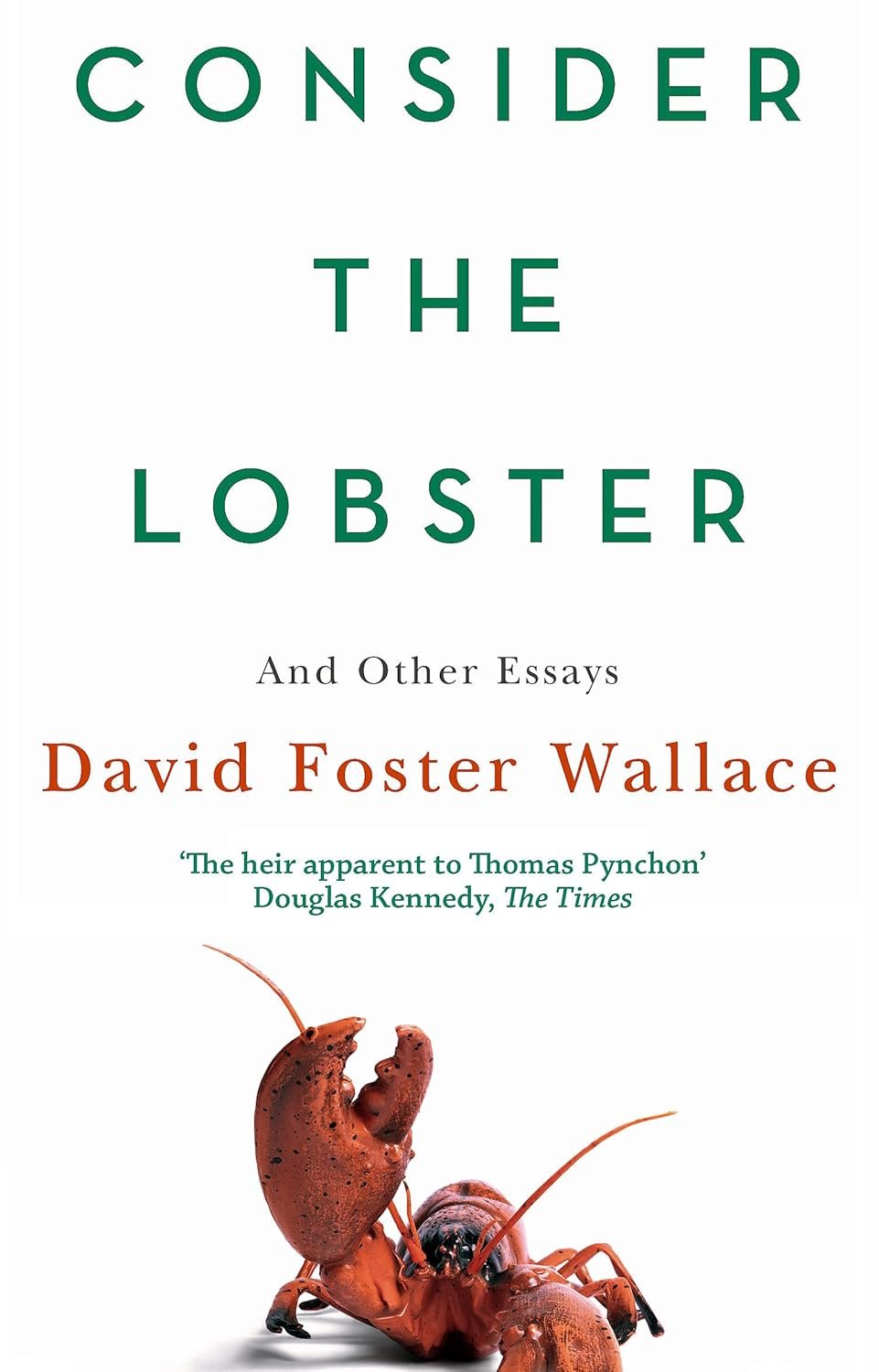
Consider the Lobster and Other Essays
Watch Prashant Sir break down the key essays, Wallace’s intellectual method, and why this collection is essential reading for serious thinkers and exam aspirants alike.
Why Read Consider the Lobster?
Consider the Lobster and Other Essays collects eight of the pieces David Foster Wallace wrote for magazines between 1998 and 2005 — on subjects ranging from the Maine Lobster Festival to John McCain’s 2000 presidential campaign to Tracy Austin’s autobiography to Dostoyevsky. What makes the collection exceptional is not the range of subjects — it is the specific quality of mind brought to each of them. Wallace writes literary journalism the way no one else has: he follows every idea wherever it leads, uses footnotes to conduct parallel arguments that complicate the main text, and consistently arrives at conclusions that are more honest, more specific, and more uncomfortable than the assignment originally required.
The collection includes eight major essays: “Big Red Son” (the Adult Video News awards convention), “Authority and American Usage” (a 67-page essay on prescriptivism versus descriptivism in American English), “The View from Mrs. Thompson’s” (watching the September 11 attacks on television in Bloomington, Illinois), “How Tracy Austin Broke My Heart” (on sports memoirs and athletic genius), “Up, Simba” (travelling with the John McCain 2000 campaign), and the title essay “Consider the Lobster” (on the ethics of boiling lobsters alive, originally written for Gourmet magazine).
The collection is not a unified argument — it is a sustained demonstration of a specific way of thinking. The diversity of its subjects is itself part of that demonstration: the same intellectual method — rigorous, honest, relentlessly self-aware, and fundamentally unwilling to accept easy conclusions — is applied to pornography and to Kafka, to lobsters and to presidential politics, with the same quality of result.
Who Should Read This
This is essential reading for anyone who writes seriously, thinks seriously about language, or is interested in how the essay form can be pushed to its limit. CAT and GMAT candidates preparing for verbal reasoning and analytical writing will find in Wallace’s essays a specific kind of training that no practice test can provide — the specific experience of following a rigorously sustained argument through its full complexity. Beyond preparation, it belongs on the reading list of every journalist, every writer, every student of rhetoric and ethics, and every person who has ever suspected that the easy conclusion to any interesting question is probably wrong.
Key Takeaways from Consider the Lobster
The most interesting ethical questions are embedded in the most ordinary practices of daily life. Wallace’s method is to take the question seriously, follow it wherever it leads, and report honestly on where that is — which turns out to be somewhere that neither the lobster festival’s organisers nor Gourmet magazine’s readers were expecting to go.
Standard American English is not a neutral medium — it is a political instrument encoding specific power relationships. Wallace’s “Authority and American Usage” manages to be both a rigorous prescriptivist argument and a full acknowledgment of the prescriptivist’s bad faith — one of the greatest intellectual achievements in the essay form.
Athletic genius may be fundamentally incompatible with the self-awareness that produces interesting memoir. The cognitive quality that made Tracy Austin a champion — performing complex actions without conscious reflection — is exactly the quality that makes it impossible for her to describe those actions with conscious precision.
How a community watches a national tragedy tells you more about that community than the tragedy itself. “The View from Mrs. Thompson’s” is the most precise account available of how small-town America actually experienced September 11 — specific, tender, honest about what it observed and what it cannot fully explain.
Key Ideas in Consider the Lobster
The collection’s most important formal feature is Wallace’s use of footnotes — not as citations or clarifications but as a second level of argument that runs parallel to and complicates the main text. The footnotes in the best essays contain material as intellectually substantial as the essays themselves — qualifications, counterarguments, extended digressions on points the main text cannot pursue without losing its thread. This is not a stylistic affectation; it is the specific formal expression of a mind that thinks in multiple registers simultaneously and that refuses to simplify its argument to fit a single channel of expression.
“Authority and American Usage” — at sixty-seven pages, the collection’s longest and most demanding piece — is by any measure one of the greatest essays written in American English in the past half century. It begins as a review of Bryan Garner’s A Dictionary of Modern American Usage, uses that occasion to conduct a sustained examination of the prescriptivism/descriptivism debate, arrives at a position Wallace calls “Snoot Democratic Realism,” and does all of this while being funnier than most comedy writing. The essay is the most complete demonstration available of what Wallace’s specific intellectual method can produce at full extension, and it is essential reading for anyone who writes in English about anything.
The title essay — “Consider the Lobster,” originally published in Gourmet magazine — is the collection’s most structurally perfect piece. Wallace was commissioned to write about the Maine Lobster Festival. What he produced begins as conventional food journalism and progressively converts into a genuine philosophical inquiry into the ethics of causing pain to sentient beings for the purposes of human pleasure. The essay’s most important formal quality is the specific patience with which Wallace allows the conventional assignment to open into the philosophical question — never forcing the transition, until the reader is deep inside an argument they did not realise they had agreed to follow.
“Up, Simba” — the account of travelling with the John McCain 2000 presidential campaign — is the collection’s most politically instructive piece. Wallace’s account of the “Straight Talk Express” bus tour is the most honest account available of the specific paradox of political authenticity: the moment genuine authenticity is recognised as a political advantage and deliberately performed, it ceases to be genuine — which is the specific problem that McCain’s campaign both embodied and eventually could not resolve.
Key Essays in the Collection
Five of the eight essays represent Wallace’s intellectual method at its most fully developed — each a different subject, each demonstrating the same quality of rigorous, honest, exhaustively qualified thinking.
Core Arguments
Four arguments run across the collection, each a different application of the same underlying intellectual commitment to following questions wherever they actually lead.
The collection’s most philosophically significant argument — concentrated in “Consider the Lobster” but present throughout — is that the ethical questions embedded in ordinary daily practice are not trivial questions resolved by the fact that the practice is ordinary. Eating lobsters, using language, watching television — each of these ordinary practices embeds specific ethical commitments that most people never examine because the practice is so normal that examination seems eccentric. Wallace’s method is to treat the examination as normal and the avoidance as eccentric, which produces the specific quality of his work — the way it consistently arrives at questions that feel both urgent and somehow already answered by the conditions of the culture he is examining.
“Up, Simba” develops the most precise available account of the specific paradox that modern democratic politics creates for authentic political communication. In a media-saturated political environment, the appearance of authenticity is one of the most valuable political commodities available — and the moment any politician’s genuine authenticity becomes recognisable as a political advantage, the strategic pressure to perform that authenticity becomes irresistible. Wallace’s observation that this paradox cannot be resolved from inside the political process is one of the most honest observations about contemporary democracy available in the essay form.
“Authority and American Usage” makes the most sustained case available in essay form for the argument that language choices are not merely aesthetic but political — that the specific form of English you write in encodes specific political relationships. Wallace’s Snoot Democratic Realist position — that Standard Written English is a real dialect with real advantages in specific contexts, and that the political conditions that produce those advantages are genuinely problematic, and that both things must be held simultaneously — is the essay’s most intellectually demanding contribution.
“How Tracy Austin Broke My Heart” develops the collection’s most psychologically interesting argument: that certain kinds of excellence may be fundamentally incompatible with the kind of conscious self-awareness that produces the best accounts of that excellence. The essay is the most complete and most generous available exploration of why the people who do things best are often the worst people to ask to explain how they do them — and why this is not a failure of intelligence but a structural feature of the specific cognitive formation that produces excellence.
Critical Analysis
A balanced assessment of the most intellectually demanding collection in this database — its extraordinary achievements and the specific challenges it presents to readers.
Wallace’s ability to apply the same rigorous, honest, self-aware intellectual method to subjects as different as lobster ethics, American usage, September 11, and pornography — and to produce results of equal quality across all of them — is the collection’s most extraordinary quality. It demonstrates that the essay form, at its highest development, is not a medium for communicating conclusions already reached but a method for reaching conclusions not yet available.
Wallace’s use of footnotes as a second level of argument is the collection’s most important formal innovation. The footnotes are not digressions — they are the parts of the argument that cannot be accommodated in the main text without destroying its architecture. Reading an essay without its footnotes is reading an argument with its qualifications removed, and the qualifications are frequently where the most interesting thinking is conducted.
The collection’s most consistent quality is the specific honesty of a writer who will not settle for the easy conclusion and who reports accurately on the conclusions he actually reaches, however inconvenient. “Consider the Lobster” does not conclude that you should stop eating lobsters; it concludes that the question is genuinely difficult and that you have not been thinking about it seriously. This is more honest and more useful than either a pro-lobster or anti-lobster argument would have been.
Wallace’s essays are the most demanding in this database — not because the ideas are inaccessible but because the form is genuinely difficult. The footnote structure, the syntactic complexity, the sustained length, and the density of allusion require a level of reading attention that most popular non-fiction does not demand. This is a feature rather than a bug — the complexity is functional, not decorative — but readers expecting the accessibility of other books in the database will find the experience significantly different.
Several essays — particularly “Big Red Son” (pornography industry, 1998) and “Up, Simba” (2000 presidential primary) — are products of their specific moment and have dated in ways the more philosophical essays have not. The arguments embedded in the dated material remain instructive, but the material itself requires contextualisation the collection does not provide.
Wallace’s consistent refusal to arrive at definitive conclusions — his commitment to leaving the hardest questions open rather than forcing premature resolution — is both his greatest intellectual virtue and, for some readers, his most frustrating quality. “Consider the Lobster” ends without telling you what to do about lobsters. These non-conclusions are honest, but they can leave readers who came for guidance rather than inquiry feeling that the work has not been completed.
Impact & Influence
A Defining Work of American Literary Journalism: Consider the Lobster was published in November 2005, three years before Wallace’s death by suicide in September 2008 at forty-six, and is the last full collection of non-fiction essays he published in his lifetime. The title essay is probably the most widely assigned piece of literary non-fiction in American university writing courses — used in ethics classes, philosophy seminars, journalism programmes, and English composition courses as a model of the essay form at its most ambitious.
Wallace’s Influence on the Form: Wallace’s influence on American literary journalism and the essay form has been enormous and is still growing. The specific qualities of his work — the footnote structure, the intellectual honesty that refuses easy conclusions, the combination of high and low registers, the formal self-awareness about the genre conventions the essay is operating within — have influenced a generation of writers who either consciously model themselves on his work or have absorbed his influence through the culture. The language of contemporary American long-form journalism — its comfort with digression, its specific kind of self-aware irony, its willingness to conduct philosophical inquiry in the middle of what appears to be conventional journalism — is significantly indebted to Wallace’s development of the form.
The Lasting Essays: “Authority and American Usage” is regularly cited as the most honest and most complete account of the prescriptivism/descriptivism debate available in non-specialist form. “Consider the Lobster” has had an analogous impact on the discourse about animal ethics — not by producing a definitive argument for a specific position but by making it genuinely difficult for anyone who has read it to dismiss the question of animal pain as trivial.
Value for Competitive Exam Preparation: Reading and following a Wallace argument in full — tracking the main text and the footnotes simultaneously, maintaining the thread of a sixty-page essay through its full complexity — is exactly the cognitive exercise that the most demanding verbal reasoning questions are attempting to assess. The ability to follow a sustained, complex, heavily qualified argument without losing its thread is the specific cognitive skill that both the essays and the best competitive reading comprehension tests are training, and the essays train it more authentically than any practice material because they are genuinely demanding rather than artificially so.
Where to Go Next: Wallace’s death in 2008 cut short a career of increasing ambition. For readers of Consider the Lobster, the most important next step is A Supposedly Fun Thing I’ll Never Do Again (1997) — his earlier essay collection, which represents the first full development of the method that this collection extends and deepens.
Love This Book? Master Every Book.
Stop struggling with reading comprehension. Our proven system transforms how you read—whether for CAT, GRE, GMAT, SAT, or personal growth.
Best Quotes from Consider the Lobster
We’re all just complex enough to feel the pull of contradictory moral imperatives.
The really interesting ethical questions are the ones that the practice of living keeps forcing on us whether we want to examine them or not.
Standard Written English is one dialect among many. It is not better or more correct than other dialects. It is, however, the dialect of power in the United States.
A good essay is a sustained attempt to find the truth about a question you don’t yet know the answer to.
The truth is that the whole infantile thing about trying to decide whether lobsters can feel pain comes down to how much discomfort we can tolerate about the question.
If You Liked This, Try…
No books found.
Test Your Understanding
Think you’ve mastered Consider the Lobster? Challenge yourself with 15 questions on Wallace’s key essays, arguments, and intellectual method. Score 80%+ to prove your mastery.
Consider the Lobster FAQ
What is Consider the Lobster and Other Essays about?
It is a collection of eight essays written for various magazines between 1998 and 2005, covering the Maine Lobster Festival and animal ethics, the prescriptivism/descriptivism debate in American English, Tracy Austin’s sports memoir, the John McCain 2000 presidential campaign, September 11 as experienced in small-town Illinois, and the Adult Video News awards convention. What unifies the essays is not their subject matter but the specific intellectual method Wallace applies to all of them: rigorous, honest, exhaustively qualified, and committed to following every question wherever it actually leads rather than where the assignment required it to go.
Is it useful for competitive exam preparation like CAT or GMAT?
Yes — specifically for verbal reasoning and analytical writing, in a way that standard practice materials cannot replicate. Reading and following a Wallace essay in full — tracking the main text and footnotes simultaneously, maintaining the thread of a sixty-page argument — is exactly the sustained cognitive engagement with complex argument that the best verbal reasoning tests are assessing. The ability to follow a sustained, heavily qualified argument without losing the thread is the specific skill both the essays and the most demanding comprehension questions are training, and the essays train it more authentically because they are genuinely demanding rather than artificially so.
What is the title essay, “Consider the Lobster,” about?
Commissioned as a conventional food journalism piece about the Maine Lobster Festival, it became a genuine philosophical inquiry into the ethics of boiling lobsters alive for human consumption. Wallace examines whether lobsters experience pain in a morally relevant sense, the history of how we have decided which creatures’ pain counts ethically, and the specific forms of avoidance through which the question is normally dismissed without being answered. The essay does not conclude that you should stop eating lobsters — it concludes that the question of whether you should is genuinely difficult and that the ease with which most people dismiss it is not evidence that they have thought about it carefully.
What is Wallace’s argument about language in “Authority and American Usage”?
He calls his position “Snoot Democratic Realism” — the view that Standard Written English is a real dialect with real advantages in specific contexts of power (the prescriptivist is correct); that the political conditions which produce those advantages are genuinely problematic and should not be obscured (the descriptivist is correct); and that both things must be held simultaneously. Writing well in Standard English, while acknowledging honestly the politics that make it the language of power, is the only honest position available to a writer who wants to communicate effectively and to think clearly about why that communication works the way it does.
How does Consider the Lobster differ from the other non-fiction in this database?
It is the only book in the database primarily valuable as a demonstration of intellectual method rather than as a source of specific conclusions. The other non-fiction books are primarily valuable for specific arguments or frameworks that can be extracted and applied independently of the reading experience. Wallace’s essays are primarily valuable for the experience of reading them — of following a mind at full extension through the complete development of an argument — and that value cannot be extracted or summarised without being destroyed. This is why the collection is the most resistant to summary in the database, and why reading it is irreplaceable in a way that reading summaries of the other books is not.








