
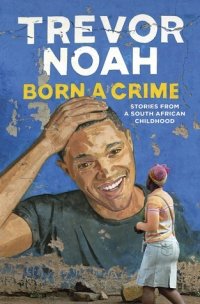
Born a Crime
Watch Prashant Sir break down the key themes, the Patricia Noah argument, and why this memoir is one of the most politically serious funny books ever written.
Why Read Born a Crime?
Born a Crime is the memoir that makes you laugh on almost every page while building, quietly and cumulatively, one of the most precise and most personal accounts of how apartheid worked as a lived system. Trevor Noah, born in 1984 to a Black South African mother and a white Swiss father at a time when their relationship was a criminal offence, uses his own improbable life as a lens through which to examine race, identity, language, poverty, and the specific human creativity required to survive a system designed to crush you — and does it with a comedian’s timing, a journalist’s precision, and an unusually generous honesty about the people he loves.
The book is structured as a series of linked essays rather than a strictly chronological autobiography — each chapter a self-contained story illuminating a specific aspect of Noah’s childhood and adolescence under and after apartheid, in the townships of Soweto, and in the specific liminal space that his mixed-race identity created between communities that had no framework for accommodating him. He was too light-skinned to be Black, too dark-skinned to be white — able to move through spaces that pure racial categories would have excluded him from, and excluded from the belonging that any single community could have provided.
The book’s structural spine is Noah’s relationship with his mother, Patricia Nombuyiselo Noah — a woman of such fierce intelligence, theological conviction, and sheer determination that she functions as the book’s moral and emotional centre. It is his mother who defied the law to have him, who educated him in multiple languages so he could navigate any community, who threw him from a moving minibus to save him from a hijacker, and who survived being shot in the head by her second husband. The book is ultimately not about Trevor Noah — it is about what his mother made possible, and what it cost her.
Who Should Read This
This is among the most enjoyable books you can read — genuinely, consistently funny — while also being among the most intellectually serious about race, identity, privilege, and the specific mechanics of systemic oppression. CAT and MBA candidates preparing for discussions about diversity, inclusion, and social justice will find in Noah’s account both a conceptual framework and a set of specific, memorable illustrations. Beyond preparation, it is essential reading for anyone who wants to understand apartheid from inside a life rather than outside a history textbook, and for anyone who has ever had to decide which version of themselves to present to which room.
Key Takeaways from Born a Crime
Language is the most powerful tool for crossing borders — racial, social, cultural, and economic. In South Africa, the language you speak places you in a racial and social category before you have said anything else. Noah’s mother gave him six languages precisely because speaking any community’s language is the ability to be received as a member of it. Language was not merely communication; it was identity, access, and survival.
Racism works most insidiously not through individual hatred but through systems. Noah’s account is most powerful when most specific: the ID book that determined your racial category; the geographic restrictions on where you could live and work; the legal penalties for personal relationships that crossed racial lines — a system so total that its cruelties required no malicious intent from individual participants.
Identity is not given — it is negotiated, continuously, in every room you enter. Noah’s mixed-race identity made him a category error the system had no box for, requiring the constant work of deciding which version of yourself to present to which community, and discovering that the version accepted in one room disqualifies you from belonging in another. The experience is specific to his context and recognisable to anyone between worlds.
Love, in its most demanding form, is the willingness to do impossible things for someone else’s future. Patricia Noah — Trevor’s mother — embodies the fierce, theologically grounded, practically unlimited love that throws you out of a moving minibus to save you from a hijacker and survives being shot in the head by the man who did it. The memoir argues that this kind of love is the most consequential force in any individual life.
Key Ideas in Born a Crime
The memoir’s most important conceptual contribution is its specific account of how apartheid worked as a system — not the legislative architecture but the lived daily experience of navigating it as a person who did not fit its categories. Noah’s mixed-race identity was itself a product of the system’s internal contradictions: the law criminalised his parents’ relationship but could not prevent the love that produced him, and the person it produced was the system’s own refutation — a human being who demonstrated, by existing, that the racial categories the system was built on were biological fictions rather than natural facts.
The language chapter is the memoir’s most intellectually original section. Patricia made a deliberate, systematic decision to raise Trevor in multiple languages — Zulu, Xhosa, Sotho, Tswana, Afrikaans, and English — because she understood that in a society sorted by race, language was the mechanism through which race was socially enforced on a daily basis. To speak a community’s language is to be, in the moment of speaking, a member of that community. Noah describes using this insight to navigate situations that would have been dangerous if his appearance had been his only identity marker.
The poverty chapters are the memoir’s most materially specific — and its most instructive about the specific mechanisms through which systemic disadvantage perpetuates itself across generations. Noah does not describe poverty as an absence of money; he describes it as a specific set of constraints on possibility: the inability to save because every surplus is consumed by immediate necessity; the specific social dynamics of township communities where solidarity and surveillance reinforce each other; the particular forms of violence that constrained lives produce in people who have no other avenue for the expression of power.
Patricia Noah is introduced early and never leaves. She is the memoir’s moral centre — the person whose decisions at every critical juncture determined the specific possibilities available to Trevor. She is one of the most fully realised characters in contemporary memoir: ferociously intelligent, irreverently funny, theologically serious, and possessed of a specific kind of courage that is best described as the refusal to accept that something was impossible simply because everyone around her had decided it was. Her decision to have Trevor was illegal. Her decision to educate him in multiple languages was strategic. Her decision to move her family out of the township was a specific act of will against the gravitational pull of the conditions her community had normalised.
Key Themes in Born a Crime
Five interconnected themes run through the memoir, each developed through specific scenes and stories rather than abstract argument.
Core Arguments
Noah builds four interconnected arguments through the memoir’s stories — none stated abstractly, all made through the specific texture of a specific life.
Noah’s most conceptually precise argument — present in the title and developed throughout — is that apartheid’s most fundamental violence was not the specific laws it enforced but the ontological claim those laws made: that certain people’s existence was itself a problem. To be born of a mixed-race relationship was to be born a crime — not merely to break the law but to constitute a legal violation by existing. This is the specific form of dehumanisation that distinguishes apartheid from ordinary racism: not merely the denial of rights but the criminalisation of being. Noah’s existence was, in this sense, both a crime and an act of resistance.
The memoir’s most original practical argument concerns the strategic value of multilingualism in a society sorted by language. Patricia’s decision to raise Trevor in multiple languages was not cultural enrichment — it was a calculated survival strategy based on a precise analysis of how power operated in South African society. The ability to speak any community’s language is the ability to access resources, navigate danger, and build cross-community relationships that single-community identity would have prevented. This is not merely a South African lesson; it is a general argument about the strategic value of cultural fluency in any divided society.
The book’s most implicit and most interesting argument concerns the relationship between the comedian’s perspective and genuine social insight. Noah’s ability to find the absurdity in apartheid’s logic is not a softening of the book’s political seriousness but an expression of it. The comedian who can make you laugh at the absurdity of a system is doing something the political analyst cannot: making the system’s internal logic visible from a vantage point that is outside it — which is the specific cognitive achievement of the person who never fully belonged to any single version of it.
The memoir’s most historically situated argument concerns what colonialism bequeathed to its survivors — not merely economic inequality and political disadvantage but specific psychological and social formations that persist long after formal colonial structures have been dismantled. The specific forms of violence, the specific social hierarchies within Black communities, the specific relationship to whiteness as both aspiration and oppression — all are shown, through specific stories, to be inheritances of a colonial history that did not end with apartheid’s formal abolition in 1994.
Critical Analysis
A balanced assessment of a memoir that achieves something genuinely rare: it is simultaneously the funniest and the most politically precise book about apartheid available to a general reader.
Noah’s background as a comedian is the memoir’s most distinctive literary quality — not because it makes the book funny (though it does, consistently) but because it produces the specific kind of observational precision that comedy requires. Every story is constructed with a comedian’s sense of exactly where the absurdity lives — which detail to emphasise, which timing to use, which specific moment of incongruity reveals the most about the broader system. This precision is a literary achievement that pure memoirists rarely manage.
The decision to make Patricia Noah the memoir’s true centre is the book’s most important structural choice and its most emotionally powerful. She is one of the most fully realised characters in contemporary memoir, and the stories about her are the ones that stay with readers longest. By making his mother the book’s real subject, Noah also makes a specific argument about whose courage and whose intelligence actually built the possibility that his own celebrity represents.
The memoir navigates unusually well between the personal and the analytical — between the specific stories of a specific life and the conceptual framework that makes those stories legible as social history. Most memoirs are either too personal (the analytical framework is absent) or too analytical (the personal is subordinated to the argument). Born a Crime holds both simultaneously, which is the achievement that makes it useful both as personal narrative and as social analysis.
The memoir’s strongest material is the childhood and early adolescence sections — the apartheid years, the township stories, the Patricia stories. The later chapters, covering Noah’s adolescent hustling and early entertainment career, are well written but carry less analytical weight. The social history that makes the early chapters exceptional is less present in the later material, which is more conventional coming-of-age memoir and less the specific kind of insider social analysis that distinguishes the book’s best passages.
The memoir’s consistent comedy is both its greatest strength and, occasionally, a limitation. Some of the most serious material — the specific violence of township poverty, the specific trauma of Patricia’s shooting — is handled with a lightness that some readers find appropriate and others find evasive. This is a genuine formal tension rather than a clear failure, but it is worth noting for readers who arrive expecting unrelieved seriousness.
The memoir is most precise about apartheid South Africa and least precise about the specific ways in which the post-apartheid period reproduced and reconfigured the inequalities the formal system had enforced. The 1994 transition and its aftermath — the persistence of economic apartheid after the abolition of legal apartheid — are present in the memoir but not examined with the same rigour as the apartheid period itself.
Legacy & Cultural Impact
Publication and Reception: Born a Crime was published in November 2016 — the same week as the US presidential election that brought Donald Trump to power — and its timing gave it an immediate cultural resonance that a book about South African apartheid might not otherwise have found in an American reading public. It debuted at number one on the New York Times bestseller list, spent over a year on the list, and has since sold over 5 million copies worldwide in more than 30 languages. It won the Goodreads Choice Award for Memoir in 2016 and was named one of the best books of the year by dozens of major publications.
Impact on How Readers Understand Apartheid: The book’s impact on how a broad popular audience understood apartheid was substantial — it provided millions of readers with their most personal, most specific, and most emotionally immediate encounter with what the system meant in lived experience. For many readers outside South Africa, the memoir was their introduction to the specific mechanisms of apartheid — not as political history but as the daily texture of a life lived within it. The combination of comic accessibility and intellectual seriousness made it effective in contexts where more purely analytical accounts would not have reached.
The Daily Show Connection: Noah’s position as host of The Daily Show — a position he assumed in 2015, a year before the book’s publication — gave the memoir an audience it might not otherwise have had, and the memoir in turn gave his television work a biographical context that deepened its credibility. The specific perspective he brought to American political commentary — the outsider’s ability to find the absurdity in a system he had not been born into — was directly traceable to the formation the memoir described.
Resonance for Indian Readers: The memoir resonates along several specific dimensions in the Indian educational and social context. The experience of navigating between communities with incompatible frameworks for identity — the first-generation student navigating between family community and university, the professional navigating between regional and metropolitan identity — is a recognisable structure even when the specific content is very different. The language-as-identity argument is particularly resonant in a multilingual country where the language you speak in public is itself a social positioning, and the Patricia argument — about what fierce maternal commitment to a child’s education can accomplish against structural disadvantage — has a specific cultural salience in a country where maternal sacrifice for children’s education is a recognisable narrative.
Love This Book? Master Every Book.
Stop struggling with reading comprehension. Our proven system transforms how you read—whether for CAT, GRE, GMAT, SAT, or personal growth.
Best Quotes from Born a Crime
We tell people to follow their dreams, but you can only dream of what you can imagine, and depending on where you come from, your imagination can be quite limited.
The genius of apartheid was convincing people who were the overwhelming majority to turn on each other. Apart hate, is what it was. You separate people into groups and make them hate one another so you can run them all.
Language, even more than colour, defines who you are to people.
My mother had always taught me that the way to make something possible is to refuse to believe it is impossible.
She taught me that even in the darkest of times, the only thing you have to do is believe, and you will find a way.
If You Liked This, Try…
No books found.
Test Your Understanding
Think you’ve mastered Born a Crime? Challenge yourself with 15 questions on key themes, the Patricia argument, and core ideas. Score 80%+ to prove your mastery.
Born a Crime FAQ
What is Born a Crime about?
It is the memoir of Trevor Noah’s childhood and adolescence in apartheid and post-apartheid South Africa, structured around his experience as a mixed-race child whose existence was itself a legal offence under apartheid law. It covers his upbringing in the townships of Soweto, his relationship with his mother Patricia, his navigation of multiple racial and cultural communities through multilingualism, his adolescent hustling and early career, and the specific daily experience of living inside a system of racial classification that had no category for who he was.
Is it useful for MBA and CAT preparation?
Yes — particularly for GD/PI discussions about race, identity, systemic inequality, diversity and inclusion, and the relationship between individual agency and structural constraint. Noah’s framework — race as system rather than sentiment, language as identity and access, the outsider perspective as cognitive asset — provides specific, well-illustrated analytical tools for questions that most candidates answer with generic platitudes. The book is also one of the most enjoyable in the database, which makes its lessons easier to retain and deploy.
What makes Patricia Noah so central to the memoir?
Patricia is the memoir’s true subject because she is the primary architect of the possibility that Trevor Noah’s life represents. Every critical advantage he had — multilingualism, educational ambition, the specific psychological formation that allowed him to navigate between worlds — was her deliberate gift. The memoir argues implicitly that the extraordinary achievement his career represents is, at its root, the product of her specific kind of love: fierce, unconditional, theologically grounded, and practically unlimited. Making her the book’s centre rather than its background is the memoir’s most important structural decision and its most honest one.
Is the book primarily about apartheid or about Trevor Noah’s personal life?
Both simultaneously, and the combination is the book’s most important quality. The personal stories are the vehicle through which the social analysis is delivered — Noah’s specific experience of apartheid is how the book makes the system’s abstract mechanics concrete and emotionally immediate. The social analysis is what gives the personal stories their significance beyond individual autobiography. Neither dimension works fully without the other.
Why is the book called Born a Crime?
Because under South Africa’s apartheid laws, specifically the Immorality Act and the Mixed Marriages Act, sexual relations and marriage between people of different racial classifications were criminal offences. Trevor Noah was born of a relationship between a Black South African mother and a white Swiss father at a time when that relationship was itself illegal. His existence was, in the most literal sense, the product of a crime — and the title is both a factual description of his birth circumstances and the memoir’s central argument: that a system willing to criminalise the existence of a child is making a claim about whose lives have value.








