
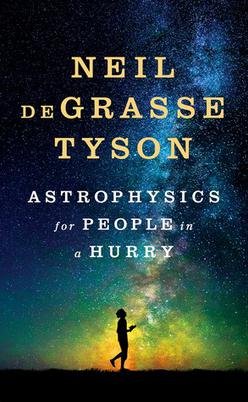
Why Read Astrophysics for People in a Hurry?
Astrophysics for People in a Hurry is the most accessible entry point into modern cosmology and astrophysics available — a slim, brilliantly written collection of twelve essays by Neil deGrasse Tyson, the director of the Hayden Planetarium and the most effective science communicator of his generation, delivering the essential concepts of modern astrophysics in 222 pages that can be read in an afternoon and will stay with the reader for years.
The book grew out of a series of essays Tyson had written for Natural History magazine, each addressing a single topic in astrophysics for general readers — covering the first moments of the Big Bang, the composition of the universe (ordinary matter is only 5% of what exists; the rest is dark matter and dark energy whose nature remains unknown), the cosmic microwave background, the formation of the elements, the electromagnetic spectrum, and the philosophical implications of what astrophysics has discovered about our place in the universe.
The book’s tone — conversational, witty, genuinely enthusiastic, and always ready to connect cosmic perspective to everyday human experience — is its primary distinguishing feature. Tyson writes about astrophysics the way a passionate, brilliant friend might explain it over dinner: with the precision of a professional scientist and the warmth of someone who finds the subject inexhaustibly delightful. The result is a book that is simultaneously informative and entertaining, communicating genuine scientific content without ever becoming a textbook.
Who Should Read This
This is a book for anyone who is curious about the universe but has limited time and no science background — the natural starting point for scientific curiosity about cosmology and astrophysics. Essential for science beginners looking for the most accessible introduction to modern astrophysics, general readers who want to understand dark matter, dark energy, and the Big Bang, CAT/GRE aspirants building elementary-level science reading comprehension, and anyone who has looked at the night sky and wondered what it all means.
Key Takeaways from Astrophysics for People in a Hurry
The Big Bang was not an explosion of matter into empty space — it was the expansion of space itself. In the first fraction of a second, the universe passed through a sequence of states in which the fundamental forces separated, the first particles formed, and the seeds of all cosmic structure were laid down. The first second of the universe’s existence contains more physics than all of recorded human history.
Ninety-five percent of the universe is invisible to us — and we don’t know what it is. Dark matter (approximately 27%) and dark energy (approximately 68%) dominate the universe; only 5% is the ordinary matter that telescopes can detect. This is not an embarrassment of ignorance but an extraordinary discovery: we know very precisely how much of the universe we cannot see.
Every atom of carbon, oxygen, iron, and every element heavier than hydrogen and helium in your body was forged in the nuclear furnaces of stars that lived and died before our solar system formed, then scattered into space by supernova explosions. You are literally made of star stuff. The periodic table is a map of cosmic nuclear history.
The cosmic perspective — the view of human beings from the scale of the universe — is the most powerful antidote to tribalism and self-importance. The entire history of human civilization occupies an undetectably brief moment; the Earth is an invisibly small speck; the entirety of human diversity is a family spat on a pale blue dot. This is not nihilism but a call to perspective and connection.
Key Ideas in Astrophysics for People in a Hurry
The book opens with the first seconds of the Big Bang — not as a single moment but as a sequence of epochs, each defined by the energy conditions that governed which particles and forces could exist. At the very beginning, the temperature was so high that the fundamental forces were unified; as the universe cooled in the first fractions of a second, gravity separated first, then the strong nuclear force, then electromagnetism and the weak force split apart. By the end of the first second, protons and neutrons had formed from quarks, and the fundamental structure of matter was in place. Tyson navigates this physics with a clarity that makes it accessible without trivialising it.
The dark matter and dark energy chapters are the book’s most philosophically provocative. The evidence for dark matter comes not from direct detection but from the behaviour of visible matter: galaxies rotate in ways that cannot be explained by the gravitational pull of their visible matter alone; galaxy clusters deflect light from distant objects by more than their visible mass would predict. All of these observations converge on the conclusion that there is approximately five times as much mass in the universe that we cannot see as there is mass that we can. Dark energy is even more mysterious — it is the energy of empty space itself, causing the universe’s expansion to accelerate against gravity.
The elements chapter is among the book’s most humanly resonant. Tyson traces the nuclear history of every element in the periodic table: hydrogen and helium formed in the Big Bang; carbon, oxygen, and the elements up to iron formed in the nuclear fusion reactions of stars; elements heavier than iron formed in supernova explosions and neutron star mergers. The conclusion — that the atoms in our bodies have a specific cosmic history, that the iron in our blood was forged in a dying star — is not poetic licence but precise astrophysics.
The electromagnetic spectrum chapter explains why visible light is a tiny fraction of the full range of cosmic phenomena, and why astrophysics requires radio telescopes, X-ray satellites, gamma-ray detectors, and gravitational wave observatories to see what the universe is actually doing. Pulsars, quasars, black holes, and the cosmic microwave background are all invisible to the naked eye. The book makes the case that the universe we can see with our eyes is the least interesting fraction of the universe that exists.
Core Frameworks in Astrophysics for People in a Hurry
Tyson builds his account of the universe on six interlocking frameworks — from the Big Bang’s first fraction of a second to the philosophical implications of cosmic scale for human self-understanding.
Core Arguments
Tyson advances four interconnected arguments — about wonder, scientific method, human tribalism, and the integration of scientific and poetic truth — that together constitute the book’s philosophical vision.
Tyson’s motivating argument — present on every page — is that the universe is systematically stranger than human intuition can generate, and that this strangeness is not a problem to be managed but the source of the deepest intellectual pleasure available. Dark matter is five times more abundant than visible matter and completely unknown; dark energy is even more abundant and even less understood; the universe’s expansion is accelerating; the first second of the universe’s existence contains more physical transitions than all of recorded human history. Each of these discoveries should produce not frustration at our ignorance but wonder at the universe’s inexhaustibility.
Running through the book is an implicit argument about what science is — not a fixed catalogue of what is known but a method of inquiry that advances by identifying what is not known and designing investigations to address the unknown. The frank acknowledgment that 95% of the universe is invisible and unexplained is not a confession of failure but a demonstration of scientific honesty and ambition: we know very precisely what we don’t know, and this precision is itself a major achievement. The contrast between scientific honesty about uncertainty and the false confidence of non-scientific worldviews is a recurring implicit theme throughout the book.
The book’s most explicit philosophical argument — developed most fully in the final chapter — is that understanding our place in the universe is the most effective available corrective to the tribalism, nationalism, and conflict that generate much of human suffering. On a cosmic scale, the differences between human groups — racial, national, religious, cultural — are infinitesimally small; we are a single species on a single planet in an unremarkable galaxy in an ordinary part of the universe. The cosmic perspective does not dissolve the genuine value of particular human identities and communities, but it insists that the universe’s scale provides a corrective to the seriousness with which we take our differences relative to our commonalities.
One of the book’s most characteristic moves is to insist that the poetic and the scientific are not in conflict — that the statement “we are made of star stuff” is both literally true (our atoms were forged in dying stars) and genuinely meaningful (it connects us to the universe’s history in a way that no purely parochial human narrative can). This integration of scientific precision and philosophical meaning is the book’s most personally distinctive contribution: Tyson argues throughout that understanding the universe scientifically does not disenchant it but deepens the grounds for wonder.
Critical Analysis
A balanced assessment examining the book’s distinctive strengths as accessible science communication alongside its genuine limitations as an introduction rather than a comprehensive treatment.
Tyson’s conversational, witty, genuinely enthusiastic prose is the book’s greatest asset. He writes about astrophysics the way an ideal teacher talks about their subject — with complete command of the material, delight in its strangeness, and no condescension toward the reader’s lack of specialist knowledge. The tone is infectious: readers who had never thought about dark energy or primordial nucleosynthesis find themselves genuinely curious about them by the end.
The book’s greatest structural achievement is communicating genuine scientific substance in 222 pages without sacrificing accuracy for accessibility. Each chapter gives the reader a real conceptual grasp of its topic — not just a vocabulary — in approximately twenty pages. This compression reflects Tyson’s mastery of the material rather than any sacrifice of depth.
The final chapter on the cosmic perspective is among the most beautiful pieces of popular science writing of the past decade — a genuine philosophical argument developed from the specific scientific content of the preceding chapters rather than attached to it as a decorative conclusion. The connection between astrophysical knowledge and human self-understanding is made with precision and sincerity.
The book is explicitly for people in a hurry — it is not intended to provide deep understanding of any of its topics, and it does not. Readers who want genuine conceptual depth on the Big Bang, dark matter, or the electromagnetic spectrum will need to follow up with more demanding reading. The book is an excellent introduction, but it is only an introduction.
The chapters on dark matter, dark energy, and primordial nucleosynthesis are the most substantive and intellectually rewarding; the chapters on the electromagnetic spectrum and the cosmic microwave background are somewhat thinner. The unevenness reflects the origin of the chapters as magazine essays rather than as a systematically planned book.
The argument that astrophysical scale provides a corrective to human tribalism is genuinely important — but it can be overstated. The cosmic scale does not dissolve the genuine moral weight of human suffering or the genuine importance of human choices, and the move from “we are insignificant on a cosmic scale” to “therefore our differences don’t matter” requires more philosophical work than the final chapter always provides.
Literary & Cultural Impact
Immediate Commercial Success: Astrophysics for People in a Hurry was published in May 2017 and was immediately the bestselling science book in the United States for that year, selling over two million copies worldwide and being translated into numerous languages. Its commercial success reflected both Tyson’s existing public profile — he had hosted the rebooted Cosmos: A Spacetime Odyssey documentary series in 2014, reaching 135 million viewers across 181 countries — and the genuine gap in the market for an astrophysics book that was genuinely short, genuinely accurate, and genuinely readable.
Cultural Impact: The book has made the basic concepts of modern astrophysics — the Big Bang’s specific timeline, dark matter and dark energy as specific quantified unknowns, stellar nucleosynthesis as the origin of the elements — part of the general educated public’s vocabulary in a way that Hawking’s A Brief History of Time had done for an earlier generation. Where Hawking’s book was purchased by millions and finished by fewer, Tyson’s book is genuinely readable in a single sitting, and its specific claims are communicated with sufficient precision that readers retain genuine understanding rather than vague impressions.
Tyson’s Legacy as Science Communicator: The book consolidated Tyson’s position as the most effective science communicator in the English-speaking world — the successor, in terms of public reach, to Carl Sagan. His combination of scientific authority (PhD in astrophysics from Columbia, director of the Hayden Planetarium), communication skill (prolific author, television host, podcast host with millions of subscribers), and philosophical commitment to the cosmic perspective as a democratic value makes him uniquely effective as a popular advocate for the scientific understanding of the universe.
For Exam Preparation: Astrophysics for People in a Hurry is excellent elementary-level reading comprehension practice in popular science prose. Its short chapters covering a single topic each mirror the structure of CAT and GRE science reading comprehension passages; its consistent movement between specific scientific fact and broader conceptual or philosophical implication provides practice for the inference and reasoning skills that such passages test.
Love This Book? Master Every Book.
Stop struggling with reading comprehension. Our proven system transforms how you read—whether for CAT, GRE, GMAT, SAT, or personal growth.
Best Quotes from Astrophysics for People in a Hurry
We are stardust brought to life, then empowered by the universe to figure itself out — and we have only just begun.
Not that the universe is hostile — it’s that it’s just not thinking of you.
You are not a special creature, but you are certainly a lucky one.
The atoms of our bodies are traceable to stars that manufactured them in their cores and exploded these enriched ingredients across our galaxy, billions of years ago.
In the cosmic perspective, every one of our problems is simultaneously very important and very small.

Test Your Understanding
Think you’ve mastered Astrophysics for People in a Hurry? Challenge yourself with 15 questions on the Big Bang, dark matter, stellar nucleosynthesis, and the cosmic perspective. Score 80%+ to prove your mastery.
Astrophysics for People in a Hurry FAQ
Is this book suitable for readers with absolutely no science background?
Yes — it is explicitly designed for readers with no science background and is the best available starting point for anyone who wants to understand modern astrophysics without taking a physics course. The book uses no mathematics, explains technical terms when it introduces them, and consistently grounds abstract concepts in concrete analogies. The only potential difficulty is the sheer novelty of concepts like dark matter and dark energy — but Tyson addresses this with patience and the reassurance that these concepts are unfamiliar to everyone, including physicists. If any book in the Readlite science series is appropriate for a reader with zero prior science exposure, this is it.
What is dark matter and why don’t we know what it is?
Dark matter is a form of matter that does not interact with electromagnetic radiation — it neither emits, absorbs, nor reflects light — but whose gravitational effects on visible matter are thoroughly confirmed by multiple independent observations. We know it exists because visible matter alone cannot explain how galaxies rotate, how light is deflected by galaxy clusters, or how the large-scale structure of the universe formed. We don’t know what it is because the only way we currently detect matter is through its electromagnetic interactions — and dark matter, by definition, has none. Dark matter is the most precisely quantified unknown in all of science: we know it constitutes approximately 27% of the universe’s energy content, we know its large-scale distribution, and we don’t know what it is.
What does “we are made of star stuff” actually mean?
It means exactly what it says — and the precision of the claim is part of its power. The Big Bang produced only hydrogen (75%) and helium (25%); everything heavier was produced later, in stars. When a massive star fuses hydrogen through to iron in its core and then explodes as a supernova, it scatters these manufactured atoms into the interstellar medium. The gas cloud from which our solar system formed approximately 4.6 billion years ago was enriched with elements produced by at least two previous generations of stars. The carbon atoms in your body’s organic molecules were forged in the nuclear fusion reactions of stars that lived and died before our solar system existed. The iron in your haemoglobin was produced in a supernova explosion. “We are made of star stuff” is not a metaphor but a description of the specific nuclear and astrophysical history of the atoms that make up your body.
How does this book relate to A Brief History of Time and Cosmos on the Readlite list?
The three books form the natural reading sequence for the cosmology and astrophysics strand of the Readlite science series, in order of increasing demand. Astrophysics for People in a Hurry (Tyson) is the starting point — the most accessible, the shortest, and the most conversational, covering essential concepts with maximum clarity and minimum demand. Cosmos (Sagan) provides greater narrative depth, more philosophical reflection, and a stronger sense of the history of astronomy; it is more demanding than Tyson but less technically rigorous than Hawking. A Brief History of Time (Hawking) is the most technically demanding — written by one of the field’s leading researchers, engaging with specific theoretical physics problems at the frontier of the discipline. The recommended sequence is Tyson first (for orientation and enthusiasm), then Sagan (for history and philosophy), then Hawking (for theoretical depth).
What will I actually remember from this book?
The five things most readers retain are: (1) the Big Bang’s timeline — the specific sequence of epochs from the unified force through quark formation to the first atoms; (2) the 5/27/68 breakdown — ordinary matter is only 5% of the universe, dark matter is 27%, and dark energy is 68%; (3) stellar nucleosynthesis — all elements heavier than hydrogen and helium were forged in stars, and we are literally made of star stuff; (4) the electromagnetic spectrum — visible light is a tiny fraction of the range of signals the universe emits, and most cosmic phenomena are invisible to our eyes; (5) the cosmic perspective — on a cosmic scale, all human differences are trivial and all human commonalities are profound. These five ideas are precisely the ones most likely to appear in science reading comprehension passages in competitive examinations.








