
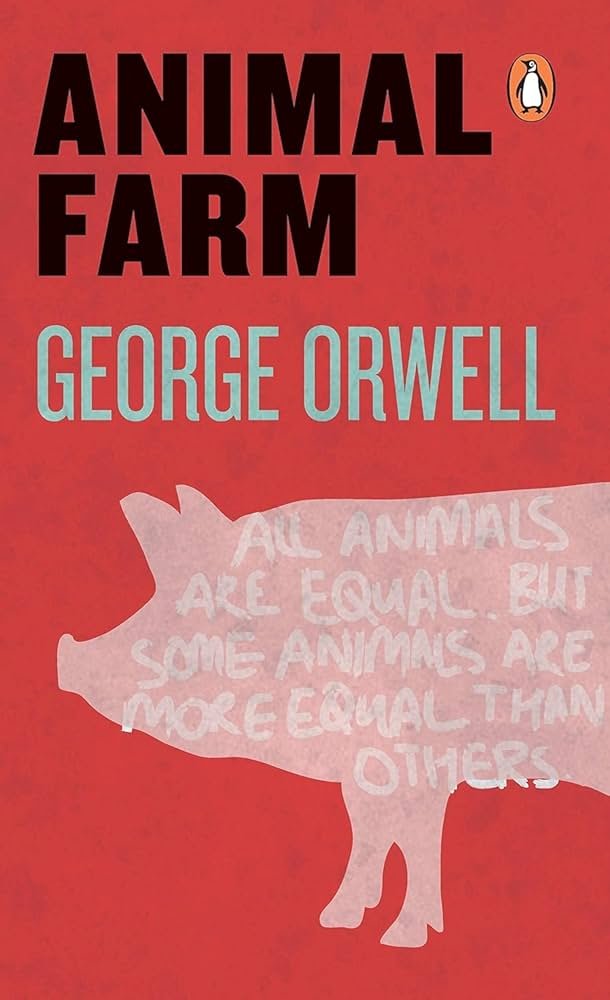
Why Read Animal Farm?
George Orwell’s “Animal Farm” is a masterclass in using allegory to critique power and corruption. In just over 100 pages, Orwell delivers one of the most memorable political satires ever written — a book that remains startlingly relevant nearly 80 years after its publication.
On the surface, it’s a simple story about farm animals who overthrow their human master, only to watch their revolution devolve into tyranny. But beneath this deceptively simple fable lies a devastating critique of the Soviet Union and, more broadly, of how revolutionary ideals are corrupted by those who seize power.
What makes Animal Farm endure isn’t just its historical allegory — it’s the universal truth it captures about human nature. The mechanisms Orwell describes (propaganda, the rewriting of history, the consolidation of power) appear in political systems across the globe and throughout history.
Who Should Read This
Animal Farm is essential reading for anyone interested in politics, history, or the psychology of power. Its accessible prose makes it perfect for readers at any level, while its depth rewards multiple readings. If you’re preparing for competitive exams, the book offers excellent practice in identifying allegory, analyzing argumentative techniques, and understanding political vocabulary in context.
Key Takeaways from Animal Farm
Power can corrupt individuals, leading them to betray their ideals and become the very oppressors they fought against.
Propaganda and manipulation of language are powerful tools for controlling populations and distorting truth.
Education is crucial — the illiterate animals couldn’t realize the commandments were being altered to serve the pigs.
Class struggle is inherent in society — even after revolution, new hierarchies emerge with different oppressors at the top.
Animal Farm Plot Summary
George Orwell’s “Animal Farm” is a novel that utilizes satire and allegory to critique the corruption that can result from absolute power. The story begins on Manor Farm where the animals are under the control of Mr. Jones, a careless and abusive farm owner.
Old Major, a prize-winning boar, inspires other animals on the farm to overthrow Jones by sharing his dream of an egalitarian society where animals live free from human domination. Shortly after, Major dies, but his vision sparks a rebellion led by two pigs, Napoleon and Snowball.
The animals establish seven commandments based on Major’s principles, which they call ‘Animalism.’ Initially, all animals work together, and the farm prospers. However, Napoleon and Snowball begin to fight for power. Napoleon seizes control by exiling Snowball and later alters the commandments to justify his actions.
The novel ends with the pigs walking on two legs and the commandments reduced to one: “All animals are equal, but some animals are more equal than others.” The animals looking through the farmhouse window can no longer distinguish between the pigs and the humans.
Animal Farm Characters
Each character represents a figure or group from the Russian Revolution and Soviet era.
A boar who becomes the tyrannical leader. Manipulative, selfish, and power-hungry.
An intelligent, passionate boar driven out by Napoleon.
A loyal cart-horse. His motto “I will work harder!” symbolizes the exploited working class.
Napoleon’s right-hand pig who spreads propaganda.
The elderly boar whose dream inspires the rebellion.
The oldest donkey. Cynical but passive.
Major Themes
Orwell weaves several interconnected themes throughout Animal Farm.
Orwell shows how power can corrupt those who hold it, turning them into the very oppressors they fought against.
The pigs manipulate language to control information and distort truth through propaganda.
The animals’ inability to question Napoleon’s authority leads to their subjugation.
Even after the rebellion, a new class hierarchy emerges with the pigs at the top.
Critical Analysis
A balanced assessment examining both literary strengths and limitations.
Makes complex concepts accessible without sacrificing depth.
Clear prose tackling profound themes about power and human nature.
Engaging critique with phrases that entered popular culture.
Black-and-white portrayal leaves no room for complexity.
Most characters serve primarily as symbols.
Full appreciation benefits from knowledge of Soviet history.
Literary & Cultural Impact
Why Animal Farm Matters Today: “Animal Farm” is one of the most notable examples of political allegory in literature. The book is considered a modern classic, taught in schools worldwide.
Cultural Influence: Phrases like “All animals are equal, but some animals are more equal than others” have entered public consciousness.
Political Relevance: The book provides a scathing critique of totalitarian regimes that remains relevant today.
Love This Book? Master Every Book.
Stop struggling with reading comprehension. Our proven system transforms how you read—whether for CAT, GRE, GMAT, SAT, or personal growth.
Best Quotes from Animal Farm
All animals are equal, but some animals are more equal than others.
Four legs good, two legs bad.
The creatures outside looked from pig to man, and from man to pig, and from pig to man again; but already it was impossible to say which was which.
Man is the only creature that consumes without producing.
His answer to every problem, every setback was ‘I will work harder!’
Test Your Understanding
Think you’ve mastered Animal Farm? Challenge yourself with 15 questions on themes, characters, and key takeaways. Score 80%+ to prove your mastery.
Animal Farm FAQ
What is Animal Farm about?
Animal Farm is a satirical allegory by George Orwell about farm animals who rebel against their human farmer, hoping to create an equal society. However, the pigs gradually become as oppressive as the humans, illustrating how power corrupts revolutionary ideals.
What reading level is Animal Farm?
Animal Farm is an Elementary to Intermediate reading level. The prose is simple and clear, making it accessible to high school readers onwards. Full appreciation of the allegory benefits from knowledge of Soviet history.
What are the main themes in Animal Farm?
The main themes include: Power and Corruption, The Manipulation of Language (propaganda), The Dangers of Naivety and Ignorance, and Class Struggle and Inequality.
Who does Napoleon represent in Animal Farm?
Napoleon represents Joseph Stalin. Like Stalin, Napoleon uses propaganda, eliminates political rivals (Snowball represents Trotsky), and betrays the revolution’s ideals for personal power.
Why is Animal Farm still relevant today?
Animal Farm remains relevant because its warnings about propaganda, the corruption of power, and the importance of critical thinking apply to political situations worldwide.








