
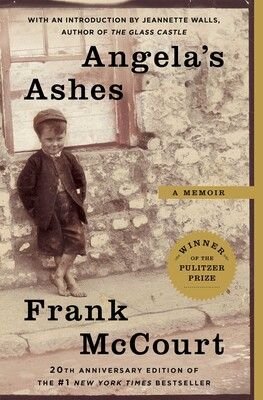
Angela’s Ashes
Watch Prashant Sir break down the narrative voice, the portrait of Malachy McCourt, and why this Pulitzer Prize memoir works as both a literary achievement and a study in resilience.
Why Read Angela’s Ashes?
Angela’s Ashes won the Pulitzer Prize for Biography in 1997, sold over four million copies in the United States alone, and spent over three years on the New York Times bestseller list — and none of those facts fully explain why it works as well as it does. Frank McCourt’s memoir of his Limerick childhood is, on its surface, an account of the most sustained and most concentrated poverty, illness, and family tragedy that Irish urban life in the 1930s and 1940s could produce. What makes it extraordinary is the narrative voice — a child’s-eye view that registers the full weight of what is happening without the adult retrospective grief that would have made it unreadable, and that finds, in the specific texture of each degraded situation, the specific absurdity that allows the reader to keep going.
The memoir begins in Brooklyn, where the McCourt family have emigrated from Ireland. When conditions in New York become desperate enough, Angela’s family sends passage money for them to return — specifically to Limerick, where they discover that conditions are even worse. From this point, the memoir is the sustained account of a Limerick childhood defined by a father who drinks the dole money, siblings who die, a mother who begs for food, and the specific social institutions of Catholic Ireland whose particular cruelties McCourt renders with a precision that is never merely bitter.
The title refers to Angela — Frank’s mother — and the ashes of the fire she tends, trying to keep her children warm. It is both a material image and a metaphor: the fire Angela maintains against the cold is the love she maintains against the conditions, and the ashes are what remain when both are exhausted. The memoir ends with McCourt’s departure for America at nineteen — the same America his family had left in despair — with nothing but the determination to build a life different from the one he was born into.
Who Should Read This
This is essential reading for anyone interested in the specific experience of poverty and survival, in the craft of literary memoir, and in the specific role that narrative voice plays in making unbearable material bearable. CAT and MBA candidates preparing for personal interviews about resilience, difficult origins, and the relationship between hardship and achievement will find in McCourt’s account both a vocabulary and a model for the kind of honest, unself-pitying narrative that personal interviews reward. Beyond preparation, it belongs on the reading list of every student of English literature and every reader interested in Irish history and culture.
Key Takeaways from Angela’s Ashes
The narrative voice is the memoir’s primary instrument — McCourt writes his childhood from the perspective of the child experiencing it, not the adult retrospectively interpreting it. Hunger is described as hunger rather than as trauma, his father’s drunkenness as confusion rather than betrayal. This is not evasion — it is the specific honesty of a consciousness that experienced what it experienced before it had the adult language to categorise the experience as damage.
Malachy McCourt Sr. is one of the most complex portraits of alcoholic paternity in the literature: a man of genuine charm, genuine love, genuine talent as a storyteller, and a genuine inability to be the father his family needed when it mattered most. The memoir refuses to reduce him to his alcoholism — holding instead the specific coexistence of his gifts and his failures in a way that is more honest about how addiction operates within a family than most accounts manage.
Institutional religion can be both a genuine source of meaning and a mechanism of social control and class oppression — and these two functions are not separable. The Catholic Church in McCourt’s Limerick simultaneously provides consolation in unbearable loss and withholds charity from families deemed insufficiently respectable. The memoir holds both functions in view simultaneously, which is more honest about how institutional religion operates in conditions of poverty than either devotional or anticlerical accounts typically manage.
America functions throughout the memoir not as an achieved destination but as a sustained imagination — the specific dream that keeps the possibility of a different life alive through conditions designed to extinguish it. Frank’s eventual departure at nineteen is not a triumph but a beginning. The memoir’s ending is a departure, not an arrival, which is more honest about what escape from poverty actually consists of than most redemption narratives acknowledge.
Key Ideas in Angela’s Ashes
The memoir’s most important formal decision is its narrative voice — the sustained, consistent use of a child’s perspective that registers experience without adult retrospective interpretation. McCourt does not look back at his childhood and explain it; he recreates it from within, at the cognitive and emotional level of the child experiencing it. This produces the memoir’s most distinctive quality: the simultaneous presence of the tragic and the comic, the terrible and the absurd, that characterises actual childhood experience of difficult material far more accurately than the retrospective adult grief that most trauma memoir employs.
The Limerick material — the lanes, the houses, the specific social geography of Irish Catholic poverty in the 1930s and 1940s — is rendered with a specificity that makes it both unique and universally recognisable. McCourt describes the particular smell of damp and turf smoke, the specific hierarchy of poverty within a poor community, the specific daily negotiations of hunger. This specificity is what prevents the memoir from becoming an abstraction about poverty — it is always the poverty of specific people in a specific place at a specific time, and that specificity is the source of its authority.
Malachy McCourt Sr. is the memoir’s most important and most contested figure — a man from the North of Ireland whose Northern Protestant-inflected Republicanism marks him as slightly foreign in Limerick’s Catholic social world. He tells his children magnificent stories at bedtime, teaches them to stand for Ireland, fills them with a sense of dignity that the material conditions of their life consistently deny. And then, reliably, he drinks the dole money, leaving Angela to manage the consequences. The memoir’s refusal to resolve this contradiction — to decide whether Malachy is a good father who happened to be an alcoholic or an alcoholic who happened to be a father — is its most psychologically honest quality.
Angela McCourt — the mother of the title — is rendered with a different kind of precision: a woman of considerable dignity in impossible circumstances, begging from the St. Vincent de Paul Society, managing food money that is never enough, absorbing the deaths of three of her children, maintaining the fire and the family through conditions that would have broken a person with fewer resources of character. What the memoir is ultimately about, beneath the specifics of poverty and Catholicism and alcoholism, is the specific form of love Angela maintains — not the comfortable, aspirational love of material plenty but the bare, exhausted, continually renewed love of a woman who keeps going because there is no one else to do it.
Key Themes in Angela’s Ashes
Five interconnected themes run through the memoir — each developed through the specific, unhurried accumulation of scenes from a childhood in which misery and absurdity coexist so naturally that separating them would falsify both.
Core Arguments
Four arguments run through the memoir — most of them implicit rather than stated, embedded in the specific texture of what is described rather than in editorial commentary about its significance.
McCourt’s most culturally significant contribution is the implicit argument that the life of the poor is as worthy of literary treatment as the life of the privileged, and that the specific experiences of poverty, hunger, and institutional humiliation are as legitimate a subject for the highest literary ambition as the drawing rooms and universities that most literary memoir had historically occupied. Before Angela’s Ashes, literary memoir was largely a middle-class and upper-class form; the memoir’s extraordinary commercial and critical success demonstrated that working-class and impoverished experience, rendered with sufficient skill and honesty, could command the same readership and the same literary attention. This democratisation is among the memoir’s most important legacies for the form.
The memoir’s most important formal argument is about the relationship between narrative voice and moral honesty. McCourt’s choice to write from the child’s perspective — to refuse the retrospective adult interpretation that would have organised the experience into the categories of trauma, resentment, or gratitude — is not a stylistic preference but a moral commitment: the commitment to render experience as it was experienced, not as it is subsequently interpreted. This means that the memoir’s judgments are embedded in the specificity of what is described rather than in explicit evaluative commentary, which is both more honest about the actual quality of childhood experience and more demanding of the reader’s own moral intelligence.
McCourt’s father is not merely weak — he is weak in the specific way that a specific formation, in a specific economic and social context, produces weakness. The poverty of Limerick in the 1930s and 1940s is not the product of individual failure — it is the product of specific historical, political, and economic structures that produced specific conditions in which individual failure became the most likely outcome. The memoir never makes this argument abstractly, but every specific scene it describes is evidence for it — the dole that is not enough, the charity that comes with humiliation attached, the schools that prepare poor children for futures as poor adults.
The memoir’s most sustained argument about the Catholic Church is not anticlerical but structural: that an institution organised around the consolation of individual souls is not necessarily well-suited to the alleviation of collective material misery, and that the specific ways in which the Church deploys its social authority in conditions of poverty can simultaneously provide genuine spiritual consolation and reproduce the social hierarchy that makes that poverty permanent. McCourt does not argue that the Church is hypocritical — most of its representatives are sincere. He argues that sincerity is insufficient when the institution’s social function is systematically at odds with its stated values, and that the specific ways in which the Church operated in Limerick were an example of this gap in action.
Critical Analysis
A balanced assessment of the most celebrated memoir of its decade — one that earns its Pulitzer Prize through genuine craft achievements, and whose limitations are worth understanding clearly.
The child’s-eye narrative voice is the memoir’s most important technical achievement, and McCourt sustains it with extraordinary consistency across 364 pages. The temptation to slip into adult retrospective interpretation — to step back and explain what the child could not have understood — is resisted almost entirely, and the result is a memoir whose emotional power comes from the accumulation of precisely rendered experience rather than from editorial commentary. This is a craft achievement of the highest order and the primary reason the memoir continues to be studied as a model of the form.
Limerick in the 1930s and 1940s is rendered with a material specificity that makes it both a unique historical location and a universally recognisable human environment. The lanes, the River Shannon, the weather, the specific social geography of poverty — each is described with the precision of someone who lived it and the skill of someone who has found the right language for what living it meant. The place becomes a character, and the specific conditions of that place become the conditions under which every human choice in the memoir is made.
McCourt sustains, across the entire memoir, a tonal range that moves between comedy and tragedy with the ease of someone who has genuinely lived the experience he is describing. The comedy is never a softening of the tragedy; the tragedy is never a denial of the comedy. Both coexist, as they do in actual human experience of extreme conditions, and the result is a memoir that is emotionally truer to the actual texture of poverty than either purely comic or purely tragic accounts of the same material could be.
Like all memoir written decades after the events described, Angela’s Ashes raises questions about the relationship between memory, imagination, and reconstruction. McCourt was a child during most of the events described, and the specific conversations, scenes, and details he renders with novelistic precision are necessarily composed from memory shaped by decades of retrospection. This is intrinsic to memoir as a form, but the degree of novelistic specificity in some scenes has led some critics to question the boundary between memoir and autofiction.
McCourt’s memoir was received with considerable hostility in Limerick itself, where many residents felt his account emphasised the most degraded aspects of their city’s history at the expense of the resilience, community, and dignity that also characterised life in the lanes. This criticism is not simply provincial defensiveness — it raises a genuine question about whose story a memoir tells and whose interests its specific emphases serve. The Limerick the international reading public received was shaped by the specific selection of a successful emigrant looking back.
The memoir’s most significant characterisation limitation is its relative thinness on the interior lives of women other than Angela. Written from a male child’s perspective within a strongly gendered social world, the women in that world — including Angela herself — are rendered primarily through their function in relation to Frank and his father rather than as fully interior beings. Angela as endurance is one of the memoir’s great achievements; Angela as a full person with her own inner life is less fully present.
Legacy & Cultural Impact
Publication and Honours: Angela’s Ashes was published in September 1996 and became one of the most celebrated literary events of the decade — winning the Pulitzer Prize for Biography or Autobiography in 1997, the National Book Critics Circle Award, and numerous other honours. It spent 117 weeks on the New York Times bestseller list and sold over four million copies in the United States alone. It was translated into more than 40 languages and sold over 10 million copies worldwide. Alan Parker’s 2000 film adaptation, starring Emily Watson as Angela and Robert Carlyle as Malachy, reached an audience of millions more — though its reception, like the book’s in Limerick, was mixed among Irish viewers who felt the film’s visual bleakness flattened the memoir’s tonal complexity.
Impact on the Memoir Form: The memoir demonstrated, at a moment when memoir as a literary form was both commercially ascendant and critically disputed, that the form was capable of the highest literary ambition — that the right voice, applied to the right material with sufficient skill and honesty, could produce a book that was simultaneously a popular bestseller and a work of lasting literary art. It also democratised the subject matter of literary memoir in ways that subsequent decades have continued to build on: the memoirs of the poor, the immigrant, the colonised, and the otherwise marginalised that have become a significant strand of the genre’s most ambitious work all owe something to McCourt’s demonstration that such material could command a serious literary readership.
McCourt’s Late Arrival: Frank McCourt published Angela’s Ashes at sixty-six — an age at which most writers have either published their significant work or concluded that they will not. He carried the material for decades, taught literature to New York City high school students for thirty years, and produced the memoir when he was old enough to have the distance and the craft to write it as well as it needed to be written. It is a reminder that the specific time at which a story can be told is not always the time at which it was lived, and that the gap between experience and its adequate articulation is sometimes a matter of decades.
Resonance for Indian Readers: The memoir carries specific resonances in the Indian context: the experience of institutional religion as simultaneously consoling and oppressive; the specific dynamics of a brilliant but unreliable father and the mother who absorbs the consequences; the experience of poverty not as a temporary condition but as a structural environment that shapes every possibility; and the specific dream of a different life in a different country that sustains survival in conditions that would otherwise extinguish hope. The specific textures are Irish, but the human architecture is broadly recognisable, and McCourt’s voice — the precise, unself-pitying account of what it actually feels like to grow up poor — has the specific universality that the best literary memoir achieves.
Love This Book? Master Every Book.
Stop struggling with reading comprehension. Our proven system transforms how you read—whether for CAT, GRE, GMAT, SAT, or personal growth.
Best Quotes from Angela’s Ashes
When I look back on my childhood I wonder how I survived at all. It was, of course, a miserable childhood: the happy childhood is hardly worth your while.
Worse than the ordinary miserable childhood is the miserable Irish childhood, and worse yet is the miserable Irish Catholic childhood.
We were wet, cold, and miserable, which was the normal condition of many people in Limerick.
Dad, why does God make it rain? So that the farmers can grow food. Why does He make it so cold? To make us appreciate the warm. Why did He let our brothers die? To test us. Why does He test us? Because He loves us.
You might be poor, your shoes might be broken, but your mind is a palace.
If You Liked This, Try…
No books found.
Test Your Understanding
Think you’ve mastered Angela’s Ashes? Challenge yourself with 15 questions on the narrative voice, key themes, and McCourt’s portrait of Limerick. Score 80%+ to prove your mastery.
Angela’s Ashes FAQ
What is Angela’s Ashes about?
It is Frank McCourt’s memoir of his childhood in Limerick, Ireland, in the 1930s and 1940s — a childhood defined by poverty, hunger, the deaths of siblings, a father whose alcoholism consumed the family’s food money, and the specific social institutions of Catholic Ireland. It begins with his family’s failed attempt to make a life in Brooklyn and ends with his departure from Ireland for America at nineteen. It is narrated from the perspective of the child experiencing it rather than the adult retrospectively interpreting it, which produces the memoir’s distinctive combination of comedy and tragedy.
Is it useful for MBA and CAT preparation?
Yes — particularly for personal interview questions about resilience, difficult origins, and the relationship between hardship and achievement. McCourt’s specific narrative approach — the refusal of self-pity, the absence of retrospective resentment, the precise rendering of experience without editorial commentary — is a model for how to discuss difficult personal history in a way that is honest without being maudlin and specific without being self-absorbed. The memoir’s frameworks — the coexistence of gift and failure, the structural dimensions of poverty, the sustaining function of a dream — provide vocabulary for engaging with PI questions at a level of sophistication most candidates do not bring.
Why is the memoir titled Angela’s Ashes?
The title refers to Frank’s mother Angela and the ashes of the fireplace she tends to keep her children warm. The image is both material and metaphorical: the fire Angela maintains against the cold stands for the love she maintains against the conditions of her life, and the ashes are what remain when both are exhausted. Angela is the memoir’s moral centre — not because she is a saint but because she is the person who, in the absence of anyone else willing or able to do it, keeps the family alive through conditions that would have broken a person with fewer resources of character.
How does the memoir handle Malachy McCourt Sr.’s alcoholism?
With the memoir’s characteristic refusal of simple categories. Malachy is not reduced to his alcoholism, though the alcoholism is documented with full specificity — the dole money drunk, the children hungry, the recurring pattern of promise and failure. He is also the father who told magnificent bedtime stories, who filled his children with a sense of Irish identity and dignity, and who loved them in the specific, insufficient way that his formation permitted. The memoir holds both the love and the failure simultaneously, which is more honest about how alcoholism operates within a family than accounts that organise the alcoholic parent’s character around either their dysfunction or their gifts alone.
What is significant about McCourt publishing this memoir at sixty-six?
It is one of the most instructive facts in the biography of literary achievement. McCourt carried the material for decades — living it, processing it, teaching literature to New York City high school students for thirty years — and produced the memoir only when he was old enough to have both the distance and the craft to write it as well as it needed to be written. The book could not have been written at thirty or forty: the voice required the specific combination of closeness to the material (which never fades) and distance from its emotional rawness (which takes decades to achieve). It is a reminder that some stories can only be told at a specific remove from their living — and that the gap between experience and its adequate articulation is sometimes a matter of a lifetime.








