
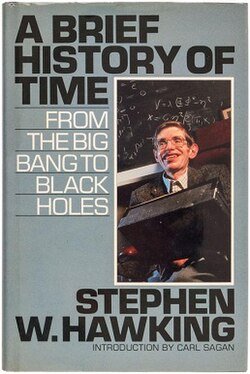
Why Read A Brief History of Time?
A Brief History of Time is the most famous popular science book ever written and the most important physics book ever published for a general audience — a work that sold over ten million copies in its first decade, spent over four years on the British Sunday Times bestseller list (a record for any book), and introduced concepts like black holes, the Big Bang, the arrow of time, and the search for a Grand Unified Theory to a global audience who had never encountered them in any form.
The book covers the major concepts of modern cosmology and theoretical physics in accessible order: from the historical development of our picture of the universe (Aristotle, Copernicus, Galileo, Newton) through the two great revolutions of 20th-century physics (general relativity and quantum mechanics) to the specific questions that defined Hawking’s own research — black holes, the Big Bang singularity, Hawking radiation, the no-boundary proposal — and ultimately to the question that defines modern theoretical physics: whether a single unified theory exists that can reconcile general relativity with quantum mechanics and explain everything from the smallest subatomic particles to the large-scale structure of the universe.
Hawking writes with characteristic clarity, wit, and the quiet courage of someone who has spent decades sitting with the deepest possible questions about the nature of reality. He uses no mathematics — following his publisher’s advice that every equation would halve the readership — and instead relies on analogy, thought experiment, and narrative to communicate concepts that professional physicists typically express in the language of differential geometry and quantum field theory.
Who Should Read This
This is a book for anyone who wants to understand how physicists think about the deepest questions about the universe — where it came from, how it works, what time is, what black holes are, and whether a single unified theory of everything is possible. Essential for advanced science and philosophy students who want the most famous accessible account of modern cosmology; general readers who want to engage with the deepest questions about the nature of reality; CAT/GRE aspirants who need advanced-level science prose reading comprehension; and anyone who has looked at the night sky and wanted to know what physicists actually understand about what they are looking at.
Key Takeaways from A Brief History of Time
Black holes — regions of spacetime from which nothing, not even light, can escape — are among the most thoroughly confirmed predictions of general relativity. Hawking’s most important contribution is Hawking radiation: the theoretical prediction that black holes emit thermal radiation from their event horizons, connecting general relativity and quantum theory in a single result.
The universe had a beginning — the Big Bang, approximately 13.8 billion years ago — but the question of what happened “before” may be meaningless, because time itself was created in the Big Bang. Hawking and Hartle’s no-boundary proposal suggests that asking what came before the Big Bang is equivalent to asking what is north of the North Pole.
Time is not the simple, universal, absolute background Newton assumed — it is a dimension of spacetime affected by gravity and velocity, with a beginning and an apparent “arrow” connected to the thermodynamic increase of entropy. Our intuitive sense of time as a river flowing uniformly from past to future is a feature of human experience, not of the universe itself.
The search for a Grand Unified Theory — a single mathematical framework reconciling general relativity with quantum mechanics — is the central project of theoretical physics. Hawking believed such a theory exists and that finding it would be, in his phrase, “the ultimate triumph of human reason — for then we would truly know the mind of God.”
Key Ideas in A Brief History of Time
The book opens with the history of our picture of the universe — from Aristotle’s Earth-centered cosmos through Copernicus’s heliocentric model, Galileo’s observational revolution, and Newton’s gravitational mechanics to the early 20th century. This historical opening is not merely scene-setting but an argument: our understanding of the universe has been transformed repeatedly by conceptual revolutions that replaced seemingly obvious common-sense pictures with counterintuitive but more accurate ones, and the reader should expect the same from the modern physical picture.
The chapters on general relativity establish the foundational conceptual shift: space and time are not a fixed background against which events occur but a dynamic, curved geometry — spacetime — shaped by the mass and energy it contains, whose curvature is what we experience as gravity. The Earth orbits the Sun not because a gravitational force pulls it through a flat space, but because the Sun’s mass curves the spacetime through which the Earth moves, and the Earth follows the straightest possible path through this curved spacetime. Hawking communicates this through analogy — the curved surface of the Earth as a two-dimensional model for curved spacetime — rather than mathematics.
The black hole chapters are the heart of the book and the section most directly connected to Hawking’s own research. A black hole forms when matter is compressed to sufficient density that spacetime curvature becomes infinite at a point — a singularity — surrounded by an event horizon beyond which not even light can escape. Hawking’s discovery of Hawking radiation — the prediction that black holes emit thermal radiation as a consequence of quantum mechanical effects near the horizon — was the first result to unite general relativity and quantum mechanics in a single calculation, and it remains one of the most elegant results in theoretical physics.
The origin of the universe chapters address the Big Bang singularity and the question of what, if anything, preceded it. Hawking and Roger Penrose had previously proved that if general relativity is correct, the universe must have begun in a singularity. The no-boundary proposal — developed by Hawking and James Hartle — suggests that this conclusion can be avoided if time near the singularity behaves like a spatial dimension, eliminating the need for an initial boundary condition. Whether this proposal is physically correct, and what it implies for the question of whether the universe required a creator, is among the most debated of Hawking’s ideas.
Core Frameworks in A Brief History of Time
Hawking develops six interlocking frameworks that together map the terrain of modern cosmology and theoretical physics for a general audience.
General relativity (Einstein, 1915) describes gravity as the curvature of spacetime caused by mass and energy, and provides the framework for understanding the large-scale structure of the universe — black holes, the Big Bang, the expansion of the universe. Quantum mechanics (Planck, Einstein, Bohr, Heisenberg, Schrödinger, Dirac, 1900–1930) describes the behavior of matter and energy at subatomic scales, incorporating the Heisenberg uncertainty principle and predicting the probabilistic rather than deterministic behavior of quantum systems. Both theories are among the most precisely confirmed in the history of physics. The problem is that they are mathematically inconsistent: when you try to apply quantum mechanics to the strong gravitational fields that general relativity predicts near singularities, you get infinite, physically meaningless results. The search for a theory that incorporates both is the central project of modern theoretical physics.
A black hole forms when matter is compressed within its Schwarzschild radius, creating an event horizon from which nothing can escape. The singularity at the centre — a point of infinite density predicted by general relativity — represents the breakdown of the theory: the laws of physics as currently understood cannot describe what happens there. Hawking radiation arises from quantum mechanical effects near the event horizon: in quantum mechanics, “empty” space is not truly empty but filled with pairs of virtual particles constantly being created and annihilated. Near an event horizon, one particle of a virtual pair can fall inside the horizon while the other escapes — appearing as thermal radiation from the black hole. The black hole slowly loses mass through this process until it eventually evaporates completely. This result — derived from quantum mechanics applied in curved spacetime — is Hawking’s most important theoretical contribution.
The laws of physics, with minor exceptions, are symmetric between past and future: a film of billiard balls colliding looks physically the same run forwards or backwards. Yet we experience time as running in one direction only — we remember the past but not the future; we can break eggs but not unbreak them; the universe moves from order to disorder. Hawking identifies three arrows of time: the thermodynamic arrow (the direction of increasing entropy), the psychological arrow (the direction in which we remember the past), and the cosmological arrow (the direction in which the universe expands). He argues that the thermodynamic and psychological arrows are connected — memory formation requires increasing entropy — and that both are connected to the cosmological arrow by the requirement that the universe began in a low-entropy state from which it has been expanding and increasing in entropy ever since.
General relativity, applied to the early universe, predicts that the universe began in a singularity of infinite density — the Big Bang — representing an edge of spacetime at which the known laws of physics break down. The no-boundary proposal suggests that near the Big Bang, time behaved like a spatial dimension, making the spacetime of the very early universe a closed four-dimensional surface with no boundary, like the surface of a sphere. On this proposal, asking what happened before the Big Bang is like asking what is south of the South Pole — the question has no answer because there is no “before.” The universe had no beginning in the sense of a moment requiring a prior cause. The philosophical implications — for whether the universe required a creator — are deliberately left open by Hawking, who ends the book with the question: “What is it that breathes fire into the equations and makes a universe for them to describe?”
The four fundamental forces of nature — gravity, electromagnetism, the strong nuclear force, and the weak nuclear force — have been progressively unified over the 20th century. Electromagnetism and the weak force were unified in the electroweak theory; combining the electroweak theory with the strong force gives the Standard Model of particle physics. The remaining unification — incorporating gravity — requires a quantum theory of gravity, which does not yet exist in a complete and consistent form. The candidate theories Hawking describes — primarily supersymmetry and the early forms of string theory — have developed enormously since 1988 into M-theory and various string theory frameworks, but the fundamental unification remains incomplete. Hawking’s conviction that such a theory exists and could in principle be fully understood by human minds is both the book’s scientific ambition and its philosophical vision.
Heisenberg’s uncertainty principle states that it is impossible, even in principle, to know both the position and the momentum of a particle with unlimited precision simultaneously — not because our measuring instruments are imperfect but because the act of measurement unavoidably disturbs the quantity being measured, and because the universe is fundamentally probabilistic at the quantum level. This eliminates the possibility of the “demon” imagined by Pierre-Simon Laplace — an intelligence that could, given complete knowledge of the present state of the universe, calculate its entire future. The universe is not deterministic at the fundamental level; it is probabilistic. This has profound implications for the concept of scientific prediction, for the question of free will, and for the classical picture of a clockwork universe running on fixed rails from creation to end.
Core Arguments
Four interlocking arguments give the book its intellectual ambition and its enduring philosophical significance.
The book’s deepest and most sustained implicit argument — present on every page but made most explicit in the concluding discussion of the Grand Unified Theory — is that the universe is, in principle, fully comprehensible to human intelligence. The history of physics is the history of discoveries that initially seemed to place parts of reality beyond human comprehension — the nature of stars, the structure of atoms, the geometry of spacetime — only to find that mathematical theory could provide complete and precise understanding. Hawking’s conviction that this process can continue to the most fundamental level — that a single, beautiful mathematical theory can capture everything — is both his scientific credo and his humanist manifesto.
The no-boundary proposal’s most philosophically consequential implication is that the universe may have no initial boundary condition requiring explanation by an external cause — no moment of creation that demands a creator. Hawking presents this argument carefully and with appropriate philosophical caution: he does not claim to have disproved the existence of God, but argues that a self-contained universe without boundaries or singularities would leave no place for a creator in the causal structure of the universe. This argument generated the most public controversy of any in the book and is the most widely discussed of Hawking’s philosophical claims.
Hawking’s discovery of black hole radiation and evaporation is presented not just as a scientific result but as a philosophical argument about the nature of information and the ultimate fate of matter. If black holes evaporate, then the information about matter that fell into them must either be lost (violating quantum mechanical principles of information conservation) or re-emitted in the radiation — a question that generated the famous “black hole information paradox” that occupied theoretical physics for decades after the book’s publication and has only recently been substantially resolved.
The book’s most practically important scientific argument is that general relativity and quantum mechanics — each extraordinarily successful in its own domain — cannot both be correct as currently formulated, because they are mathematically inconsistent with each other. The search for a theory that reconciles them is not a luxury of theoretical curiosity but a scientific necessity: without such a theory, physics cannot describe the conditions that existed at the Big Bang, cannot fully understand black hole singularities, and cannot provide the “theory of everything” that would represent the completion of the physical sciences. This argument remains as urgent in 2025 as it was in 1988.
Critical Analysis
A balanced assessment of the most famous popular science book ever written — its genuine intellectual achievements and its real limitations.
Hawking’s ability to communicate genuinely difficult concepts — the curvature of spacetime, event horizons, the no-boundary proposal, Hawking radiation — without mathematics and without condescension is remarkable. The analogies he uses are both illuminating and conceptually accurate; they do not distort the ideas they represent.
The book is not a survey of modern physics but an account of physics as seen from one of its most significant contributors — someone who worked on the problems it describes at the research frontier. The chapters on black holes and the no-boundary proposal carry an authority that comes from being written by the person who derived the results.
Hawking does not limit himself to describing what physics has found but consistently asks what it means — for our understanding of time, for determinism and free will, for whether the universe required a creator. This philosophical engagement gives the book a depth that purely descriptive popular science accounts lack.
The widespread reputation of A Brief History of Time as a book that is purchased but not finished reflects a real difficulty — the concepts it communicates (curved spacetime, quantum uncertainty, imaginary time) are genuinely hard, and the absence of mathematics sometimes makes the arguments harder to follow rather than easier, because the mathematical scaffolding that would make the reasoning precise is absent.
Published thirty-seven years ago, the book predates the discovery of dark energy and the accelerating expansion of the universe (1998), the detection of gravitational waves (2016), the first imaging of a black hole’s shadow (2019), and substantial progress on the black hole information paradox. The conceptual framework remains valuable but the specific physics needs significant updating.
Hawking presents the no-boundary proposal — his most speculative scientific idea — with a confidence that many physicist colleagues found overclaiming. The proposal is mathematically elegant but its physical interpretation remains contested, and the cosmological implications Hawking draws go beyond what the scientific evidence strictly supports.
Impact & Legacy
Publishing Phenomenon: A Brief History of Time was published in April 1988 and became one of the most remarkable publishing phenomena of the 20th century. It spent 237 weeks on the British Sunday Times bestseller list — over four and a half years — a record for any book. It sold over ten million copies in its first decade, has been translated into over forty languages, and has sold an estimated fifteen million copies in total. It was adapted into a documentary film by Errol Morris in 1991 and inspired a generation of popular science writing that followed its template: serious scientific ideas communicated for a general audience through analogy, narrative, and philosophical reflection.
Cultural Impact: The book made Stephen Hawking the most famous scientist in the world — a status he retained until his death in 2018 — and established the public understanding of cosmology that has informed popular engagement with space, the universe, and the Big Bang for three decades. Concepts like black holes, the Big Bang, the event horizon, and the arrow of time entered mainstream cultural vocabulary largely through the book’s extraordinary reach.
Impact on Physics Careers: For physics, the book’s most important long-term contribution was the influence it had on a generation of young scientists who read it as teenagers and chose careers in physics. Numerous practicing physicists have cited A Brief History of Time as the book that first showed them that the deepest questions about the universe were scientifically approachable and personally engaging.
For Competitive Exam Preparation: A Brief History of Time is advanced-level reading comprehension in science philosophy prose. Its consistent movement between specific scientific concepts and their broader philosophical implications, its use of analogy and thought experiment as primary explanatory tools, and its habit of posing questions that cannot be fully answered within the book’s scope all provide direct practice for the analytical reading skills — tracking complex argumentation, evaluating the scope and limits of a claim, distinguishing the empirical from the philosophical — that the most demanding CAT and GRE science passages require.
Love This Book? Master Every Book.
Stop struggling with reading comprehension. Our proven system transforms how you read—whether for CAT, GRE, GMAT, SAT, or personal growth.
Best Quotes from A Brief History of Time
If we find the answer to that, it would be the ultimate triumph of human reason — for then we would truly know the mind of God.
Even if there is only one possible unified theory, it is just a set of rules and equations. What is it that breathes fire into the equations and makes a universe for them to describe?
We are just an advanced breed of monkeys on a minor planet of a very average star. But we can understand the Universe. That makes us something very special.
Not only does God play dice, but… he sometimes throws them where they cannot be seen.
My goal is simple. It is a complete understanding of the universe, why it is as it is and why it exists at all.

Test Your Understanding
Think you’ve mastered A Brief History of Time? Challenge yourself with 15 questions on black holes, the arrow of time, and Hawking’s core frameworks. Score 80%+ to prove your mastery.
A Brief History of Time FAQ
Why is this book so famous but so often unfinished?
The book’s fame is the product of its extraordinary subject matter, the extraordinary person who wrote it, and the extraordinary publishing achievement of making the deepest questions in physics accessible to millions of readers. Its reputation for being unfinished reflects a real difficulty: the concepts it explains — curved spacetime, quantum uncertainty, imaginary time, the no-boundary proposal — are genuinely hard, and the absence of mathematics sometimes makes the arguments harder to follow rather than easier, because the mathematical structure that would make the reasoning precise is missing. Readers who find themselves confused should not be discouraged. The chapters on black holes and on the arrow of time are the most accessible; the chapters on the no-boundary proposal and on quantum gravity are the most demanding.
What is Hawking radiation and why is it so important?
Hawking radiation is the theoretical prediction that black holes are not completely black — they emit thermal radiation from their event horizons as a consequence of quantum mechanical effects. The mechanism: in quantum mechanics, empty space is constantly producing pairs of virtual particles and antiparticles that annihilate almost immediately. Near a black hole’s event horizon, one particle of such a pair can fall inside the horizon before annihilation, while its partner escapes as real radiation. The black hole slowly loses mass through this process until it eventually evaporates completely. The importance of Hawking radiation is that it is the first result to unite general relativity and quantum mechanics in a single calculation — making it the most important known connection between the two great theories that physics is still trying to unify.
What is the no-boundary proposal and what does it imply about God?
The no-boundary proposal, developed by Hawking and James Hartle, is a cosmological model in which the universe has no initial singularity — no moment of creation at which the laws of physics break down and an external cause might be required. The proposal achieves this by treating time as behaving like a spatial dimension in the very early universe, transforming the four-dimensional spacetime from a structure with an initial boundary into a closed, smooth, boundaryless surface — like the surface of a sphere. On this model, asking what happened before the Big Bang is as meaningless as asking what is south of the South Pole. Hawking drew the philosophical implication that a universe with no initial boundary requires no initial cause — leaving, as he put it, “nothing for a creator to do.” Many philosophers and theologians dispute this inference, arguing that even a no-boundary universe requires explanation for why the laws governing it have the form they do.
How does A Brief History of Time relate to Cosmos and The Elegant Universe on the Readlite list?
The three books address modern cosmology and theoretical physics from complementary perspectives. Cosmos (Sagan, 1980) is the most narrative and humanistic — a celebration of science as a human activity, with less technical depth but the warmest accessible voice. A Brief History of Time (Hawking, 1988) is the most focused on the specific theoretical physics problems Hawking worked on — black holes, the Big Bang singularity, quantum gravity — and the most connected to an active research frontier, written by a practitioner rather than a commentator. The Elegant Universe (Brian Greene, 1999) provides the most accessible account of string theory and the subsequent development of the Grand Unified Theory project that Hawking describes as the central goal of physics. The recommended reading sequence is A Brief History of Time for the specific theoretical physics depth, then The Elegant Universe for the string theory extension.
Is the book still relevant given how much physics has advanced since 1988?
The book remains relevant for three reasons. First, the conceptual foundations it explains — general relativity, quantum mechanics, black holes, the Big Bang, the arrow of time — have not been superseded, even though the details have advanced. Second, Hawking’s explanation of these concepts remains among the clearest and most authoritative available, written by someone at the research frontier of every topic the book addresses. Third, the philosophical questions it raises — the origin of the universe, the nature of time, whether a unified theory exists, what it would mean for our understanding of reality — are as alive in 2025 as they were in 1988. What has changed substantially: the cosmological evidence for dark energy (1998); the detection of gravitational waves (2016); the first imaging of a black hole’s shadow (2019); and significant progress on the black hole information paradox. Hawking’s The Universe in a Nutshell (2001) updated some of the physics for those who want the follow-on.








