
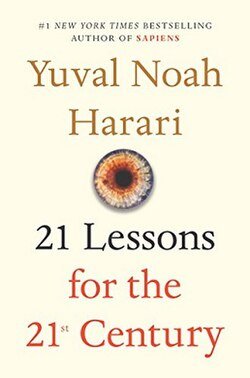
Why Read 21 Lessons for the 21st Century?
21 Lessons for the 21st Century is the most practically oriented and most immediately relevant book in Yuval Noah Harari’s Sapiens trilogy — a collection of twenty-one interconnected essays that address the specific political, technological, and psychological challenges of the present moment with the same sweeping historical perspective that made Sapiens and Homo Deus global phenomena.
Published in 2018 — in the midst of the political turbulence that followed Brexit, the election of Donald Trump, the rise of authoritarian nationalism across multiple democracies, and the accelerating disruption of labour markets by automation — it is Harari’s attempt to apply the macro-historical framework he developed in his previous books to the questions that people were actually asking: What do I do about AI? How should I think about nationalism? Is liberal democracy really in crisis? What does climate change require of us? How do I raise children for a future I cannot predict?
Unlike Sapiens (primarily retrospective) and Homo Deus (primarily prospective), 21 Lessons is explicitly presentist — it is about the moment we are in, the decisions we are making now, and the mental tools we need to make them well. It is less unified than its predecessors but also the most accessible entry point into Harari’s thinking for readers who want to engage with specific contemporary questions.
Who Should Read This
This is a book for anyone trying to think clearly about the present moment — about the political, technological, and cultural forces reshaping the world in real time, and about how to navigate them without being overwhelmed by information overload, political tribalism, or the anxiety of genuine uncertainty about the future. Essential for intermediate students of history, politics, and technology; professionals across all sectors navigating rapid change; CAT/GRE aspirants building analytical prose reading comprehension; and anyone who wants Harari’s framework applied to the questions keeping them awake at night.
Key Takeaways from 21 Lessons for the 21st Century
Artificial intelligence and biotechnology are transforming the labour market, but the most profound threat is not unemployment — it is the possibility that algorithms will come to know human beings better than humans know themselves, making individual autonomy and liberal democracy empirically untenable rather than merely politically contested.
The four most powerful political narratives — nationalism, religion, liberalism, and globalisation — are each inadequate on their own to address the three defining challenges of our era: nuclear weapons, climate change, and technological disruption. The 21st century requires a global identity without erasing local identities that give life meaning.
In an age of information overload, the most important intellectual skill is not acquiring more information but distinguishing reliable from unreliable information. Post-truth is primarily a psychological problem: the human brain evolved to respond to emotional cues rather than statistical evidence, making it structurally vulnerable to manipulation at scale.
Meditation — specifically the practice of observing one’s own mental processes with disciplined attention — is Harari’s personal and intellectual foundation for navigating the uncertainty of the present moment. Not as a spiritual practice but as an empirical one: the capacity for accurate introspection as the foundation for accurate perception of the external world.
Key Ideas in 21 Lessons for the 21st Century
The book opens with what Harari calls the central crisis of our time: the collapse of the liberal narrative. For most of the post-Cold War period, the dominant political story — that liberal democracy, free markets, and individual rights were the endpoint of human political development — seemed secure. The financial crisis of 2008, the rise of authoritarian nationalism in multiple democracies, and the failures of globalisation to distribute its benefits broadly enough shattered this narrative without replacing it with a coherent alternative. People are disoriented because the stories that previously gave meaning to their political lives have lost their credibility, and no new stories have emerged to take their place.
The technological disruption chapters are among the book’s most practically urgent. Harari does not argue that AI will create mass unemployment in the near future, but he insists that the disruption of labour markets by automation is creating new forms of economic inequality and political instability that liberal democracy — designed for the 19th-century industrial economy — is poorly equipped to address. The specific challenge is the creation of a “useless class” not in a morally evaluative sense but in a strictly economic one: people whose labour is not required by the economy and for whom no new function has been found.
The chapters on nationalism and religion are among the book’s most politically balanced. Harari acknowledges that nationalism — the attachment to a specific community, its history, culture, and land — is a genuine and valuable human phenomenon that liberal globalism has often dismissed too quickly. The problem is not that people have national identities but that national identity alone cannot provide the framework for addressing specifically global challenges that require global cooperation.
The final section on meditation and equanimity is the most personal and the most controversial. Harari has practised Vipassana meditation for over two decades and credits this practice with giving him both the intellectual clarity and the psychological resilience to engage with the overwhelming complexity and uncertainty of the topics he writes about. His argument is that the capacity to observe one’s own mental processes — to notice when one is being manipulated by emotional appeals, when one is constructing self-serving narratives — is the most important intellectual tool available for navigating the present.
Core Frameworks in 21 Lessons for the 21st Century
Harari develops six interlocking analytical frameworks to map the challenges of the present moment.
The liberal narrative — that free markets, liberal democracy, and individual rights are the natural endpoint of political development — provided the organising framework for Western political life from 1989 to approximately 2008. Its credibility depended on the experienced reality that liberal institutions delivered improving lives for most people. When they demonstrably failed large populations through the financial crisis, rising inequality, and the social disruption of globalisation, the narrative lost its purchase. None of the competing narratives — nationalism, religious fundamentalism, or nostalgia for a pre-globalised past — is adequate to the specifically global challenges of the present.
The liberal political system rests on the empirical premise that individuals are the best judges of their own interests. This premise is challenged if algorithms can predict individual preferences, behavioural patterns, and emotional responses more accurately than individuals can predict their own. The specific contemporary manifestation is the exploitation of algorithmic knowledge of individual psychology by political actors — the use of social media algorithms and targeted political advertising to manipulate political behaviour by exploiting identified emotional vulnerabilities.
Harari identifies nuclear weapons (which have made large-scale interstate war existentially dangerous), climate change (a genuinely global problem that no national action can solve), and technological disruption (creating new forms of power and inequality that existing national political frameworks cannot address) as the three challenges that make a functional global identity essential. The political crisis of nationalism — the resurgence of “my nation first” politics — is dangerous specifically because these three challenges are not amenable to national solutions.
The post-truth environment is not primarily created by the increase in false information but by the combination of digital media’s ability to generate and distribute emotionally resonant content at scale and the human brain’s evolved tendency to respond to emotional and social cues rather than statistical evidence. The appropriate response is not more information — which can make the problem worse — but better tools for discriminating reliable from unreliable information, which requires understanding one’s own cognitive biases.
The traditional model of education is predicated on the assumption that the future will resemble the present closely enough that today’s skills will be relevant tomorrow. This assumption is increasingly untenable. Harari argues that the most important skills to develop are therefore meta-skills: the ability to learn rather than the possession of specific knowledge; the ability to evaluate information critically; the ability to manage uncertainty and change; and the capacity for self-awareness about one’s own cognitive processes.
Harari has practised Vipassana meditation for over two decades and argues that the most important thing this practice has given him is the ability to observe his own mental processes — to notice how his mind generates emotions, constructs narratives, and responds to threats — without being automatically controlled by them. In the context of the post-truth environment, the ability to observe one’s own cognitive biases is the most important epistemological tool available. This is not mystical but empirical: the capacity for accurate introspection as the foundation for accurate perception of the external world.
Core Arguments
Four interlocking arguments form the intellectual spine of Harari’s twenty-one essays.
Harari’s most fundamental framing is that the political turbulence of the early 21st century is not primarily a crisis of specific policies or specific leaders but a crisis of the stories through which people make sense of their political lives. Liberal democracy, nationalism, religion, and globalisation are competing narratives — ways of organising the meaning of political life — and the crisis consists in the failure of the dominant narrative (liberalism) without the emergence of a convincing replacement. The political anxiety of the present is the anxiety of people who have lost their organising story and have not found a new one.
The book’s most practically urgent political argument is that nuclear weapons, climate change, and technological disruption are specifically global challenges that cannot be addressed by national political frameworks, however well-designed. Any political identity adequate to the present must therefore have a global dimension — capable of generating the international cooperation these challenges require — while also acknowledging and preserving the local identities that give human life meaning. This is not an argument for world government but for a global political consciousness that treats these three challenges as genuinely shared human problems.
Harari’s most important contribution to the post-truth debate is that the vulnerability of democratic politics to misinformation is not primarily a technical problem (fake news, filter bubbles, social media algorithms) but a psychological one: the human brain evolved to respond to social and emotional cues rather than statistical evidence, and this makes it structurally vulnerable to the emotionally resonant misinformation that digital media is particularly efficient at generating and distributing. Fixing the technical infrastructure may help but cannot address the underlying cognitive vulnerability. The appropriate complement is epistemic: developing the capacity for critical self-awareness about one’s own cognitive biases.
The book’s final and most personal argument is that the appropriate response to the overwhelming complexity and uncertainty of the present is not optimism (which requires believing things will work out in ways the evidence does not clearly support) or pessimism (which is both emotionally corrosive and epistemically premature) but equanimity: the ability to hold uncertainty without being destabilised by it, to engage with difficult questions without requiring reassuring answers, and to maintain clear perception of the present without being overwhelmed by anxiety about the future. This equanimity is not passive acceptance but the active cultivation of psychological resilience through practices Harari describes from direct personal experience.
Critical Analysis
A balanced assessment examining the book’s genuine strengths and its real limitations.
Engages directly with the specific political and technological anxieties of the present moment — Brexit, Trump, AI, climate change, fake news — in ways that feel genuinely timely and useful to readers navigating the same landscape.
The twenty-one self-contained essays allow readers to engage with the specific questions they find most pressing without reading the whole book sequentially — making it more practically useful than its predecessors.
The most personal section — the argument for meditation as epistemic practice — is both the most controversial and the most honest. Harari is describing a personal intellectual practice, not prescribing a lifestyle choice.
21 Lessons lacks the sustained argumentative architecture of Sapiens or Homo Deus — the twenty-one chapters are relatively self-contained, connected by Harari’s perspective and voice but not by a single developing argument. It reads as a collection of essays rather than a unified book.
The quality and depth of the twenty-one chapters varies considerably. The chapters on AI, nationalism, and post-truth are substantive and carefully argued; some shorter chapters on humility, God, and immigration read more as position statements than as arguments.
Published in 2018, the book engages with the specific political landscape of that moment in ways that feel more dated than the macro-historical arguments of Sapiens or Homo Deus. Readers in 2025 will need to update the framework to the current moment.
Impact & Legacy
Reception and Sales: 21 Lessons for the 21st Century was published in September 2018 and immediately reached the top of multiple international bestseller lists, selling over three million copies in its first year and being translated into more than forty languages. It was read widely in political and corporate circles — Barack Obama and Bill Gates both cited it among their recommended reading — and its arguments about AI, post-truth, and the crisis of liberal democracy influenced public discourse in ways that are difficult to trace but clearly present.
Position Within the Trilogy: For Harari’s project, the book occupies an important transitional position: it is the present-tense link between the historical analysis of Sapiens and the future speculation of Homo Deus, providing the specific contemporary application of the macro-historical framework the first two books established. Reading the trilogy in sequence — Sapiens, then Homo Deus, then 21 Lessons — gives readers the full trajectory of Harari’s intellectual project: where we came from, where we are going, and what we should be doing about it right now.
For Competitive Exam Preparation: 21 Lessons is excellent intermediate-level reading comprehension practice in analytical essay prose. Its structure — twenty-one self-contained essays addressing specific contemporary topics from a consistent analytical perspective — mirrors the structure of many CAT and GRE reading comprehension passages, which typically take a specific question and apply a theoretical framework to it. The quality of the analytical writing in the best chapters is directly relevant to the kind of argumentative prose that competitive examination passages require students to navigate.
Love This Book? Master Every Book.
Stop struggling with reading comprehension. Our proven system transforms how you read—whether for CAT, GRE, GMAT, SAT, or personal growth.
Best Quotes from 21 Lessons for the 21st Century
In a world deluged by irrelevant information, clarity is power.
The ability to tolerate uncertainty is the most important skill of all.
If you feel overwhelmed and confused by the global predicament, you are on the right track.
Questions you cannot answer are usually far better for you than answers you cannot question.
Humans were always far better at inventing tools than using them wisely.

Test Your Understanding
Think you’ve mastered 21 Lessons for the 21st Century? Challenge yourself with 15 questions on themes, frameworks, and key takeaways. Score 80%+ to prove your mastery.
21 Lessons for the 21st Century FAQ
Do I need to read Sapiens and Homo Deus before 21 Lessons?
Reading the trilogy in order — Sapiens, Homo Deus, then 21 Lessons — provides the fullest understanding and the most complete intellectual context for Harari’s arguments. However, 21 Lessons is the most accessible entry point for readers who want to engage with specific contemporary questions rather than the full macro-historical sweep. Its twenty-one self-contained chapters can be read selectively based on the reader’s specific interests. For readers who want to engage specifically with present-moment questions, 21 Lessons can be read first; reading Sapiens and Homo Deus subsequently provides the historical and future context that enriches the present-tense arguments.
What is Harari’s argument about AI and jobs?
Harari does not predict near-term mass unemployment from AI — he acknowledges that the economic dynamics are complex and that humans have successfully adapted to technological disruption before. His concern is more fundamental: that the disruption of labour markets by automation and AI is creating new forms of economic inequality and political instability faster than existing political institutions can address, and that the specifically 21st-century challenge is the emergence of a large population whose labour is not required by the economy and for whom no new economic function has yet been identified. The political consequences — resentment, populism, the appeal of authoritarian nationalism — are being experienced now, before the full extent of the disruption has arrived.
What does Harari mean by “post-truth”?
By “post-truth” Harari means not primarily that false information is being produced and distributed more efficiently (though it is) but that the conditions for political epistemology — the shared standards of evidence and reasoning through which democratic publics evaluate political claims — are breaking down. The specific mechanism is the combination of digital media’s ability to generate and distribute emotionally resonant content at scale and the human brain’s evolved tendency to respond to social and emotional cues rather than statistical evidence. People believe things not primarily because they have evaluated the evidence but because the belief signals social affiliation, confirms pre-existing emotional commitments, and is endorsed by trusted community members.
Why does Harari recommend meditation at the end of a book about political and technological challenges?
Harari’s recommendation of meditation — specifically Vipassana, the practice of observing one’s own mental processes — is not a spiritual recommendation but an epistemological one. His argument is that the most important tool for navigating the post-truth environment and the psychological disorientation of rapid change is the ability to observe one’s own mind accurately: to notice when one is being manipulated by emotional appeals, when one is constructing self-serving narratives, when the story one tells about oneself diverges from the reality of one’s experience. The recommendation is explicitly personal rather than universal — he is describing what works for him, not prescribing a universal solution.
How does 21 Lessons compare to Sapiens and Homo Deus as a reading experience?
21 Lessons is a deliberately different kind of book from its predecessors. Sapiens is a sustained macro-historical argument with a coherent thesis developed across the full length of the book. Homo Deus is a sustained speculative argument about the human future. 21 Lessons is a collection of essays — topically focused, relatively self-contained, addressing specific contemporary questions from a consistent analytical perspective rather than developing a single sustained argument. It reads more like a very good collection of magazine essays. This makes it more accessible and more practically useful for selective reading; it also makes it less architecturally satisfying as a book. Most readers find Sapiens the most rewarding of the three as a unified reading experience; 21 Lessons is the most useful as a practical reference for specific contemporary questions.








