

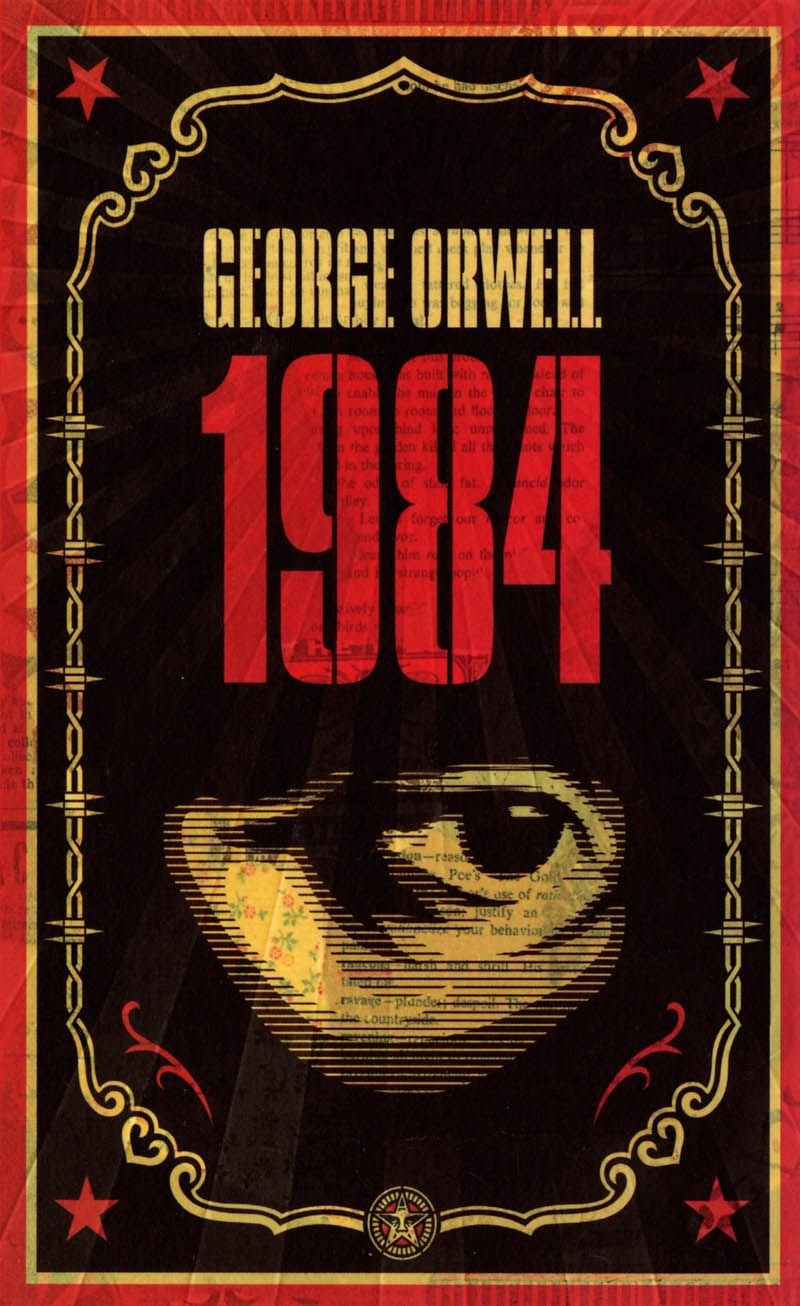
Why Read 1984?
1984 is the most politically consequential novel ever written. George Orwell’s vision of a society governed by perpetual surveillance, manufactured truth, and the systematic destruction of individual thought has not merely predicted aspects of the modern world — it has given us the language to recognize and resist them. Totalitarianism, doublethink, Newspeak, the Memory Hole, Big Brother: these are not just fictional inventions but diagnostic tools that millions of people now reach for instinctively when describing the abuse of power.
Written in 1948 by a dying man racing to finish his masterwork, 1984 follows Winston Smith, a low-ranking member of the ruling Party in the superstate of Oceania, as he secretly rebels against the system he serves — falls in love, joins what he believes is a resistance movement, and is systematically destroyed. The novel is simultaneously a political thriller, a love story, a philosophical treatise on the nature of truth and power, and an act of prophetic imagination so precise that it named phenomena — doublethink, Newspeak, the Two Minutes Hate — that the 20th century had not yet fully produced but would.
Orwell drew on his experiences fighting in the Spanish Civil War, his observations of Stalinist propaganda techniques, and his time at the BBC to construct a world whose mechanisms of control were disturbingly familiar even in 1949. The novel’s horror is not science fiction — it is an extrapolation of tendencies Orwell had observed operating in the real world, amplified to their logical extreme. For reading comprehension preparation, 1984 offers one of the most analytically rich fictional texts in the English language: its treatment of language, truth, memory, and power is directly relevant to the critical reasoning skills tested in CAT, GRE, and GMAT examinations.
Who Should Read This
1984 is essential reading for every educated person — not as a historical curiosity but as a living manual for understanding how power operates, how language is weaponized, and how individual thought is the first and most essential freedom. Particularly valuable for CAT and GRE aspirants preparing for literary and political prose passages, for MBA candidates engaging with leadership and ethics discussions, and for any reader who wants the intellectual tools to understand the political environment they inhabit.
Key Takeaways from 1984
Surveillance is not merely about observation — it is about producing self-censorship. The genius of the Party’s telescreens is not that they see everything but that citizens can never know when they are being watched, and therefore must behave as if they always are. This transformation of external control into internal control is the most efficient form of totalitarianism because it requires the citizen to do the work of their own oppression.
Language is the architecture of thought — control language and you control what can be thought. Newspeak, the Party’s engineered language, is designed not to communicate but to eliminate: by steadily reducing vocabulary, it makes heretical thought literally impossible, because there will be no words in which to conceive it. Orwell’s insight — that the impoverishment of language is the impoverishment of consciousness — is one of the most important ideas in modern political thought.
Doublethink — the capacity to hold two contradictory beliefs simultaneously and accept both — is the Party’s most powerful psychological tool. It is not hypocrisy (which involves knowing you are lying) but a trained ability to genuinely believe contradictory things without experiencing cognitive dissonance. Orwell shows that this capacity, once cultivated, makes rational resistance impossible: the mind that can believe “War is Peace” has lost the tool it would need to see through the deception.
Orwell’s most disturbing insight is that the purpose of totalitarian power is power itself — not wealth, not security, not ideology, but the pure experience of domination. O’Brien’s chilling explanation of the Party’s goals strips away all ideological justification and reveals that Oceania’s ruling class craves power not as a means to an end but as the end itself — making the system immune to reform from within.
1984 Plot Summary
Winston Smith is thirty-nine years old, employed by the Ministry of Truth in Airstrip One (formerly England), and secretly in revolt. His job is to rewrite historical newspaper articles to align with the Party’s constantly shifting version of reality — erasing figures who have been “vaporized,” updating predictions that proved wrong, manufacturing quotes that were never spoken. He does his job expertly and despises himself for it. In a small act of rebellion, he begins keeping a diary — a capital offense in a world where thoughtcrime is the gravest sin.
Winston becomes increasingly fixated on O’Brien, a senior Inner Party official whose face seems to communicate, in unguarded moments, a kind of secret understanding. He also becomes transfixed by a young woman named Julia, initially assuming she is a Party spy, until she slips him a note: “I love you.” Their affair — conducted in stolen hours in a rented room above an antique shop — becomes both an act of political rebellion and the most vivid experience of humanity Winston has ever had. Julia is pragmatic and sensualist where Winston is intellectual and haunted; together they constitute a complete human being the Party has failed, so far, to fragment.
O’Brien eventually makes contact, inviting Winston and Julia to his apartment and inducting them into what he presents as “The Brotherhood” — a secret resistance organization led by the mysterious Emmanuel Goldstein, the Party’s designated enemy. He gives Winston a copy of Goldstein’s book — a comprehensive analysis of how the Party maintains power — which Winston reads in the rented room above the shop with a sense of profound recognition. The room, he has gradually realized, is directly below the apartment of the shop’s proprietor, Mr. Charrington, who has been warm and nostalgic and full of fragments of the pre-Party past.
The trap closes. Charrington is a Thought Police agent. O’Brien was never a conspirator. The Brotherhood may not exist. Winston and Julia are arrested, separated, and subjected to the Ministry of Love’s systematic process of destruction — not execution but re-education, the careful dismantling of every thought, loyalty, and value until the prisoner genuinely loves Big Brother. Room 101, where each prisoner faces their deepest personal terror, is the final stage. Winston betrays Julia, sincerely and completely, and the novel ends with him sitting in a café, tears running down his face, genuinely loving Big Brother. The Party has not merely defeated him — it has remade him.
1984 Characters
Each character in the novel embodies a different relationship to power — different ways of living within, resisting, serving, or embodying a totalitarian system.
A thirty-nine-year-old clerk at the Ministry of Truth whose rebellious consciousness makes him simultaneously the novel’s hero and its most tragic figure. Winston’s intelligence is his defining characteristic and his death warrant: he can see what the Party is doing clearly enough to hate it but lacks the power, the allies, and ultimately the psychological fortitude to resist its total onslaught. His journey from secret rebel to genuine convert is the novel’s central horror.
A young woman who works in the Fiction Department whose rebellion is practical and physical rather than intellectual. Where Winston wants to understand the system and imagine alternatives, Julia wants to enjoy life in the spaces the system cannot fully control. She is the novel’s embodiment of the stubborn persistence of human pleasure against institutional control — and her ultimate betrayal of Winston in Room 101 confirms that even this persistence has its limit.
A senior Inner Party member who spends years cultivating Winston’s trust before revealing himself as his torturer. O’Brien is the novel’s most intellectually frightening character — not a crude thug but a sophisticated, articulate philosopher of power who genuinely believes in what he is doing. His extended conversations with Winston in the Ministry of Love constitute Orwell’s most direct philosophical statement about the nature of totalitarianism.
Big Brother never appears directly in the novel — he exists only as an image on posters, a face on the telescreen, a name invoked in the Two Minutes Hate and the daily rituals of loyalty. His omnipresence without presence is the point: Big Brother may not be a real person at all, but it doesn’t matter. The cult of personality he anchors is the emotional mechanism through which the Party channels both devotion and hatred.
The designated enemy of the Party — seen only in propaganda films and the pages of the book attributed to him — Goldstein is the object of the daily Two Minutes Hate and the figurehead of the Brotherhood. He is, O’Brien eventually reveals, a construction: real or not, his function is to provide the hate object around which the Party channels popular anger. Every totalitarian system requires an enemy; Goldstein is Oceania’s.
The proprietor of the antique shop above which Winston and Julia rent their room — seemingly a nostalgic, harmless old man full of fragments of pre-Party culture and memory. His warmth and apparent love of the past make him one of the few figures in the novel who seems genuinely human — which is precisely why his revelation as a Thought Police agent is so devastating. Orwell uses Charrington to show that the most dangerous agents of totalitarianism wear the most human faces.
Major Themes
Orwell weaves four interlocking philosophical and political themes through the novel — each one a lens for understanding a different mechanism of totalitarian control.
1984 builds its most original argument around the relationship between language and thought: that language does not merely describe reality but constitutes it, and that controlling language is therefore controlling the very capacity for independent thought. Newspeak is Orwell’s extrapolation of this insight to its logical conclusion — a language engineered to make heresy literally unthinkable by eliminating the vocabulary in which heretical thoughts could be formulated. The Appendix on Newspeak, written in the past tense (implying Newspeak eventually failed), is one of the novel’s most quietly hopeful gestures.
The Party’s control of the past is as important as its control of the present. By continuously rewriting historical records to align with current policy — a process Winston performs professionally — the Party eliminates the standard against which present claims could be measured. Without an independent past, there is no basis for saying that things were ever different, that promises were broken, or that reality has been falsified. Orwell shows that the control of memory is the precondition for the control of truth, and that a society without reliable historical record is a society without the tools to resist any claim its rulers make.
O’Brien’s philosophical conversations with Winston constitute the novel’s deepest theme: the Party’s explicit rejection of the idea that objective reality exists independent of power. “Whatever the Party holds to be truth is truth,” O’Brien tells Winston — not as a cynical manipulation but as a sincere metaphysical position. Reality is not discovered; it is made by those with the power to enforce it. This is Orwell’s most nightmarish insight: that the ultimate form of totalitarianism is not the suppression of truth but the abolition of the category of truth itself.
Winston’s affair with Julia is not merely romantic — it is, within the world of the novel, a political declaration. The Party is dedicated to eliminating all bonds between individuals that it does not control, because private loyalty is the foundation of private thought, and private thought is the enemy of total power. The love between Winston and Julia — imperfect, pragmatic, ultimately unable to survive Room 101 — represents the last defense of individual humanity against institutional annihilation. Its destruction is the novel’s most emotionally devastating event.
Critical Analysis
A balanced assessment of one of the most influential novels ever written — examining what makes it a genuine masterwork alongside its acknowledged artistic limitations.
Orwell’s inventions — doublethink, Newspeak, the Memory Hole, the Two Minutes Hate, the telescreen — have proven so descriptively accurate that they have become standard vocabulary for analyzing real-world political phenomena, a measure of insight that no purely theoretical political analysis has matched.
The novel’s final third, in which O’Brien explains the Party’s goals with patient intellectual clarity, elevates 1984 from political thriller to genuine philosophical work — an extended argument about the nature of truth, power, and reality that stands independently of the narrative that surrounds it.
Despite its bleakness, the novel generates genuine emotional investment in Winston and Julia — their love, their small pleasures, their doomed hope — which makes the final betrayal and capitulation genuinely devastating rather than merely intellectually disturbing.
The novel offers no redemption, no successful resistance, no hope that survives the final page — a deliberate artistic choice that some readers find philosophically honest and others find paralysing. The Appendix on Newspeak provides the one implicit gesture toward the system’s eventual failure, but it is easily missed.
Julia, the novel’s only significant female character, is defined primarily through her relationship with Winston and her pragmatic appetite for pleasure — she lacks the intellectual and political interiority that Winston possesses, a limitation that reflects both Orwell’s era and his specific artistic choices.
The extended excerpts from Goldstein’s book in Part Two, and O’Brien’s philosophical monologues in Part Three, are intellectually essential but narratively inert — long passages of argument that temporarily halt the novel’s momentum in ways that some readers find demanding.
Literary & Cultural Impact
Immediate Recognition, Enduring Relevance: 1984 was published in June 1949, six months before Orwell’s death from tuberculosis, and was immediately recognized as a masterwork. Over the following seven decades it has sold over 30 million copies, been translated into every major language, adapted for film, theatre, radio, and television, and assigned in schools and universities across the world. It has never been out of print and shows no signs of declining relevance — sales spike measurably whenever political events trigger comparisons to Orwell’s world, as they did after Edward Snowden’s revelations about mass surveillance and again after the phrase “alternative facts” entered political discourse.
A Vocabulary That Changed Political Language: The novel’s cultural impact is difficult to overstate. It is responsible for a vocabulary — Big Brother, doublethink, Newspeak, thoughtcrime, the Memory Hole, Room 101, unperson — that has become standard in political commentary across languages and ideologies. Politicians, journalists, and citizens on all sides of the political spectrum invoke Orwell when accusing their opponents of manipulation, surveillance, or suppression of truth. The novel has become a shared reference point for debates about power, privacy, and truth that its author could not have anticipated — a sign of its genuine universality.
The Single Most Useful Novel for Exam Aspirants: For competitive exam aspirants, 1984 is arguably the single most useful novel on the reading list. Its themes — the relationship between language and thought, the construction of truth, the mechanisms of political control — appear regularly in the most challenging CAT, GRE, and GMAT reading comprehension passages, which frequently draw on political philosophy, media studies, and the sociology of knowledge. The novel’s analytical vocabulary (doublethink, surveillance, propaganda, the construction of reality) gives readers a ready framework for engaging with these passages at the highest level.
Love This Book? Master Every Book.
Stop struggling with reading comprehension. Our proven system transforms how you read—whether for CAT, GRE, GMAT, SAT, or personal growth.
Best Quotes from 1984
War is Peace. Freedom is Slavery. Ignorance is Strength.
If you want a picture of the future, imagine a boot stamping on a human face — forever.
Who controls the past controls the future. Who controls the present controls the past.
The choice for mankind lies between freedom and happiness and for the great bulk of mankind, happiness is better.
Perhaps a lunatic was simply a minority of one.
Test Your Understanding
Think you’ve mastered 1984? Challenge yourself with 15 questions on Orwell’s characters, themes, doublethink, and the mechanics of totalitarian control. Score 80%+ to prove your mastery.
1984 FAQ
What is 1984 about?
1984 follows Winston Smith, a clerk in the totalitarian superstate of Oceania, as he secretly rebels against the ruling Party — falls in love, joins what he believes is a resistance movement, and is ultimately captured, broken, and remade into a genuine believer. It is simultaneously a political thriller, a love story, and a philosophical examination of how totalitarian systems use surveillance, language, and the control of truth to eliminate individual thought and make genuine resistance impossible.
Is 1984 difficult to read?
It is rated Intermediate — the prose is clear and compelling, and the narrative moves with considerable urgency. The most demanding sections are the excerpts from Goldstein’s book in Part Two and O’Brien’s philosophical monologues in Part Three, which require careful, active reading. Readers comfortable with analytical prose and political argument will find these sections among the most rewarding in the novel.
What are the main themes in 1984?
The novel’s central themes are the weaponization of language (Newspeak), the construction and control of truth and historical memory, surveillance and self-censorship, the nature of totalitarian power (power as an end in itself), doublethink and the abolition of objective reality, and love and solidarity as political acts in a world that seeks to eliminate all private bonds.
What is doublethink?
Doublethink is the trained capacity to hold two contradictory beliefs simultaneously and accept both as true — not as a conscious act of hypocrisy but as a genuine psychological state. The Party requires its members to know they are falsifying reality while simultaneously believing the falsified version, to forget that they have forgotten things while knowing they have forgotten them. Orwell presents doublethink not as a human impossibility but as a learnable skill that the Party systematically cultivates — and its cultivation is what makes rational resistance impossible.
Why is 1984 still relevant today?
Because the mechanisms Orwell describes — surveillance, the manipulation of language, the rewriting of history, the manufacture of enemies, the claim that power defines truth — are not historical artifacts but recurring features of political life that appear in new forms in every generation. The novel gives readers a vocabulary and a framework for recognizing these mechanisms wherever they appear, which is why its sales spike whenever political events seem to echo Orwellian patterns.








