

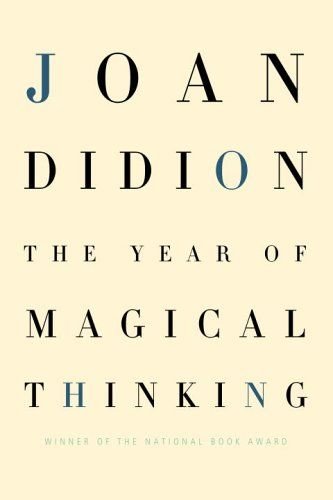
The Year of Magical Thinking
Watch Prashant Sir break down Didion’s key arguments, her extraordinary prose style, and why this National Book Award winner is considered one of the most important works on grief in the English language.
Why Read The Year of Magical Thinking?
On the evening of December 30, 2003, Joan Didion and her husband of forty years sat down to dinner. Then he was dead — a massive coronary, without warning, in the middle of an ordinary evening. The Year of Magical Thinking is the book Didion wrote in the year that followed. It is not grief as it appears in condolence cards or self-help literature — it is grief as it actually operates: disorienting, irrational, physically exhausting, and shot through with a private logic that the grieving person knows is irrational and cannot stop.
The “magical thinking” of the title refers to the private logic of bereavement. Didion found herself unable to give away her husband’s shoes because, at some level she could not entirely disown, she believed he might come back and need them. She replayed the evening of his death looking for the moment where a different choice might have produced a different outcome. Didion’s great achievement is to describe this from the inside, with a clinical precision that makes it universally recognisable.
The book is also a work of research. When her world collapsed she did what journalists do: she investigated. She read the medical literature on grief, the anthropological literature on mourning, and the poets who had written about loss. All of this is woven into the personal narrative — not as academic citation but as the texture of a mind trying to understand what has happened to it. The book won the National Book Award in 2005.
Who Should Read This
This book is for anyone who has experienced significant loss — or who knows they will, which is everyone. It is for readers who want to understand grief not as an abstract process with neat stages but as a lived experience with its own strange, specific logic. It is also for readers interested in what great prose can do with a subject that resists language. For CAT, GMAT, and GRE aspirants, it builds the reading skills needed for RC passages on psychology, cognition, and human behaviour — and models the integration of personal insight with research that the best essay responses require.
Key Takeaways from The Year of Magical Thinking
Grief is a cognitive disruption as much as an emotional one. It makes concentration impossible, decisions difficult, and rationality unreliable. The medical literature confirms what Didion describes: bereavement is a form of cognitive trauma with well-documented effects on memory and concentration.
Memory triggers can ambush grief long after it seems to have subsided. Didion’s concept of “the vortex” — a trigger that pulls you back into full grief without warning — explains why people seem fine one day and destroyed the next. Grief does not diminish linearly; it waits, and it returns.
Magical thinking is a structural feature of grieving minds, not a sign of weakness. The mind that spent forty years learning that a person was reliably present does not simply accept their absence — it keeps performing small, irrational acts based on the deep assumption of return.
In a long relationship, each person becomes part of the other’s cognitive architecture. The loss of a decades-long partner is therefore a partial loss of the self — a loss of part of the apparatus through which one understood and organised one’s own experience and memory.
Key Ideas in The Year of Magical Thinking
The central insight of the book is that grief is not primarily an emotional state — it is a cognitive one. It disrupts thinking, makes concentration impossible, decisions difficult, and rationality unreliable. Didion describes reading the same paragraph dozens of times and being unable to take it in. She describes walking into rooms and forgetting why she was there. She describes performing normal social behaviour — answering questions, eating meals, having conversations — while simultaneously existing in a state of total internal dislocation. By grounding her experience in medical and psychological research, Didion rescues grief from the realm of the merely personal and situates it as a human universal.
The book introduces one of its most practically useful concepts: the vortex. A particular street, a restaurant, a piece of music, a phrase someone uses. You think you are managing. Then something pulls you back into the full force of grief without warning. This explains why people seem fine one day and destroyed the next — grief does not diminish linearly. It waits, and it returns. The ambush is not a sign of weakness; it is a structural feature of how loss works in a mind that has been shaped by decades of shared experience.
One of the subtler arguments concerns the nature of a long marriage. Didion and her husband had been together for forty years. Over those decades, each became part of the other’s cognitive structure — part of the way each processed the world, made sense of experience, and organised memory. When he died, she did not simply lose a companion. She lost part of the apparatus through which she understood her own life. This explains why grief after a long relationship is qualitatively different from grief after a shorter one.
Freud used the phrase “the work of mourning” to describe what the grieving mind must do to eventually incorporate loss and continue living. Didion returns to this phrase repeatedly, both accepting it and questioning it. The book does not offer a clean answer about whether loss can truly be resolved or merely incorporated. What it offers instead is a precise account of what the first year of that work looks like — which is worth more than any resolution.
Key Themes in The Year of Magical Thinking
Five interlocking themes run through the book, each examining a different dimension of how grief operates in the human mind and the human life.
Core Arguments
Four arguments run through the book, each building the case that grief is a cognitive and psychological phenomenon that deserves the same rigorous, unsentimental attention we give to any other aspect of human experience.
The most important argument in the book is that grief belongs to cognitive psychology as much as it belongs to emotional life. The disruption of concentration, the failure of memory, the irrationality of magical thinking — these are not signs of weakness or instability; they are the documented features of how a human mind responds to the loss of a person who has been deeply integrated into its structure. Didion’s use of medical and psychological research to corroborate her personal experience is not merely rhetorical — it is an argument about the nature of grief itself: that it is something that happens to the mind, not merely something the mind feels.
The book implicitly argues throughout that the social frameworks available to grieving people — the stages of grief, the expectation of gradual recovery, the social pressure to move on — are badly misaligned with how grief actually operates. Grief does not proceed through stages in sequence. It does not diminish smoothly over time. It ambushes the grieving person in specific places, with specific triggers, long after they thought they had moved through it. The social scripts that tell grieving people what to expect and how to behave are, on this account, not wrong but radically incomplete — and their incompleteness leaves grieving people alone with experiences they have no language for.
Didion’s formal choice — to weave medical literature, poetry, and anthropology through a personal grief memoir — is not merely stylistic. It is an argument about how to think about loss: that the personal and the clinical, the literary and the medical, illuminate each other. The poet writing about loss is not doing something different from the grief researcher; they are approaching the same reality from different angles. By holding these perspectives together, Didion models a way of thinking about human experience that refuses to segregate feeling from understanding.
One of the book’s quietest and most powerful arguments is made through its style rather than its content. Didion writes about her husband’s death and the year that followed with extraordinary precision — exact dates, exact sentences, exact sequences of events. This precision is not clinical distance; it is the opposite. It is the insistence that John Gregory Dunne was a specific person who died on a specific evening in a specific way, and that the truth of that specificity must not be softened into generality. The precision is a form of love — and a refusal of the consolation that generalisation offers at the cost of the particular.
Critical Analysis
A balanced assessment of a book that is simultaneously a work of personal memoir, clinical research, and literary art — and one of the finest prose achievements in contemporary American non-fiction.
Didion’s restraint is extraordinary. The book is written in short, clipped sentences — spare, controlled, sometimes almost flat — and this restraint does enormous emotional work. The gap between the plainness of the sentences and the enormity of what they describe is itself a form of expression. The flat delivery makes the content land harder, not softer. This is a lesson in how understatement can be more powerful than expressiveness, and it is one of the finest demonstrations of that principle in the language.
Didion’s weaving of medical, anthropological, and literary sources into personal narrative without footnotes or academic apparatus is a model of how great non-fiction essays work. The research does not interrupt the prose — it deepens it. It elevates the personal to the analytical without losing the personal, and it is one of the most instructive demonstrations available of how to blend lived experience with external authority in a piece of writing.
Didion’s term for the memory trigger that pulls a grieving person back into full loss without warning is one of the genuinely useful ideas in the book — the kind of concept that, once you have it, you cannot unlearn. It provides a word and a framework for an experience that many people have had without being able to describe or understand. This is what the best non-fiction does: it gives form to experience that previously had none.
This is a book written from a position of considerable privilege. Didion and her husband were wealthy, successful, well-connected New Yorkers. The grief is real and the analysis is universal, but the material circumstances within which it plays out — the access to specialist medical care, the freedom from financial anxiety, the social network of support — are not. Some readers find this distance jarring, particularly when the book is positioned as a universal account of grief. The analysis travels; the context does not, entirely.
The book ends without narrative closure. Didion’s daughter Quintana was still gravely ill when the manuscript was submitted; she died in August 2005, shortly after publication. The absence of a concluded narrative can feel unfinished to readers expecting the conventional arc of memoir — a movement through crisis toward some form of accommodation or understanding. Didion’s honesty about this incompleteness is itself a form of truthfulness, but it can leave readers who came for consolation feeling that the book has withheld something.
The book is emotionally demanding in ways that are hard to prepare for. The restraint of the prose can make the emotional impact hit suddenly and without warning — which is, of course, structurally appropriate for a book about the vortex, but which can make it difficult reading for people in the middle of their own grief. For these readers, the identification with Didion’s experience may be too close for the reading to be useful rather than overwhelming.
Impact & Influence
A Defining Work of Grief Literature: The Year of Magical Thinking won the National Book Award for Nonfiction in 2005 and is now considered one of the most important works on grief written in the English language — placed alongside C.S. Lewis’s A Grief Observed as a book that manages to be both deeply personal and universally instructive. It was adapted into a one-woman stage play by Vanessa Redgrave in 2007, which further extended its reach beyond the reading public. It has been cited in medical training programmes, psychological counselling literature, and university courses on death and dying as a model of how grief actually operates.
Changing the Language of Grief: The book introduced into general usage several concepts — particularly the vortex — that have become part of how people talk and think about bereavement. Before Didion, the dominant popular framework for grief was Elisabeth Kübler-Ross’s stages model (denial, anger, bargaining, depression, acceptance). Didion’s account — with its emphasis on cognitive disruption, non-linear ambush, and the permanent incorporation of loss rather than its resolution — offered a far more accurate and far more honest description of the actual experience, and it has had a lasting effect on how grief is discussed in both clinical and popular contexts.
Didion’s Place in American Non-Fiction: The book cemented Didion’s reputation not merely as a journalist and cultural critic but as one of the greatest prose stylists in American non-fiction. Her earlier collections — Slouching Towards Bethlehem (1968) and The White Album (1979) — had established her as the defining voice of a certain kind of American cultural anxiety. The Year of Magical Thinking showed that the same precision and rigour that she brought to politics and culture could be turned inward with equally devastating results.
Value for Competitive Exam Preparation: The book’s non-linear, circling structure — returning to the same moments and sentences from different angles, each time with slightly more understanding — mirrors the structure of many challenging RC passages that do not present arguments in neat linear sequence but build meaning through return and variation. Reading Didion trains the specific cognitive skill of tracking how an argument develops across non-chronological material — which is exactly what the hardest RC questions are testing. The book also provides a sophisticated vocabulary for discussions on mental health, psychology, human relationships, and the experience of loss in GD/PI and essay contexts.
Love This Book? Master Every Book.
Stop struggling with reading comprehension. Our proven system transforms how you read—whether for CAT, GRE, GMAT, SAT, or personal growth.
Best Quotes from The Year of Magical Thinking
Grief turns out to be a place none of us know until we reach it.
Life changes fast. Life changes in the instant. You sit down to dinner and life as you know it ends.
We tell ourselves stories in order to live.
I know why we try to keep the dead alive: we try to keep them alive in order to keep them with us.
A single person is missing for you, and the whole world is empty.

Test Your Understanding
Think you’ve mastered The Year of Magical Thinking? Challenge yourself with 15 questions on Didion’s key concepts, arguments, and prose style. Score 80%+ to prove your mastery.
The Year of Magical Thinking FAQ
What is The Year of Magical Thinking about?
It is Joan Didion’s account of the year following the sudden death of her husband of forty years, the writer John Gregory Dunne, in December 2003. The book is not a conventional grief memoir — it is a rigorous investigation of how grief actually operates: as a cognitive disruption that makes concentration impossible and rationality unreliable; as a source of irrational “magical thinking” that the grieving person knows is irrational and cannot stop; and as an ambush that returns without warning long after it seems to have subsided. It blends personal narrative with medical research, literary sources, and anthropological literature on mourning.
What does “magical thinking” mean in the context of this book?
It refers to the private, irrational logic that grief produces in the mind of the bereaved. Didion could not give away her husband’s shoes because part of her mind — the part that had spent forty years learning he was reliably present — held on to the possibility that he might return and need them. She avoided certain thoughts because thinking them might make the loss permanent. She replayed the evening of his death looking for the branch point where a different choice could have produced a different outcome. These are the forms magical thinking takes — and Didion’s great contribution is to describe them without shame, showing that they are structural features of how the mind responds to loss, not signs of psychological weakness.
What is “the vortex” that Didion describes?
The vortex is Didion’s term for a specific kind of memory trigger — a place, a piece of music, a phrase, a restaurant — that pulls the grieving person back into the full force of loss without warning. You think you are managing. Then you encounter the trigger and the ground disappears. The concept explains why people who have experienced significant loss seem fine on some days and destroyed on others: grief does not diminish smoothly over time. It waits in specific places and returns in full force when those places are encountered. This is not weakness or instability; it is a structural feature of how loss works in a mind shaped by years of shared experience.
Is it useful for competitive exam preparation?
Yes — in several ways. RC passages on psychology, cognition, and human behaviour are common across CAT, GMAT, and GRE, and Didion’s book trains you to read this material with both analytical precision and emotional intelligence. Her non-linear, circling structure — which returns to the same moments from different angles, building understanding incrementally — mirrors the structure of many challenging RC passages that resist linear reading. For GMAT AWA and essay sections, the book models how to integrate personal observation, clinical research, and literary reference into a coherent argument. For GD/PI, it provides a sophisticated vocabulary for discussions on mental health, grief, psychology, and the experience of loss.
How does The Year of Magical Thinking compare to other books on grief?
It is most often compared to C.S. Lewis’s A Grief Observed — a book it consciously echoes and departs from. Lewis’s book is more theological; Didion’s is more clinical. Both are personal accounts of the first year of grief after the loss of a spouse; both resist consolation and refuse to pretend that loss resolves neatly. Didion’s distinctive contribution is the combination of journalistic rigour, clinical research, and literary precision — the insistence that grief can and should be examined with the same analytical tools we bring to any other human phenomenon, and that this examination is itself a form of respect for the dead.








