

Walden
Watch Prashant Sir break down Thoreau’s argument about the economics of a life, why simplicity is liberation rather than deprivation, and how this 1854 essay influenced Gandhi, the environmental movement, and the modern minimalist tradition.
Why Read Walden?
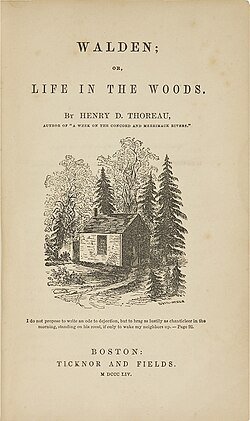
On the fourth of July, 1845 — Independence Day, not by accident — Henry David Thoreau walked into the woods outside Concord, Massachusetts, built a small cabin by Walden Pond, and began two years, two months, and two days of deliberate, stripped-back living. He grew beans, read books, received visitors, observed the seasons, and thought hard about what a human life was actually for. Walden, published in 1854, is the record of that experiment — and underneath its seasonal structure lies a single, urgent argument: that most of us are too busy earning money to live the lives we actually want, and that the solution is not more money but fewer wants.
Thoreau was a student and close friend of Ralph Waldo Emerson, whose land he was living on, and whose ideas about self-reliance and the individual’s capacity for truth he was now subjecting to the test of lived experience. Where Emerson theorised, Thoreau practised. Where Emerson wrote from a comfortable study, Thoreau built his own shelter, raised his own food, and reduced his expenses to the barest minimum to free as much of his time and attention as possible for thinking and observing.
The book is not a nature diary, though it contains extraordinary nature writing. It is not a survival manual, though it contains precise accounts of building costs and caloric calculations. It is not a polemic, though it contains sharp critiques of how most people live. It is all of these things together — and it is one of the foundational texts of American literature, the environmental movement, and the global tradition of voluntary simplicity. Its core question — what does a person actually need? — has never been more relevant.
Who Should Read This
Walden is for readers who are willing to slow down. It rewards readers who are curious about the natural world, interested in philosophy, or simply dissatisfied with the pace and purpose of modern life and looking for a vocabulary for that dissatisfaction. For competitive exam aspirants, it is among the most valuable books on this list — not because it is easy but because it trains exactly the quality of attentive, unhurried reading that hard RC passages require, and provides frameworks that appear directly in exam essays and interview discussions.
Key Takeaways from Walden
The true cost of anything is not its price in money but the amount of life required to earn that money. Thoreau reframes every purchase as a trade: you are giving a portion of your finite hours on earth in exchange for whatever you are buying. This single reframing — measuring cost in life rather than currency — is one of the most practically useful ideas in the book, and it changes how you evaluate every spending decision you make.
Simplicity is not deprivation — it is the removal of what obscures genuine experience. When you stop spending time earning money to buy things you do not need, what remains is reading, walking, observing, thinking, and paying very close attention to a world that most people are too busy to notice. Thoreau’s experiment demonstrates that the life most people are too busy to live is available to them right now, if they are willing to want less.
The natural world is both beautiful and instructive: attention to it is a form of wisdom, and disconnection from it is a form of impoverishment. Thoreau’s sustained observation of Walden Pond across the seasons — its freezing, thawing, and return to life — is not mere nature description. It is a philosophical argument about patience, endurance, and the cyclical nature of all meaningful change — an argument made more convincing by being grounded in a real pond and real seasons rather than abstraction.
Living deliberately means choosing your life rather than merely enduring it: examining each day’s activities against the question of whether they serve what you actually want, rather than simply repeating the patterns habit and social pressure have established. Thoreau’s woods experiment is his way of forcing that question into the open — going to the woods not to escape society but to see it, and himself, more clearly than proximity to either allowed.
Key Ideas in Walden
The opening chapter of Walden, “Economy,” is one of the most sustained and original pieces of social criticism in American literature. Thoreau undertakes a meticulous accounting of his experiment — the cost of the lumber for his cabin, the food he grew and ate, the hours he worked to earn what he needed — and arrives at a scandalous conclusion: that a person can meet all their genuine needs with a small fraction of the labour that most people assume is necessary. The implication is uncomfortable. If you are working fifty hours a week and still feel that you do not have enough, Thoreau asks you to consider whether the problem is insufficient income or excessive desire. Most of us, he suggests, have traded our lives for things we did not actually need.
Thoreau’s experiment in the woods is not an exercise in deprivation. It is an exercise in subtraction — removing what is unnecessary in order to see what remains. When you stop spending time earning money to buy things you do not need, what is left? Thoreau’s answer: reading, walking, observing, thinking, talking to interesting people, and paying very close attention to a world that most people are too busy to notice. This is not a call for poverty or asceticism for its own sake. Thoreau is interested in clarity — in the quality of attention that becomes possible when the noise of unnecessary obligation is removed.
Walden contains some of the finest nature writing in English. Thoreau describes the freezing of Walden Pond, the behaviour of ants, the songs of birds at different hours, the colours of ice, the movements of fish under the surface — with a precision and tenderness that transforms observation into meditation. But nature, in Thoreau’s framing, is not merely beautiful; it is instructive. The seasonal cycle — dying, dormancy, regeneration — is not just a fact of botany; it is a model for how human lives should be understood.
Running through every chapter is a single insistent question: are you actually living? Not surviving, not accumulating, not conforming — but living, deliberately, fully, with your eyes open to what you are doing and why? Thoreau calls this “living deliberately” — choosing each day with intention rather than being carried along by habit and social pressure. The woods experiment is his way of forcing that question into the open — stripping away the accumulated noise of ordinary life until only the essential remains, and asking whether the essential is enough. His answer, and the book’s quiet, hard-won conclusion, is that it is more than enough.
Key Themes in Walden
Five themes run through Thoreau’s essay — each developed through concrete observation and precise accounting rather than abstract assertion, in a prose style that enacts its own argument about the value of slow, attentive engagement with the world.
Core Arguments
Four arguments run through Walden — each developed through personal experiment and precise observation rather than abstract assertion, in a tradition of American thinking that tests ideas against lived experience rather than accepting them on theoretical authority.
Thoreau’s most enduring argument is that most people in modern society are caught in a cycle of unnecessary labour — working to earn money to buy things they do not genuinely need, leaving no time or energy for the things that make life worth living. The argument is structural rather than motivational: he is not urging people to work harder or want more. He is identifying a specific trap — the trap of confusing what you desire with what you need — and demonstrating by experiment that the trap can be escaped. The escape route is not more income; it is a deliberate reduction of desire, so that less labour is required and more life becomes available. This argument is one of the most consistently relevant in the entire book: the trap Thoreau describes in 1854 is, if anything, more tightly sprung in the present than it was then.
One of Thoreau’s most politically consequential arguments is that the individual’s moral judgment can and should override legal authority when the two conflict — that a law requiring you to participate in an injustice is not a law you are morally obliged to obey. This is not an argument for lawlessness; it is an argument for moral seriousness. Thoreau is not saying that every individual dissatisfaction with a law justifies non-compliance; he is saying that when the law requires you to act against a fundamental moral principle — as the Fugitive Slave Act required Northern citizens to return escaped slaves — the moral principle takes precedence. The political tradition this argument launched — through Gandhi to King — is one of the most important in modern history.
Running through Walden’s extended nature writing is an argument about the primacy of attention as a human capacity and a practical skill. Thoreau spends a page describing the behaviour of loons on the pond not because loons are the most important subject he could address but because the ability to observe — to see clearly what is actually in front of you rather than what you expect or assume to be there — is the foundational skill of both science and wisdom. A person who can attend carefully to loons can attend carefully to anything — to a business problem, to a person, to their own life. The nature writing is, in this sense, practical training disguised as description.
Thoreau inherits from Emerson — and develops with more personal specificity — the argument that the deepest form of social pressure is not legal or economic but psychological: the pressure to conform, to be like others, to avoid the discomfort of standing apart. The woods experiment is, among other things, a deliberate act of non-conformity — a demonstration that the life most people live is a choice, not a necessity, and that a different choice is available to anyone willing to bear the social discomfort of making it. Thoreau is not arguing that everyone should go to the woods. He is arguing that everyone should examine whether they are living as they have chosen or as they have merely been told to live — and that the difference between the two is the difference between a life and an imitation of one.
Critical Analysis
A balanced assessment of one of the most important books in American literature — a text that operates simultaneously as philosophy, nature writing, social criticism, and memoir, and succeeds at all four while carrying a strand of limitations worth understanding as clearly as its achievements.
The opening chapter is one of the most concentrated and original pieces of social criticism in American literature. Thoreau’s reframing of cost as “life exchanged” — his insistence on measuring the price of things in hours of finite human existence rather than units of currency — is both intellectually precise and practically transformative. It is the kind of argument that, once encountered, changes how you make decisions — not by telling you what to decide but by giving you a cleaner frame for deciding.
Thoreau’s sustained descriptions of Walden Pond across the seasons are among the finest passages of nature prose in English. They are not decorative — they are argumentative, grounding Thoreau’s philosophical claims in specific, verifiable observations of the natural world. The precision of the nature writing is what makes the philosophy credible: it is the work of a man who has actually looked, not merely of a man who has thought about looking.
Thoreau’s essay “Civil Disobedience” — the direct product of his 1846 arrest — is one of the most consequential short texts in modern political history. Gandhi read it in South Africa in 1907 and called it one of the most important texts he had encountered. Martin Luther King used it as a theoretical foundation for the American civil rights movement. The line of political influence running from a Massachusetts jail cell in 1846 to the Indian independence movement and the American civil rights movement is one of the most remarkable in the history of political thought — and it begins in the pages of this book.
Thoreau’s experiment was not as self-sufficient as the book implies. He ate regularly at his mother’s house in Concord, a mile away. He had Emerson’s land to use at no cost. The “simplicity” he achieved depended on social privileges and family support he did not fully acknowledge. The heroic individualist narrative of the book is complicated — not invalidated, but complicated — by these facts, and being aware of them demonstrates exactly the kind of critical reading that both serious scholarship and competitive exams reward.
Thoreau knows he is right, and he wants you to know it too. There is a strand of self-congratulation in Walden — a certainty about his own insights that occasionally tips into preachiness — that is the cost of the book’s remarkable confidence. The critique of his neighbours’ lives, sustained across the opening chapter, is more generous in its intentions than it sometimes feels in its execution. The dry wit that lightens much of the book does not always rescue the passages where Thoreau is most convinced of his own correctness.
Walden is long and moves slowly. The natural history chapters in particular require patience from readers whose interest is primarily in the philosophical and social arguments rather than in the behaviour of ants or the acoustics of the pond in winter. This is not a flaw in the book — the slowness is part of the argument, and resisting it is missing the point — but it means that readers who cannot bring their reading pace down to match Thoreau’s will find the experience unrewarding in ways that are entirely their own doing.
Legacy & Cultural Impact
Foundational Status: Walden was published in 1854 and sold modestly in its own time — Thoreau died in 1862 without seeing the full extent of the book’s influence. It has been in continuous print since the late nineteenth century and is now established as one of the foundational texts of American literature and one of the most widely read extended essays in the English language. It is taught in schools and universities across the world, in courses on literature, environmental studies, philosophy, and political theory, and has been translated into dozens of languages.
The Environmental Movement: Walden is a foundational text of the American environmental movement. Thoreau’s precise, loving attention to the natural world at Walden Pond — his insistence that this specific place, with its specific inhabitants and its specific seasonal rhythms, was worth careful observation and serious thought — established a model for the kind of sustained, place-based attention that has informed environmental writing and activism from John Muir and Aldo Leopold to Rachel Carson and Bill McKibben. The argument that the natural world is worthy of serious attention, and that the human relationship to it is a moral as well as a practical matter, begins — in the American tradition — with Thoreau at Walden Pond.
The Voluntary Simplicity Movement: The tradition of voluntary simplicity — the deliberate reduction of material consumption as a path to a more fully lived life — traces one of its clearest lines of descent to Walden. From the Arts and Crafts movement of the late nineteenth century to the counterculture of the 1960s to the modern minimalist movement, Thoreau’s argument that sufficiency is both possible and liberating has been continuously rediscovered and reapplied. The core claim — that most people have traded their lives for things they did not actually need — has never been out of date.
Relevance for Indian Readers and Exam Aspirants: The Thoreau–Gandhi connection is one of the most important intellectual genealogies for UPSC and MBA interview preparation. Gandhi read “Civil Disobedience” in South Africa in 1907 and called it one of the most important texts he had encountered; he used its framework of principled non-violent resistance as a foundation for satyagraha. Being able to trace this line of influence — from a Massachusetts jail cell in 1846 to the salt march and Indian independence — and to connect it to the Indian philosophical traditions of sanyasa and simple living that echo Thoreau’s arguments from within the Indian tradition, is the kind of intellectual connection that distinguishes excellent answers from competent ones. Walden is also among the most valuable RC preparation texts available: if you can follow Thoreau without losing the thread, you can follow almost any passage a competitive exam sets.
Love This Book? Master Every Book.
Stop struggling with reading comprehension. Our proven system transforms how you read—whether for CAT, GRE, GMAT, SAT, or personal growth.
Best Quotes from Walden
I went to the woods because I wished to live deliberately, to front only the essential facts of life, and see if I could not learn what it had to teach, and not, when I came to die, discover that I had not lived.
The mass of men lead lives of quiet desperation.
The cost of a thing is the amount of what I will call life which is required to be exchanged for it, immediately or in the long run.
However mean your life is, meet it and live it; do not shun it and call it hard names.
You must live in the present, launch yourself on every wave, find your eternity in each moment.

Test Your Understanding
Think you’ve mastered Walden? Challenge yourself with 15 questions on Thoreau’s core arguments, the economics of a life, civil disobedience, and the Gandhi connection. Score 80%+ to prove your mastery.
Walden FAQ
What is Walden about?
Walden is Henry David Thoreau’s account of the two years, two months, and two days he spent living in a self-built cabin by Walden Pond in Massachusetts — an experiment in deliberate, stripped-back living conducted to test the question of what a person actually needs. The book is organised seasonally and develops a sustained argument that most people have traded their lives for things they did not genuinely need, and that a deliberate reduction of desire can free time and attention for the things that make life actually worth living. It is simultaneously a work of social criticism, nature writing, philosophy, and memoir, and it is one of the foundational texts of American literature and the global environmental tradition.
Is it useful for MBA and competitive exam preparation?
Directly — across multiple exam types. CAT and XAT RC passages regularly include texts from the American and British essay tradition; Thoreau’s dense, allusive, observation-grounded prose is typical of the highest difficulty levels, and reading Walden directly prepares you for these. UPSC Essay Paper topics on environment, simplicity, civil disobedience, and the individual versus society all have direct touchpoints with Thoreau’s arguments. MBA GD/PI topics on consumerism, work-life balance, and environmental sustainability connect directly to the book’s themes. And the Thoreau–Gandhi connection — traceable from a Massachusetts jail cell in 1846 to the salt march and Indian independence — is one of the most impressive intellectual genealogies you can deploy in an interview or essay.
What is the connection between Walden and Gandhi?
Thoreau was arrested in July 1846 — during his time at Walden Pond — for refusing to pay a poll tax in protest against slavery and the Mexican-American War. He spent one night in jail and wrote an essay about the experience, “Civil Disobedience” (1849), arguing that the individual conscience is a higher authority than the state’s law, and that it is both a right and a duty to refuse to participate in an unjust system through principled, non-violent resistance. Gandhi read this essay in South Africa in 1907 and called it one of the most important texts he had encountered; he used its framework of non-violent non-cooperation as a theoretical foundation for satyagraha. Martin Luther King later read both Thoreau and Gandhi and used the same framework as a foundation for the American civil rights movement. The line of political influence — from Thoreau’s jail cell to Gandhi to King — is one of the most consequential in modern history.
What does Thoreau mean by “the cost of a thing is the amount of life exchanged for it”?
Thoreau proposes that the true cost of any purchase should be measured not in money but in the time of your life required to earn that money. If something costs “two hours of your working life,” that is its real price — you are trading two hours of your finite time on earth in exchange for whatever you are buying. This reframing is the intellectual centre of the book’s economic argument: most people calculate what things cost in currency and lose track of what they cost in life. Once you have made that calculation honestly — asking not “can I afford this?” but “is this worth this portion of my life?” — the purchase looks different. Thoreau’s conclusion is not that you should never spend money but that the deliberate reduction of unnecessary expenditure directly increases the amount of your life that is your own rather than spent in service of someone else’s goods.
Was Thoreau’s experiment at Walden genuinely self-sufficient?
Not entirely — and this is the most important critical qualification to know. Thoreau ate regularly at his mother’s house in Concord, a mile away. He had Emerson’s land to use at no cost. He received visitors frequently and participated in Concord social life throughout his two years at the pond. Critics argue that the “simplicity” he achieved depended on social privileges and family support that he did not fully acknowledge in the book, and that the heroic individualist narrative of Walden overstates his actual independence. This critique does not invalidate his ideas — the argument about the economics of a life, the value of attention, or the authority of conscience over law does not depend on whether Thoreau ate dinner at his mother’s house. But it complicates the narrative, and being aware of it — able to both appreciate the argument and acknowledge its limitations — demonstrates exactly the critical maturity that serious reading and competitive exams reward.








