

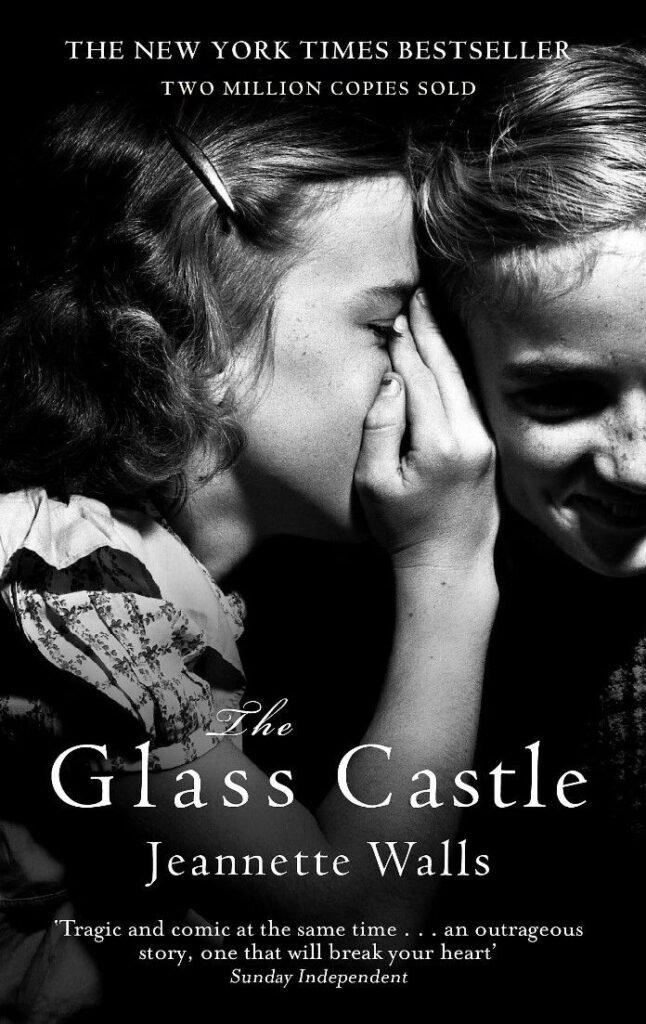
The Glass Castle
Watch Prashant Sir break down the key ideas, themes, and the unforgettable portrait of the Walls family in this extraordinary memoir.
Why Read The Glass Castle?
The Glass Castle is among the most extraordinary memoirs in American literature — not because Jeannette Walls’s childhood was the most difficult imaginable, though it was genuinely extreme, but because of the specific quality of attention she brings to it. She does not write her parents as villains, though they neglected their children in ways that were real and dangerous. She does not write herself as a victim, though she was one. She writes the whole thing — the fire at three years old, the hunger, the nomadic poverty, the alcoholic father’s brilliant mind, the mother’s magnificent selfishness — with a specificity and a generosity that is the memoir’s most remarkable achievement.
The memoir covers Walls’s childhood and adolescence, moving with her parents Rex and Rose Mary Walls and her three siblings across a series of increasingly desperate living situations — from the Nevada desert to Phoenix to a nearly uninhabitable house in Welch, West Virginia — driven by her father’s inability to hold a job, his alcoholism, and his grandiose plans for a self-sufficient life. The title refers to Rex’s lifelong promise to build his children a glass-and-solar-powered castle — a promise that sustained their imagination and, eventually, became the emblem of everything he promised and could not deliver.
What distinguishes the memoir is its refusal of the simple redemption narrative: Walls does not escape her childhood, achieve success, and then return with forgiveness that resolves the story. She achieves success — she becomes a journalist in New York, builds the stable life her childhood denied her — but the story does not resolve. Her parents remain homeless by choice in New York. The love she has for them remains real and complicated. The memoir ends not with resolution but with the specific ongoing complexity of what it means to love people whose choices damaged you.
Who Should Read This
This is among the most compelling memoirs in the database — compulsively readable, specific in its detail, and honest in ways that more polished literary memoirs sometimes are not. CAT and MBA candidates preparing for personal interviews about family, resilience, and the relationship between difficult origins and achieved success will find in Walls’s account both a vocabulary for engaging with these questions and a model of the specific kind of honesty — without self-pity, without resentment, without false resolution — that gives personal narrative its authority.
Key Takeaways from The Glass Castle
Resilience is not the absence of damage — it is the capacity to function despite it and make something out of it. The resilience is not separate from the damage; it is its specific product, which is a more honest account of how resilience actually works than most inspirational narratives provide.
Brilliance and dysfunction are not opposites. Rex Walls was a man of genuine intellectual brilliance who also stole his children’s savings and spent his life promising a glass castle he would never build. The memoir refuses to resolve Rex into either the brilliant father or the failing one, because both were equally real.
Poverty is not merely an economic condition — it is an ecological one, reshaping every aspect of a child’s experience of safety and possibility. You cannot read it and continue to think of poverty as a policy problem; it is a lived experience whose specific textures Walls renders with a precision that policy language cannot achieve.
The gap between the family you came from and the life you have built cannot be fully crossed. Walls achieves everything her childhood denied her and discovers it does not close the distance. She remains permanently both the person who grew up in poverty and the person who did not.
Key Ideas in The Glass Castle
The memoir’s most important formal decision is its opening scene: Walls, riding in a taxi through Manhattan on her way to a party, sees her mother rummaging through a dumpster in the street. The scene establishes, immediately and without preamble, the specific duality that organises the entire memoir — the coexistence of the life she has built and the family she came from, present simultaneously on the same Manhattan street. The memoir then goes back to the beginning, and the reader spends the rest of the book understanding how the taxi scene became possible.
Rex Walls is the memoir’s most fully realised character and its most complex argument. He is a man who read voraciously, who taught his children science and mathematics with genuine passion, and who told them stories about physics and geology that made the natural world feel magical. He is also a man who could not stop drinking, who stole money from his children’s piggy banks, who moved his family across the country to escape his own failures, and who spent his life promising a glass castle he never built. The memoir does not resolve this contradiction; it holds it — providing one of the most precise available accounts of how parental failure and parental love can coexist in the same person and produce the same child.
Rose Mary Walls — the mother — is the memoir’s most uncomfortable figure. A painter and writer who considered her own needs legitimate regardless of their cost to her children, she ate chocolate in secret while her children went hungry and refused to sell her Texas land to provide for her family. The memoir’s treatment of Rose Mary is its most honest achievement: she is presented as genuinely selfish, genuinely talented, genuinely loving, and genuinely incapable of prioritising anyone else’s needs — all simultaneously, without resolution.
The Welch, West Virginia section is the memoir’s most materially specific and structurally important — the most sustained account of genuine childhood poverty: the hunger, the cold, the specific social humiliation of being the poorest children in an already poor community. It is also the section in which Walls’s determination to escape becomes concrete and actionable — the specific plan she formulates to get herself to New York, to make money, to leave, and eventually to take her younger sister with her.
Key Themes in The Glass Castle
Five interlocking themes run through the memoir, each examining a different dimension of the relationship between love, failure, poverty, and resilience.
Core Arguments
Four arguments distinguish The Glass Castle as a work of serious moral intelligence, not merely a compelling personal story.
Walls’s most distinctive formal argument is implicit in her narrative voice: that self-pity is not merely emotionally unproductive but epistemologically limiting — that the victim’s narrative, by organising experience around suffering received, forecloses the kind of observation that produces genuine understanding. By refusing self-pity, Walls gains access to the full complexity of her parents’ characters — their gifts alongside their failures, their love alongside their dysfunction — in a way that a victim’s narrative would have prevented. The absence of self-pity is not evidence that the damage was not real; it is evidence of a specific narrative discipline that the memoir’s quality depends upon.
The memoir’s most socially significant argument concerns the specific ways in which poverty shapes human character, family dynamics, and individual possibility — not abstractly but in the specific texture of particular lives. Walls’s account of the Walls family’s poverty is not a case study in policy-relevant deprivation but a portrait of the specific human architecture that poverty produces: the creativity born of scarcity, the specific forms of denial and magical thinking that make impossible situations habitable, the specific social dynamics of communities where everyone is poor but some are more so.
The memoir’s most intellectually important argument is that parents are complex moral agents who produce their children through the entirety of their character, not merely through their successes or their failures. Rex Walls gave his children his intellectual curiosity, his love of the natural world, and his contempt for conventional constraint — gifts that were inseparable from the specific qualities that also made him a catastrophically unreliable father. Understanding what your parents gave you requires understanding the whole of who they were, which is a more demanding and more useful exercise than simple attribution of blame or gratitude.
The memoir’s most emotionally counterintuitive argument is that genuine love — the kind that survives full knowledge of its object’s failures — is not blind but acutely sighted. Walls sees her parents with extraordinary clarity: Rose Mary’s selfishness is not minimised, Rex’s failures are not excused. And yet the love survives the clarity, which is the memoir’s deepest argument about what love actually is when it is not merely the comfortable response to comfortable behaviour. This is a more demanding conception of love than most narratives provide, and it is what makes the memoir’s emotional experience so different from the simple rescue narrative its commercial success might suggest.
Critical Analysis
A balanced assessment of a memoir that is simultaneously one of the most accessible and one of the most morally serious books in this database.
Walls’s prose is direct, specific, and entirely free of the rhetorical signals — the laboured scene-setting, the performed emotion, the writerly self-consciousness — that mark less accomplished memoirs. She writes her childhood with the clarity of someone who has thought about it for a long time and found the precise language for what she saw, not the blurred impressionism of traumatic memory or the over-explained interpretation of therapeutic resolution.
Rex Walls is one of the most fully realised characters in contemporary memoir — not a villain, not a saint, not a case study in alcoholism, but a specific person whose specific combination of gifts and failures the memoir holds in suspension without resolving. This is difficult to achieve in memoir, where the temptation to simplify people who hurt you is strong, and the fact that Walls achieves it is the clearest evidence of the memoir’s specific maturity.
The taxi scene — Walls seeing her mother in a dumpster on the way to a Manhattan party — is one of the most precisely constructed memoir openings in the genre. It establishes, in a single image, everything the memoir is about: the duality of Walls’s position, the persistence of her origins, and the specific question the memoir will spend its pages answering. It is a masterclass in memoir architecture worth studying as a formal example.
Like all memoir, The Glass Castle is Walls’s account of events that other people experienced differently. Her siblings have broadly corroborated her account, and her parents did not publicly contest it, but the memoir is not independently verified and reflects one perspective on a shared experience. This is intrinsic to memoir as a form, but worth noting given the extreme nature of some events described.
Some critics have argued that the memoir’s treatment of Rose Mary does not fully account for the gendered dimensions of her situation: a woman of genuine artistic talent in a mid-twentieth-century marriage to an unstable, dominating man, with four children and no financial independence. The memoir presents Rose Mary primarily through her children’s experience of her failures without fully examining the structural conditions that shaped those failures.
The memoir’s final movement follows a pattern — damaged origins, individual determination, achieved success — that does not fully examine the structural dimensions of how that escape was possible. Not every child of poverty with equivalent determination makes it to Manhattan; the memoir does not fully account for the specific luck, timing, and structural factors that also contributed to her escape alongside the individual determination the narrative foregrounds.
Impact & Influence
Commercial Phenomenon: The Glass Castle was published in March 2005 and became one of the most extraordinary commercial successes in memoir history — spending over six years on the New York Times bestseller list, including 261 weeks in the top fifteen. It has sold over 5 million copies in the United States and over 8 million worldwide, been translated into more than 30 languages, and remained continuously in print for nearly two decades. It was adapted into a feature film in 2017, with Brie Larson as Jeannette Walls and Woody Harrelson as Rex.
A Rare Double Achievement: The memoir’s sustained commercial success reflects a specific quality that most bestselling books do not possess: it is better than its commercial success suggests. The accessibility that makes it compulsively readable does not come at the cost of the honesty that makes it genuinely illuminating. It is one of the rare memoirs that works simultaneously as entertainment and as serious literature — that can be read on an airplane and studied in a classroom without either use diminishing the other.
Impact on the Public Conversation: The memoir provided millions of readers with the most specific and most human account they had encountered of what childhood poverty actually looks like — not as a demographic category but as the specific daily experience of specific children in specific American communities. It shifted the conversation about poverty from abstraction to the bodily and particular, in a way that policy language cannot achieve.
Half Broke Horses: Walls’s follow-up (2009) reconstructed the life of her maternal grandmother Lily Casey Smith — a frontierswoman whose specific combination of toughness and unconventional values illuminated the family formation that produced Rose Mary and therefore produced Walls herself. Together, the two books constitute a three-generation family portrait that is one of the most complete available accounts of how specific qualities — both functional and dysfunctional — are transmitted through family lines.
Indian Context: The memoir resonates in the Indian context along dimensions familiar across cultures: the experience of growing up in conditions that were not chosen, the relationship between parental love and parental failure, and the specific form of in-betweenness that first-generation achievement produces. The glass castle itself — the promise of something better that sustains hope without ever being built — is recognisable in any culture where parental aspiration exceeds parental capacity, and its specific beauty and its specific cruelty are universally comprehensible.
Love This Book? Master Every Book.
Stop struggling with reading comprehension. Our proven system transforms how you read—whether for CAT, GRE, GMAT, SAT, or personal growth.
Best Quotes from The Glass Castle
You should never hate anyone, even your worst enemies. Everyone has something good about them. You have to find the redeeming quality and love the person for that.
Life is a drama full of tragedy and comedy. You should learn to enjoy the comic episodes a little more.
It’s the Joshua tree’s struggle that gives it its beauty.
Things usually work out in the end. What if they don’t? Well, that just means you haven’t come to the end yet.
No child is born a delinquent. They only became that way if nobody loved them when they were little.
If You Liked This, Try…
No books found.
Test Your Understanding
Think you’ve mastered The Glass Castle? Challenge yourself with 15 questions on key themes, the Walls family, and Jeannette’s core arguments. Score 80%+ to prove your mastery.
The Glass Castle FAQ
What is The Glass Castle about?
It is Jeannette Walls’s memoir of her childhood and adolescence, raised by her parents Rex and Rose Mary Walls — an alcoholic, intellectually brilliant father and a self-absorbed, artistically gifted mother — across a series of impoverished, nomadic living situations in the American West and South. It covers the specific experiences of poverty, hunger, instability, and occasional wonder that her parents’ choices produced, her determination to escape to New York, and the specific ongoing complexity of loving people whose failures were real and whose gifts were equally real.
Is The Glass Castle useful for MBA and CAT preparation?
Yes — particularly for personal interview questions about family, resilience, difficult origins, and the relationship between where you came from and what you have become. Walls’s specific narrative voice — clear, honest, without self-pity or false resolution — is itself a model for how to discuss difficult personal history in a PI context. The memoir’s frameworks — resilience as inheritance, love as clarity rather than blindness, the permanent in-betweenness of first-generation achievement — provide vocabulary for engaging with these questions at a level of sophistication that most candidates do not bring.
What is the glass castle?
The glass castle is Rex Walls’s lifelong promise to build his children a house made of glass and powered by solar energy — a beautiful, technologically sophisticated, self-sufficient home that he sketched in detailed architectural drawings and described with genuine visionary passion. He never built it. The glass castle is therefore simultaneously an emblem of his specific genius — the genuine intellectual ambition and aesthetic vision that were his real gifts — and his specific failure — the inability to translate aspiration into the mundane, sustained effort that actual building requires. It is the memoir’s central symbol precisely because it holds both things at once: the beauty of the dream and the cruelty of the promise that was never kept.
How does the memoir handle the damage her parents caused?
With extraordinary clarity and without self-pity, resentment, or false resolution. Walls does not excuse her parents’ failures — the hunger is real, the cold is real, the specific damage is documented specifically. She also does not reduce her parents to their failures — Rex’s intellectual gifts are real, Rose Mary’s artistic talent is real, the love both of them had for their children in their specific, insufficient way is real. The memoir holds all of this simultaneously, which is its most difficult and most important achievement. It ends not with forgiveness as a concluded act but with love as a continuing condition — complicated, clear-eyed, and genuine.
How does The Glass Castle compare to Educated as a memoir of difficult childhood and achieved independence?
Both are memoirs of women who escaped extreme childhoods through extraordinary individual determination and who are honest about what the escape cost them. The key difference is in the nature of the difficulty and the quality of the surviving love. Westover’s difficulty was epistemological — her family denied reality — which made the escape a cognitive achievement and produced irreconcilable estrangement. Walls’s difficulty was material and relational — her family knew what reality was and could not sustain a stable response to it — which allowed a different kind of love to survive the distance she created. Westover escapes from a family whose love required her to deny what she knew; Walls escapes from a family whose love was genuine and whose failures were also genuine — and the different structure of each situation produces a very different memoir and a very different aftermath.








