

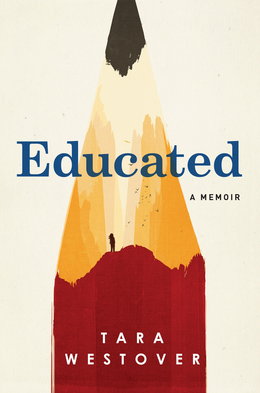
Educated
Watch Prashant Sir break down the key ideas, themes, and arguments in Westover’s extraordinary memoir of education and identity.
Why Read Educated?
Educated is one of the most extraordinary memoirs published in the past decade — extraordinary not primarily because of the circumstances it describes, though those are extreme, but because of the precision and honesty with which Tara Westover examines what happens to a mind, an identity, and a family when one person chooses knowledge over the version of reality she was raised to accept. At its deepest level, it is a memoir about epistemology — about how we know what we know, who gets to define reality, and what it costs to insist on your own experience.
Tara Westover grew up on a mountain in rural Idaho, the youngest of seven children in a survivalist family. She had no birth certificate until she was nine, received no formal education, and worked from childhood on her father’s scrapyard and in her mother’s herbal medicine practice. At seventeen, she taught herself enough algebra and grammar to pass the ACT and was admitted to Brigham Young University — her first entry into formal education.
What follows is one of the most intellectually and emotionally demanding self-education narratives in contemporary memoir: Westover discovering, through contact with books and professors and a world she had never been permitted to know, that the version of reality she had been raised in was not merely different from the mainstream but actively false in specific, documentable ways. The memoir tracks her navigation of this discovery — the exhilaration of it, the disorientation of it, and the specific price it extracted from her relationship with her family.
Who Should Read This
This is essential reading for anyone interested in education as a transformative force — not education as credential acquisition but education as the fundamental alteration of how a person sees the world. CAT and MBA candidates preparing for personal interviews about education, self-development, family, and identity will find in Westover’s account a framework for thinking about these questions that is far more complex and more honest than conventional narratives about self-improvement and social mobility.
Key Takeaways from Educated
Education is not the acquisition of information — it is the development of the capacity to examine your own assumptions. Westover was given the tools to ask for evidence, to distinguish memory from reality, and applying them honestly to her own life was the most painful application they had.
The family that shapes you is also the family you must most carefully examine. The memoir is not an indictment of her family; it is the record of her attempt to hold love and truth simultaneously — and the discovery that her family could not accept both.
The first generation to cross a significant educational boundary does not merely acquire new knowledge — they must rebuild the epistemological architecture through which all knowledge is processed. That reconstruction is work no one who has not done it can fully appreciate.
The price of becoming yourself can be the loss of the people who made you. Westover’s estrangement is not presented as a victory but as a loss that was the consequence of a choice she could not not make — the memoir’s most honest and most difficult territory.
Key Ideas in Educated
The memoir’s most important structural decision is that Westover does not present her childhood as simply abusive and her education as simply liberating. She presents both as more complex: her childhood contained genuine love, beauty, and the specific freedom of a life lived outside institutional constraints; her education produced genuine knowledge alongside disorientation, shame, and the progressive alienation from her family that the knowledge eventually made inevitable. The memoir refuses the narrative of simple rescue — the idea that education saved Tara Westover from a bad life — because it is honest enough to acknowledge that what education gave her, it also took something in return.
The memory question is one of the memoir’s most sophisticated formal choices. Westover opens with a note acknowledging that her family members remember events differently. This is not a qualification that diminishes the memoir’s honesty; it is, paradoxically, what makes it most honest. The memoir is explicitly about the unreliability of memory, about who gets to define what happened, about the specific ways in which families construct shared realities that protect their cohesion at the cost of individual members’ experience.
The intellectual awakening sections are the memoir’s most quietly extraordinary passages. Westover arrives at Brigham Young University not knowing what the Holocaust was, not having heard of the civil rights movement. What she describes is not the acquisition of those facts but the disorientation of discovering that facts can be checked — that claims about the world are subject to evidence, that truth is not merely what the people who love you most believe.
The Cambridge chapters track the progressive deepening of Westover’s intellectual life alongside the progressive deterioration of her family relationships. As her academic capabilities develop — she eventually wins a Gates Cambridge Scholarship and earns a PhD in intellectual history — her family’s demands that she recant her account of abuse intensify. The memoir’s structure is the structure of a widening irreconcilable gap: the person Westover is becoming through education cannot coexist with the version of herself her family requires.
Key Themes in Educated
Five interlocking themes run through the memoir, each examining a different dimension of the education-identity-family relationship.
Core Arguments
Westover advances four original arguments that distinguish Educated from conventional memoirs about unusual childhoods.
Westover’s most original contribution is the specific argument that education does not merely add to a person — it restructures them, sometimes at the cost of the identity that preceded it. The version of herself that Westover was before education could not have survived education intact, because education gave her tools that, applied honestly to her own experience, produced conclusions incompatible with the family loyalty her pre-educational identity required. This is a specific feature of education received across a very large cultural and cognitive distance, and Westover’s memoir is the most precise available account of what that specific experience costs.
The memoir’s most intellectually sophisticated argument concerns the specific social function of shared family memory. Family memory is not merely personal — it is constitutive of family identity. A member who insists on a divergent account is not merely disagreeing about facts but threatening the family’s coherent account of itself. Westover’s family’s demand that she recant her account of her brother’s abuse is, in their own experience, not a demand that she lie — it is a demand that she prioritise family identity over individual truth-claiming. The memoir makes this demand intelligible without accepting it.
Westover’s most socially significant argument — understated in the memoir itself but visible throughout — is that the cost of first-generation educational achievement is consistently underestimated by the institutions that celebrate it. The narrative of social mobility through education treats the achievement as pure gain. It rarely examines what the achievement costs — the relationships, the belonging, the specific identity that the world of origin provided and that the world of the destination cannot replace in kind. Westover’s account is the most honest available examination of that cost.
The memoir’s formal acknowledgment of its own unreliability — the opening note about the divergence between Westover’s memory and her family’s — is one of its most important argumentative moves. It does not make the memoir less credible; it makes it more so, because it demonstrates that Westover is not claiming documentary objectivity but phenomenological honesty — the truth of her own experience, held with full awareness that her family’s experience of the same events was different. This is not epistemological relativism but epistemological honesty about the specific kind of knowledge a memoir can provide.
Critical Analysis
A balanced assessment of Educated’s considerable literary strengths and the genuine limitations inherent to its form and subject.
Westover is a historian by training, and it shows. Her sentences are precise, her pacing is deliberate, and her ability to contextualise her own experience within broader intellectual and cultural frames gives the memoir a depth that most personal narratives cannot achieve. The writing never strains for effect; its power comes from the specificity and honesty of what it observes.
The memoir’s most important literary quality is its insistence on holding complexity — a family that was simultaneously loving and damaging, an education that was simultaneously liberating and disorienting, a journey that was simultaneously triumph and loss. This is what distinguishes it from the category of inspirational escape narrative it superficially resembles.
Most memoirs about unusual childhoods operate at the level of event description. Educated operates at the level of epistemological analysis — it is not merely about what happened but about the specific cognitive mechanisms through which Westover was able to perceive, and then contest, the version of reality she had been raised in. This analytical depth is rare in memoir.
Because Westover acknowledges that her family’s account of events differs from hers, readers cannot fully distinguish between accurate account and possible distortions of memory or perspective that she herself acknowledges. This is inherent to memoir as a form, but it is more present as a concern here because the events described are so extreme and the family disputes so directly addressed.
The memoir ends with Westover’s estrangement from most of her family established but not processed — she is describing a wound still open at the time of writing. Some readers find this unresolved quality honest and appropriate; others find it emotionally unsatisfying. The memoir’s ending is a present-tense condition, not a conclusion.
Westover’s experience is so extreme — the specific combination of survivalist ideology, parental illness, sibling abuse, and absence of any formal education — that readers from more conventional backgrounds may find it difficult to apply its lessons directly. Its more universal resonances require more active reader work to extract.
Impact & Influence
Commercial and Critical Reception: Educated was published in February 2018 and became one of the most celebrated non-fiction books of the decade — spending over 130 weeks on the New York Times bestseller list, selling over 5 million copies in the United States alone, and being translated into more than 40 languages. Barack Obama included it on his annual reading list; Bill Gates called it one of his favourite books of 2018.
Cultural Impact: The book’s impact was concentrated in two areas: the education debate and the discussion of family loyalty versus individual truth. In education circles, it provided the most vivid available illustration of what education as transformation — as opposed to credential acquisition — actually means and what it actually costs. In broader cultural discussion, it contributed a carefully rendered case study to ongoing conversations about gaslighting and the experience of having one’s own reality denied by people in positions of authority and love.
Westover’s Public Life: Her subsequent public life has been notably restrained — she has declined most interview requests and resisted the celebrity author circuit. This restraint is consistent with the memoir’s own argument about the difference between genuine self-knowledge and performed identity, and it has protected the book from the commercialisation that diminishes many successful memoirs.
The Family’s Response: The response from Westover’s family — specifically from her parents and brother Shawn — has been to deny the accuracy of her account. The family’s response to the memoir has, in the most uncomfortable way possible, confirmed the memoir’s argument about the specific social function of family-constructed reality — and about the specific price paid by the person who chooses their own account over the version the family requires.
Relevance for Indian Readers: The memoir resonates along specific dimensions in the Indian context: the tension between family loyalty and individual ambition, the experience of being the first person in one’s family to cross a significant educational boundary, and the psychological challenges of navigating between the world of origin and the world of aspiration. The specifics are very different — Westover’s Idaho is not most Indian readers’ context — but the underlying structure of the experience is recognisable across cultural distance.
Love This Book? Master Every Book.
Stop struggling with reading comprehension. Our proven system transforms how you read—whether for CAT, GRE, GMAT, SAT, or personal growth.
Best Quotes from Educated
You can love someone and still choose to say goodbye to them. You can miss a person every day, and still be glad that they are no longer in your life.
I had been educated enough to know that the life I was living was not the only possibility.
My life was narrated for me by others. Their voices were forceful, emphatic, absolute. It had never occurred to me that my voice might be as strong as theirs.
Everything I had worked for, all my years of study, had been to purchase for myself this one privilege: to see and experience more truths than those given to me by my father, and to use those truths to construct my own mind.
The skill I was learning was a crucial one, the patience to read things I could not yet understand.
If You Liked This, Try…
No books found.
Test Your Understanding
Think you’ve mastered Educated? Challenge yourself with 15 questions on key themes, arguments, and ideas. Score 80%+ to prove your mastery.
Educated FAQ
What is Educated about?
It is the memoir of Tara Westover, who grew up in a survivalist family in rural Idaho with no formal education, taught herself enough at seventeen to gain admission to Brigham Young University, and eventually earned a PhD from Cambridge. The book is not primarily about the unusual circumstances of her childhood — though those are extreme — but about what education means when it fundamentally restructures how a person sees the world, and what it costs when that restructuring puts you in irreconcilable conflict with the family that formed you.
Is Educated useful for MBA and CAT preparation?
Yes — particularly for personal interview questions about education, self-development, family, identity, and the relationship between individual ambition and social belonging. Westover’s account provides a framework for thinking about these questions with a complexity and honesty that conventional self-improvement narratives do not. Candidates who can discuss the education-identity argument, the first-generation crossing experience, or the cost of truth-claiming in the context of family loyalty are engaging with questions that distinguish serious thinkers from formulaic responders.
Is the memoir reliably factual?
Westover acknowledges in an opening note that her family remembers the events she describes differently — that her account is her experience, not a court-established record of fact. This is not a qualification that diminishes the memoir’s value; it is what makes it most epistemologically honest. The memoir is a first-person account of a first-person experience, held with full awareness that the family’s account differs. Readers should engage with it as memoir — the most honest available account of one person’s experience — rather than as journalism.
What is the most important theme in Educated?
The relationship between education and identity — specifically, the argument that education at sufficient depth and across sufficient cultural distance does not merely add to a person but restructures them, and that this restructuring can put the educated person in irreconcilable conflict with the identity and relationships that preceded it. This is the memoir’s most original intellectual contribution and the one most relevant to any reader thinking seriously about what education actually is and what it actually costs.
How does Educated relate to other self-improvement books?
It is the most honest available corrective to the self-improvement genre’s consistent tendency to present development as pure gain. Where most self-help books present growth as the acquisition of capability without examining what is lost, Educated is a sustained, honest account of the specific losses that accompany specific gains. It does not argue that the gains were not worth the losses — Westover clearly believes they were — but it insists that both be acknowledged, which is the intellectual honesty that most self-improvement narratives lack.








