

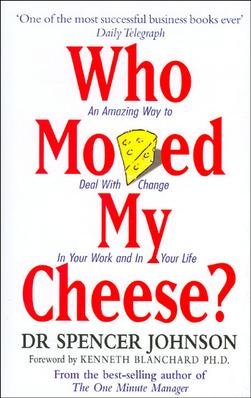
Who Moved My Cheese?
Watch Prashant Sir break down Spencer Johnson’s change parable — the four characters, the seven wall writings, and why this ninety-six-page fable became the world’s most widely distributed corporate change-management text.
Why Read Who Moved My Cheese?
Who Moved My Cheese? is the shortest book in this database and, measured by copies distributed per page, possibly the most widely circulated business parable ever written. Spencer Johnson’s ninety-six-page fable about four characters navigating a maze in search of cheese has sold over 28 million copies, been translated into more than 37 languages, and been bulk-purchased by corporations worldwide as orientation material for employees facing change. Its longevity is not accidental — it distils a genuine psychological insight about the relationship between comfort, change, and adaptability into a form so simple that no excuse remains for not understanding it. Whether that simplicity is a virtue or a limitation is the book’s central critical question.
The story follows four characters in a maze: two mice named Sniff and Scurry, and two “Littlepeople” named Hem and Haw. All four have been finding their cheese at Cheese Station C, a plentiful supply that has structured their daily routines and self-identities. When the cheese disappears, their responses diverge dramatically. Sniff and Scurry immediately set off to find new cheese. Hem is paralysed by denial and anger. Haw is paralysed by fear and attachment to what was.
The narrative follows Haw’s eventual journey through the maze — his fear, his gradual recognition that his attachment to the old cheese was destroying him, and the handwriting he leaves on the maze walls for Hem, who never comes. The book’s argument is encoded in those wall writings — seven maxims about change that together constitute Johnson’s philosophy of adaptability. The story is a parable precisely because its simplicity is an invitation: the reader is expected to recognise themselves in the characters and draw their own conclusions about which character they are being, in their own maze, right now.
Who Should Read This
This book is appropriate for almost any reader — its accessibility is genuine rather than condescending. MBA and CAT candidates will encounter it in virtually every corporate orientation context they enter after their degrees, and understanding its framework at depth — rather than merely recognising its cultural ubiquity — distinguishes serious students. Beyond preparation, it is useful for anyone navigating a significant life transition: a career change, an organisational restructuring, the end of a relationship, the loss of a stable identity. The cheese is whatever you have built your sense of security around. The maze is the rest of your life.
Key Takeaways from Who Moved My Cheese?
Change happens — whether you are ready for it or not, whether you caused it or not, whether you think it is fair or not. The cheese will always move eventually. The only variable is not whether change will come but how quickly you will notice it, accept it, and move — and that variable determines whether the change destroys you or leads you to something better.
The fear of change is almost always worse than the change itself. Most of the suffering caused by change is not caused by the change but by the anticipatory fear of the unknown it produces. When Haw finally enters the maze despite his fear, he finds that the act of moving is itself liberating — and that the paralysis he had been enduring was far more painful than the uncertainty he had been avoiding.
Monitoring change proactively — noticing when the cheese is getting smaller, older, or less reliable — is the difference between adaptation and crisis. Most human resistance to change is not resistance to the change itself but to the shock of having ignored its approach — and that shock is preventable through the habit of honest, regular attention to the reality of one’s situation.
Letting go of old cheese is not disloyalty to the past — it is the precondition for finding new cheese. Attachment to what was — a former role, a former identity, a former way of doing things — prevents the discovery of what could be, and the longer it persists, the more it costs. The maze always contains more cheese than the last station you found.
Key Ideas in Who Moved My Cheese?
The book’s structure is a story within a story. It opens with a group of former classmates at a reunion discussing a parable that one of them tells to explain how he handled a significant life change. The parable is the maze story; the reunion conversation is a framing device that allows Johnson to show different characters responding to the parable differently — recognising themselves in Hem, in Haw, in the mice. This framing makes explicit that the story is a mirror, and that what matters is not the parable but the reader’s recognition of which character they are.
The four characters are deliberately designed to represent four different psychological orientations toward change. Sniff represents the ability to anticipate change — noticing signals that the current situation is shifting before it becomes a crisis. Scurry represents the ability to act quickly once change is recognised — to move without over-thinking. Hem represents the refusal to accept change — denial, anger, and attachment to the way things were. Haw represents the gradual, effortful journey from resistance to adaptation — the most fully human of the four characters, and the one with whom most readers most honestly identify.
The seven wall writings are the book’s philosophical core — the maxims that Haw writes as he moves through the maze: Change Happens; Anticipate Change; Monitor Change; Adapt to Change Quickly; Change; Enjoy Change; Be Ready to Change Quickly Again. Together they constitute a complete philosophy of adaptability — compressed into a form that can be read in an hour and applied for a lifetime.
The book’s central psychological insight concerns the relationship between self-identity and resistance to change. Hem’s paralysis is not merely about the cheese — it is about what the cheese represents. He has built his identity, his routines, and his sense of who he is around Cheese Station C. The disappearance of the cheese is experienced not merely as an inconvenience but as a threat to his self-concept. This is why rational argument does not help Hem — his resistance is not based on a rational assessment of his situation but on the psychological terror of being someone whose defining structure has dissolved.
Core Frameworks in Who Moved My Cheese?
Johnson builds four interlocking frameworks — the four character archetypes, the seven wall writings, the cheese metaphor itself, and the maze as environment — each illuminating a different dimension of the same central insight: that adaptability is a choice, and that the obstacles to it are psychological rather than circumstantial.
Core Arguments
Johnson advances four interconnected arguments — about the inevitability of change, the specific psychology of fear-based paralysis, the identity trap that makes cheese into something more than cheese, and the corporate utility of the parable format itself — each grounding the simple story in a more sophisticated analysis than its brevity might suggest.
Johnson’s foundational argument is that change is not a problem to be solved or a threat to be defeated — it is the permanent condition of existence. The question is not whether change will come but whether your relationship to it is adaptive or defensive. The mice’s response — immediate, instinctive, efficient — is presented not as ideal because it requires no thought but as useful precisely because it is not contaminated by the elaborate psychological defences that make change so difficult for the Littlepeople. The mice’s advantage is not intelligence; it is the absence of the identity investment that makes Hem’s cheese into something more than cheese.
Haw’s journey through the maze is a study in the specific psychology of fear-based paralysis. He knows he should move. He understands that the old cheese is not coming back. He can see, rationally, that staying is more dangerous than going. And yet he stays — because the fear of the unknown maze is more immediately present and more emotionally powerful than the rational assessment of his situation. Johnson’s argument is not that fear is irrational but that it is manageable — that the question “What would you do if you weren’t afraid?” is not rhetorical but practical. When Haw finally moves, the fear does not disappear; it simply becomes less important than the alternative.
Johnson’s most psychologically sophisticated argument concerns the difference between having cheese and being cheese — between a stable situation that provides security and an identity constructed around that stability. When people resist change with unusual intensity, it is almost always because the change threatens not just their comfort but their self-concept. Hem does not merely miss the cheese; he is the person who has cheese at Station C, and without it he does not know who he is. The book argues, implicitly, that the most important preparation for any future change is to build an identity flexible enough to survive the loss of its current contents — to be someone who finds cheese rather than someone who has it.
Johnson published the book in 1998 — a moment of rapid organisational change driven by technology, globalisation, and the restructuring of traditional employment relationships. Its corporate adoption was so rapid and so widespread precisely because it addressed a need that organisations recognised acutely: employees who could not adapt to change were becoming their organisations’ most significant liability, and the organisations themselves were struggling to communicate the necessity of change without provoking the resistance that change announcements reliably trigger. The parable format was, in corporate terms, a change-management tool that could be given to employees without triggering the defensiveness that a direct communication about the need to change would have produced.
Critical Analysis
A balanced assessment examining the book’s genuine accessibility, emotional precision, and universal metaphor alongside its oversimplification of complex change, the unresolved Hem problem, and the inherent depth-versus-reach trade-off that defines both its greatest strength and its greatest limitation.
The parable format produces a level of memorability that no conventional business text achieves. The characters — Sniff, Scurry, Hem, Haw — become permanent shorthand for change orientations that most people recognise immediately in themselves and others. The cheese metaphor is flexible enough to be applied to any domain where attachment meets change. These are the properties of a genuinely useful conceptual tool, and the book deserves credit for producing them.
Johnson’s rendering of Hem’s paralysis and Haw’s fear-based delay is psychologically accurate in ways that much more sophisticated psychological literature is not. The specific feeling of knowing you should change and being unable to — of constructing elaborate justifications for staying where you are — is described with an accuracy that produces recognition in virtually every reader who has experienced it.
The cheese metaphor is genuinely flexible across professional and personal contexts: a corporate restructuring, a career plateau, the end of a relationship, the loss of a belief system, the obsolescence of a professional skill. This universality is not vagueness — it is the mark of a metaphor that has identified something genuinely structural about how human beings relate to change.
The book’s framework works well for changes where the obstacle is internal resistance rather than external constraint. It works less well for changes that involve genuine injustice, structural barriers, or situations where adaptation is not straightforwardly available. The maxim “move with the cheese” is good advice for a redundant middle manager in a stable economy; it is inadequate for a worker whose entire industry has been destroyed by forces entirely outside their control. The book does not distinguish between these cases.
Hem never adapts — he is last seen waiting at Cheese Station C. Johnson’s parable offers no path for the person whose resistance is so deep that they genuinely cannot move. The book identifies the problem with unusual precision but offers no solution for the people most completely in its grip. In corporate change-management contexts, distributing the book to deeply resistant employees does not, by itself, help them become less resistant.
The book’s greatest strength — its simplicity — is also its greatest limitation. It identifies that change requires adaptability and that fear is the primary obstacle. It does not address why people develop specific patterns of resistance, how those patterns can be changed at a deeper level, or what distinguishes adaptive change from change that should be resisted. Readers who need that depth will need to go elsewhere.
Literary & Cultural Impact
A Publishing Phenomenon: Who Moved My Cheese? was published in September 1998 and became one of the most remarkable commercial phenomena in publishing history. It spent over five years on the New York Times Business Best Seller list — one of the longest runs in the list’s history. It sold 28 million copies worldwide, was translated into 37 languages, and became the bestselling business book of 1998, 1999, and 2000 in the United States. Companies including Apple, Hewlett-Packard, and Southwest Airlines purchased it in bulk — sometimes distributing copies to thousands of employees simultaneously during organisational restructuring.
Story as Change-Management Tool: The book’s corporate adoption pattern reveals something important about its actual function. It was not primarily purchased by individuals seeking self-improvement; it was purchased by organisations seeking a low-resistance medium for communicating the necessity of change to employees who were resistant to it. The parable format — non-threatening, non-accusatory, metaphorically distant enough to allow self-recognition without defensive rejection — made it ideal for this purpose. Whether this corporate use constituted genuine change facilitation or a sophisticated form of change-management communication — using a parable about accepting change to smooth the acceptance of changes that employees might have legitimate reasons to question — is the book’s most interesting and least-discussed question.
The Legacy of a Vocabulary: The book’s cultural legacy is visible in the permanent entry of its metaphors into everyday professional vocabulary. “Who moved my cheese?” became standard shorthand for “why has my comfortable situation been disrupted?” Sniff, Scurry, Hem, and Haw became recognisable archetypes across industries and cultures. The cheese metaphor itself — the idea of building your identity around something that can be taken away — became a reference point in leadership development, coaching, and organisational psychology that has outlasted the specific business context in which Johnson introduced it.
Connection to Johnson’s Broader Work: Johnson’s career placed him in the company of management thinkers who understood that the most powerful ideas are often the simplest ones. His collaboration with Ken Blanchard on The One Minute Manager (1982) — which sold over 13 million copies — had already demonstrated his ability to distil management principles into accessible, story-based formats. Who Moved My Cheese? extended this approach into the domain of personal and organisational change, producing a text that has outlasted most of its more sophisticated contemporaries.
Love This Book? Master Every Book.
Stop struggling with reading comprehension. Our proven system transforms how you read—whether for CAT, GRE, GMAT, SAT, or personal growth.
Best Quotes from Who Moved My Cheese?
What would you do if you weren’t afraid?
The quicker you let go of old cheese, the sooner you can enjoy new cheese.
If you do not change, you can become extinct.
It is safer to search in the maze than to remain in a cheeseless situation.
Movement in a new direction helps you find new cheese.

Test Your Understanding
Think you’ve mastered Who Moved My Cheese? Challenge yourself with 15 questions on the four characters, the seven wall writings, the cheese and maze metaphors, and the psychology of change resistance. Score 80%+ to prove your mastery.
Who Moved My Cheese? FAQ
What is Who Moved My Cheese? about?
It is a parable about four characters — two mice (Sniff and Scurry) and two Littlepeople (Hem and Haw) — who live in a maze and depend on a large supply of cheese that one day disappears. The story follows their divergent responses: the mice adapt immediately; Hem denies and resists; Haw eventually overcomes his fear and sets off to find new cheese, writing philosophical maxims on the maze walls as he goes. The book uses this simple narrative to argue that change is inevitable, that the primary obstacle to adaptation is fear-based identity attachment, and that movement — even in uncertainty — is always preferable to paralysis.
Is it useful for MBA and CAT preparation?
Yes, in two specific ways. First, the four-character framework is immediately applicable to GD/PI questions about change management, adaptability, and organisational behaviour — understanding the psychological mechanisms of change resistance at depth demonstrates the kind of analytical engagement that distinguishes strong candidates. Second, every MBA candidate will encounter this book in corporate contexts after their degree, and knowing it well before the degree places you ahead of the orientation curve.
What do the four characters represent?
Sniff represents the ability to detect change early — noticing signals that a situation is shifting before it becomes a crisis. Scurry represents rapid, instinctive action once change is recognised. Hem represents denial and resistance — the refusal to accept that the old situation is gone, driven by identity investment in what was. Haw represents the gradual, fear-driven journey from resistance to adaptation — the most fully human character and the one with whom most readers most honestly identify. The characters are not personalities to emulate or avoid; they are orientations available to all of us in different situations and at different moments.
What is the most important lesson in the book?
“What would you do if you weren’t afraid?” — Haw’s question to himself, written on the maze wall — is the book’s most important single insight. It identifies the specific mechanism of change paralysis (fear, not incapability) and the specific intervention that unlocks adaptation (imagining action from a hypothetical state of fearlessness, then taking that action while still afraid). The lesson is not that you should be unafraid of change — fear of the unknown is a normal response. The lesson is that the fear need not determine the action.
Why has such a short, simple book been so widely distributed by corporations?
Because the parable format achieves something that direct communication about change cannot: it allows readers to recognise their own resistance in the characters without feeling accused or instructed. A memo telling employees to “embrace change” triggers defensive resistance; a story in which a character visibly suffers from refusing to embrace change invites self-recognition. The corporate adoption of the book was, in effect, the use of story as a change-management tool — which is both the book’s most interesting legacy and its most ambiguous one, since the same format that facilitates genuine reflection can also be used to smooth acceptance of changes that employees might have legitimate reasons to question.








