

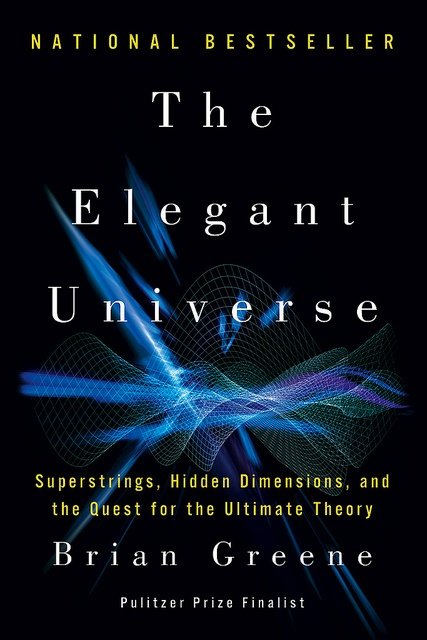
Why Read The Elegant Universe?
The Elegant Universe: Superstrings, Hidden Dimensions, and the Quest for the Ultimate Theory is the most comprehensive and most accessible account of string theory — the leading candidate for a unified theory of all physical forces — available to general readers, and one of the finest works of popular physics writing of the past quarter century. A Pulitzer Prize finalist and Aventis Prize winner, it introduced to a general audience the theoretical framework that has dominated the frontier of theoretical physics for four decades.
The book has three parts. The first establishes the conceptual foundations: Einstein’s special and general relativity (the physics of the very large) and quantum mechanics (the physics of the very small), and the central problem that their mathematical inconsistency creates for any theory aspiring to describe both. The second introduces string theory — the proposal that the fundamental constituents of nature are not point particles but one-dimensional vibrating strings of energy. The third covers the two superstring revolutions: the 1984–85 demonstrations of mathematical consistency, and the 1995 M-theory conjecture by Edward Witten that unified all five string theories into a single eleven-dimensional framework.
Greene writes with unusual gifts: a practising string theorist who understands the technical content from the inside, he has the rare ability to communicate genuinely difficult mathematical and physical concepts through analogy and thought experiment without distorting their content. The result is a book that goes further into the technical landscape of theoretical physics than any comparable popular work, while remaining accessible to readers with no physics background.
Who Should Read This
This is a book for readers who want the most complete account of string theory and the quest for a unified theory of physics available at the popular science level — readers who have already encountered Hawking’s A Brief History of Time and want to follow the theoretical physics story into its most recent and most ambitious chapters. Essential for advanced science students who want the deepest available popular treatment of theoretical physics, readers fascinated by the conceptual frontier of physics, CAT/GRE aspirants who need advanced-level physics reasoning prose, and any thoughtful reader who wants to understand the most ambitious intellectual project currently underway in fundamental science.
Key Takeaways from The Elegant Universe
String theory proposes that the fundamental constituents of nature are not point particles but one-dimensional vibrating strings of energy — whose different vibrational modes, like different notes on a violin, correspond to different fundamental particles. A string vibrating in one mode is an electron; in another, a quark; in another, a graviton. This single picture could, in principle, unify all the forces and all the particles of nature in a single mathematical description.
String theory requires six or seven extra spatial dimensions beyond our familiar three, curled up into geometric shapes called Calabi-Yau manifolds so small they are invisible to any current instrument. The specific geometry of these extra dimensions determines the physical constants — the masses of particles, the strengths of forces — that we observe in our universe. This is simultaneously the theory’s greatest conceptual ambition and its greatest empirical challenge.
The five distinct string theories developed before 1995 were unified by Edward Witten’s M-theory conjecture — the proposal that all five are different limiting cases of a single eleven-dimensional theory, related by mathematical dualities. M-theory is the most ambitious theoretical unification in the history of physics, but also the least completely formulated: its full equations remain unknown.
String theory has not yet produced a single unambiguously confirmed experimental prediction. The energy scales at which string effects would become observable are approximately fifteen orders of magnitude beyond any conceivable particle accelerator. This gap between mathematical beauty and experimental inaccessibility raises genuine philosophical questions about what it means for a physical theory to be scientific if it cannot in principle be tested.
Key Ideas in The Elegant Universe
The book’s first section is the most accessible and most foundational: a clear, precise account of the two great theories of 20th-century physics — general relativity and quantum mechanics — and the specific ways in which they are incompatible. General relativity describes the universe as a smooth, curved spacetime whose curvature we experience as gravity. Quantum mechanics describes the universe as fundamentally discrete and probabilistic, governed by the Heisenberg uncertainty principle. The incompatibility is precise: applying quantum mechanics to the strong gravitational fields that general relativity predicts near singularities produces mathematical infinities — physically meaningless results that signal the breakdown of both theories in exactly the regime where both should apply.
The string theory sections introduce the proposal systematically: if the fundamental constituents of nature are not points but one-dimensional strings, the infinities that plague quantum gravity are eliminated. A point particle has no spatial extent, so interactions are infinitely localised and produce infinitely large quantum fluctuations. A string has a finite length (approximately the Planck length, 10⁻³³ centimetres) — and when strings interact, the interaction is spread over a finite region of space, smearing out the divergences. This simple change from point particle to string tames the infinities without destroying the mathematical structure of the theory.
The extra dimensions chapters are among the book’s most conceptually demanding. String theory requires that spacetime have ten or eleven dimensions — six or seven more than our familiar experience. The extra dimensions must be compactified into geometrical shapes called Calabi-Yau manifolds. The specific shape of compactification is not determined by current theory: estimates suggest between 10¹⁰⁰ and 10⁵⁰⁰ distinct possible shapes, each producing a universe with different physical constants — the so-called “landscape” of string vacua.
The M-theory chapters cover the second superstring revolution: the 1995 discoveries that the five distinct string theories are all related by mathematical dualities and are all limiting cases of a single eleven-dimensional theory whose full equations are not yet known. The dualities are the technical achievement at the heart of the revolution — they show that a strongly coupled version of one string theory is mathematically equivalent to a weakly coupled version of another, meaning calculations impossible in one formulation can be performed in its dual. These duality symmetries transformed the theoretical landscape and are among the deepest mathematical structures in modern physics.
Core Frameworks in The Elegant Universe
Greene builds his account of string theory on six interlocking frameworks — from the incompatibility problem that makes unification necessary to the landscape problem that represents its greatest current challenge.
Core Arguments
Greene advances four interconnected arguments — about mathematical beauty as evidence, the necessity of unification, the physical reality of extra dimensions, and the philosophical status of an experimentally inaccessible theory.
The book’s most philosophically significant argument — running throughout but explicit in the discussions of Calabi-Yau geometry and the string dualities — is that the extraordinary mathematical beauty of string theory (its internal consistency, the elegance of its unification of all forces, the depth of its duality symmetries) is genuine evidence in its favour, even in the absence of experimental confirmation. This is a philosophically contested position: the history of physics includes beautiful theories that turned out to be wrong, and the standard of scientific confirmation is experimental, not aesthetic. Greene presents the argument carefully — acknowledging its limitations — but the book’s emotional and rhetorical power rests substantially on it, and readers should engage with it critically.
Greene’s central scientific argument — maintained throughout with the quiet confidence of an insider — is that the incompatibility between general relativity and quantum mechanics makes a unified theory not just desirable but logically necessary, and that string theory is the most mathematically serious candidate. The necessity argument is well-established: any theory that describes the physics of black hole singularities or the Big Bang must incorporate both gravity and quantum mechanics. The claim that string theory is the most serious candidate is more contested — loop quantum gravity and other approaches exist — but Greene makes the case with the authority and specific technical detail that only an active researcher can provide.
One of the book’s most important arguments — conveyed through the history of Kaluza-Klein theory and the development of string compactification — is that extra spatial dimensions beyond our familiar three are not a mathematical convenience but a genuine physical claim about the structure of space. Kaluza’s 1919 proposal that a fifth spatial dimension could unify electromagnetism with gravity established the precedent for extra dimensions in fundamental physics. String theory’s requirement of six or seven additional dimensions is a direct extension of this programme. The argument that these dimensions are physical — currently hidden because they are compactified at the Planck scale — is the strongest form of the claim, and the one that Greene defends throughout.
The book’s most intellectually honest and most practically challenging argument is that string theory’s current inability to produce experimentally testable predictions is a serious problem that must be acknowledged — but that it does not constitute a refutation of the theory. The energy scales at which string effects become observable are beyond any foreseeable experimental reach; the extra dimensions are below any foreseeable resolution; the landscape of vacua makes determining which compactification describes our universe currently impossible. Greene acknowledges all of this while arguing that the mathematical achievements of string theory represent genuine scientific progress even without experimental confirmation. This argument sits at the boundary between physics and philosophy of science, and readers who engage with it will find it productively challenging.
Critical Analysis
A balanced assessment examining the book’s extraordinary technical depth and analogy quality alongside the significant developments since its 1999 publication that complicate its optimism about string theory’s prospects.
The Elegant Universe goes further into the actual technical content of string theory than any comparable popular work — covering not just the basic idea of strings but the specific features of the five superstring theories, the Calabi-Yau geometry of the compactified dimensions, the duality transformations, and the M-theory conjecture. This depth is possible because Greene is an active string theorist who has contributed directly to several of the developments he describes, and it gives the book an authority that science journalism cannot match.
Greene’s gift for analogy — garden hoses to explain compactified dimensions, violin strings to explain fundamental string vibrations, rubber band networks to explain duality transformations — is among the highest available in popular physics writing. The analogies are both illuminating and honest: Greene consistently flags where the analogy breaks down and what it cannot capture.
The book is not just an account of string theory’s current state but a history of how it developed — from the Veneziano amplitude in 1968, through the first superstring revolution of 1984–85, to the second of 1995. This historical embedding gives the theoretical content a human and narrative context that makes both the achievements and the remaining challenges more comprehensible.
Published in 1999, the book predates the full development of the landscape problem — the discovery that string theory admits an enormous number of possible vacuum states, each describing a different possible universe with different physical constants. This development significantly changed the theoretical landscape; readers should supplement with more recent discussions, including Greene’s own The Fabric of the Cosmos (2004).
Since 1999, the string theory community has become more openly divided on whether the theory can ever be experimentally tested, and critics (Lee Smolin in The Trouble with Physics, Peter Woit in Not Even Wrong) have made serious arguments that string theory in its current form is not a scientific theory in the standard sense. The book’s optimism about eventual experimental confirmation has not been borne out in the intervening twenty-five years.
Unlike Tyson’s Astrophysics for People in a Hurry or Hawking’s A Brief History of Time, The Elegant Universe makes genuine demands on the reader’s concentration. The extra dimensions, duality, and M-theory chapters are among the most conceptually demanding content in the popular science genre. Readers should set their expectations accordingly and allow time for multiple readings of the hardest sections.
Literary & Cultural Impact
Immediate Recognition: The Elegant Universe was published in February 1999 and became an immediate critical and commercial success — a finalist for the Pulitzer Prize in General Nonfiction (2000), winner of the Aventis Prize for Science Books (2000), and a New York Times bestseller. It has sold over a million copies and been translated into over twenty languages. In 2003 it was adapted into a three-part PBS documentary series that reached millions of additional viewers and introduced string theory to the widest popular audience it had yet encountered.
Popularising String Theory: The book’s cultural impact was to make string theory a household concept in the early 21st century, at a moment when the theory was at the peak of its intellectual prestige but before the landscape problem and the continued absence of experimental confirmation had created a more contested atmosphere. Greene became, alongside Stephen Hawking and Neil deGrasse Tyson, one of the most publicly recognised theoretical physicists of his generation; his subsequent books — The Fabric of the Cosmos (2004), The Hidden Reality (2011), Until the End of Time (2020) — have maintained his position as the most productive communicator of frontier theoretical physics to general audiences.
Scientific Influence: The book contributed to the surge of interest in string theory that produced a generation of string theorists in the early 2000s, and is widely cited as the book that introduced working physicists to the landscape of the field at the level of a comprehensive popular treatment. The controversies that have emerged since its publication — about the landscape problem, the absence of experimental confirmation, whether string theory is science in the standard sense — have not diminished its value as the most complete popular treatment of where the field stood at the turn of the millennium.
For Exam Preparation: The Elegant Universe is the most demanding book in the Readlite science series — advanced-level reading comprehension in sustained theoretical physics argument. The analogical reasoning that carries the argument (garden hoses for compactified dimensions, violin strings for fundamental strings) is directly relevant to the kind of metaphorical and analogical reasoning that advanced CAT and GRE passages frequently test.
Love This Book? Master Every Book.
Stop struggling with reading comprehension. Our proven system transforms how you read—whether for CAT, GRE, GMAT, SAT, or personal growth.
Best Quotes from The Elegant Universe
String theory is a framework in which all matter and all forces are unified through the common bond of being vibrational patterns of one basic ingredient — strings.
The history of physics is the history of the progressive unification of apparently distinct natural phenomena.
Extra dimensions — the idea that there are more dimensions of space than the three we see — sounds like science fiction. But there is a growing body of evidence that this may be the case.
The mathematics of string theory is so deep and so powerful that we have barely begun to mine its implications.
In the arena of the very small and the very energetic, nature plays by a completely different set of rules — rules that turn out to be extraordinarily elegant.


Test Your Understanding
Think you’ve mastered The Elegant Universe? Challenge yourself with 15 questions on string theory, extra dimensions, the five superstring theories, M-theory, and the landscape problem. Score 80%+ to prove your mastery.
The Elegant Universe FAQ
What is string theory in one paragraph?
String theory is the proposal that the fundamental constituents of nature are not zero-dimensional point particles but one-dimensional vibrating strings of energy, whose different vibrational modes correspond to the different fundamental particles and forces — including, crucially, the graviton (the carrier of the gravitational force), which emerges naturally from string theory but cannot be consistently incorporated into any other quantum field theory. The strings are approximately the Planck length (10⁻³³ centimetres) in size — far below the resolution of any current or conceivable instrument. String theory requires the existence of extra spatial dimensions curled up at the Planck scale, and its full formulation requires an eleven-dimensional framework called M-theory that has not yet been completely specified. It is the leading candidate for a unified theory of all physical forces, but it has not yet produced an experimentally confirmed prediction.
Why do physicists take string theory seriously if it has no confirmed experimental predictions?
The absence of confirmed experimental predictions is the most important criticism of string theory, and it is a serious one. Physicists take the theory seriously for several reasons. First, it is the only consistent quantum theory of gravity currently known — it incorporates gravity with the other forces without producing the mathematical infinities that destroy every other approach. Second, it has produced significant mathematical achievements — particularly the duality symmetries and the mirror symmetry results — that have had profound implications for pure mathematics independent of whether the physics is correct. Third, it naturally includes all the particles and forces of the Standard Model as vibrational modes. None of these is an experimental confirmation, and critics argue that the absence of experimental predictions disqualifies string theory from being called a scientific theory in the standard sense. The debate about this point is one of the most important discussions in contemporary philosophy of physics.
What are extra dimensions and why does string theory need them?
Extra dimensions are spatial dimensions beyond the three (length, width, height) that we perceive directly. String theory requires extra dimensions for a mathematical reason: the equations of string theory are only consistent (free of mathematical anomalies that would make the theory unphysical) in ten spacetime dimensions (superstring theory) or eleven (M-theory). Since we observe only four dimensions, the remaining six or seven must be hidden from observation — either because they are compactified (curled up) at the Planck scale, too small to be directly detected, or because they extend in directions that matter and energy cannot access. The Kaluza-Klein idea — that extra dimensions could be physically real but hidden by compactification — dates to 1919; string theory’s extra dimensions are the modern extension of this programme, now required by the mathematical consistency of the theory rather than merely suggested by the possibility of geometric unification.
What happened after this book was published? Has string theory made progress?
Since 1999 the string theory landscape has changed significantly. The landscape problem — the discovery that string theory admits approximately 10⁵⁰⁰ possible vacuum states, each describing a universe with different physical constants — has made the original hope of predicting the constants of nature from string theory appear very remote. The AdS/CFT correspondence (Maldacena, 1997), developed extensively since, has provided the most productive application of string theory methods to date — not as a theory of quantum gravity but as a calculational tool for understanding strongly coupled quantum field theories, with applications to quark-gluon plasma and condensed matter physics. The Large Hadron Collider has not found the supersymmetric particles that many string theorists expected. The debate between string theory’s proponents and critics has become more public and more contentious. Greene addresses some of these developments in The Fabric of the Cosmos (2004) and The Hidden Reality (2011).
How does The Elegant Universe relate to A Brief History of Time and Astrophysics for People in a Hurry on the Readlite list?
The three books form the reading sequence for the cosmology and theoretical physics strand of the Readlite science series, in order of increasing demand. Astrophysics for People in a Hurry (Tyson) is the entry point — the most accessible, the broadest, and the most conversational, covering the essential concepts of modern astrophysics with maximum clarity. A Brief History of Time (Hawking) provides the next level of depth — the conceptual foundations of general relativity and quantum mechanics, black holes, the Big Bang, and the search for a unified theory as of 1988. The Elegant Universe (Greene) provides the most technically complete account of string theory and the unification programme as of 1999 — going significantly further into the theoretical landscape than Hawking while remaining accessible through the quality of its analogies. The recommended sequence is Tyson (orientation) → Hawking (foundation) → Greene (frontier), with the understanding that each step is significantly more demanding than the last.








