

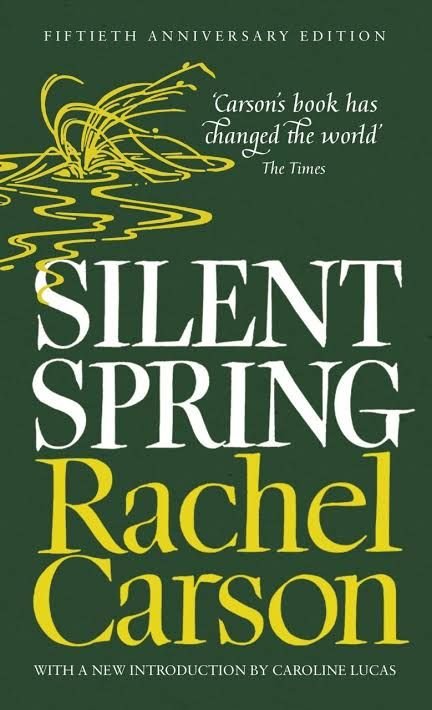
Why Read Silent Spring?
Silent Spring is the most consequential popular science book ever written in terms of direct policy impact — a work that almost single-handedly created the modern environmental movement, led to the banning of DDT in the United States, inspired the creation of the Environmental Protection Agency, and permanently changed how democratic societies think about the relationship between industrial chemistry, ecological systems, and public health.
The book documents the widespread and indiscriminate use of synthetic pesticides — particularly the chlorinated hydrocarbons (DDT, aldrin, dieldrin, endrin, heptachlor) and the organic phosphates — that followed World War II, as chemical weapons technologies were repurposed for agricultural use. Carson documents the effects of these chemicals on birds, fish, mammals, insects, soil organisms, and human beings: the killing of songbirds, the collapse of fish populations, the poisoning of water supplies, the disruption of insect food chains, and the accumulation of persistent chemical residues in the fatty tissues of animals across the entire food chain.
Carson’s argument operates at two levels simultaneously. At the scientific level, she documents the specific ecological and biological effects of pesticide use with meticulous citation of the scientific literature. At the political level, she argues that the uncontrolled release of synthetic chemicals into the environment is an assault on the public’s right to a liveable natural world — and that the regulatory apparatus of government has been captured by the very industries it is supposed to regulate. Both arguments are as relevant today as they were in 1962.
Who Should Read This
This is a book for anyone who wants to understand how the modern environmental movement came to exist, and why the relationship between industrial chemistry, ecological systems, and democratic governance remains one of the most politically contested questions in contemporary society. Essential for science and environmental studies students, policy professionals in environmental and public health fields, CAT/GRE aspirants building scientific prose reading comprehension, and any reader who has wondered why a book published in 1962 is still considered dangerous enough to warrant organised industry opposition.
Key Takeaways from Silent Spring
Synthetic pesticides like DDT are fat-soluble and persistent — they accumulate in the fatty tissues of animals at each level of the food chain (bioaccumulation), reaching concentrations in top predators thousands of times higher than the original environmental application. The most affected animals are often not the target pests but the birds, fish, and mammals at the top of food chains.
Ecosystems are complex webs of interdependence — not simple pest-crop systems. The indiscriminate killing of insects, including pollinators, predatory insects, and decomposers, undermines the very ecological foundations of the agriculture that pesticides are supposed to protect.
The long-term toxicological effects of chronic, low-level chemical exposure were not understood when synthetic pesticides were deployed at mass scale. Carson argued that the precautionary principle — requiring demonstration of safety before mass deployment, not proof of harm after the fact — should govern the introduction of novel chemicals into the environment.
The regulatory apparatus of the US government had been captured by the chemical industry — accepting industry-funded research, suppressing inconvenient findings, and approving inadequately tested chemicals. This regulatory capture is the systemic problem of which DDT was a symptom, and it remains one of the most important challenges in environmental governance.
Key Ideas in Silent Spring
The book opens with a fable — a description of a small American town where all life has fallen silent: no birds singing in the spring, no fish in the streams, no bees to pollinate the orchards. Carson is explicit that no such town yet exists — she is depicting a possible future assembled from actual events that have happened in different places. This opening fable established the book’s emotional register and its political purpose: not simply to document what is happening but to make it imaginable as a total catastrophe before it becomes one.
The chapters on individual pesticide families are models of scientific communication for a general audience. Carson explains the chemistry of chlorinated hydrocarbons — their persistence in the environment, their fat-solubility causing accumulation in fatty tissues, and their disruption of neurological function — with clarity and precision that is accessible without being reductive. She traces the pathway from aerial spraying through soil and water contamination, ingestion by invertebrates, accumulation in fish, concentration in birds, and eventually the appearance of pesticide residues in human mothers’ milk.
The chapters on birds are the book’s most eloquent and most politically effective. Carson documents the mass die-offs of American robins following DDT spraying of elm trees, and the collapse of bald eagle and peregrine falcon populations due to DDT-induced eggshell thinning — a well-documented mechanism causing breakage during incubation. The title — Silent Spring — refers to the spring that will come when there are no more birds to sing, and these chapters give that title its specific ecological and emotional content.
The regulatory and political chapters are the book’s most historically significant. Carson documents the extent to which the regulatory agencies responsible for pesticide oversight had been staffed by individuals with industry connections, the extent to which industry-funded research had replaced independent scientific assessment, and the specific mechanisms by which the chemical industry had suppressed or ignored inconvenient scientific findings. Her analysis of regulatory capture anticipates by decades the academic literature on the subject.
Core Frameworks in Silent Spring
Carson builds her argument on six interlocking frameworks that together constitute a complete account of pesticide harm — from molecular chemistry to democratic governance.
Core Arguments
Carson advances four interconnected arguments — scientific, political, economic, and practical — that together constitute a complete case for democratic environmental accountability.
The book’s deepest political argument — stated most directly in the chapter “The Other Road” — is that the natural environment is not simply a resource available for industrial exploitation but a living system on which human health and survival depend, and that the public has a right to a natural environment that is not systematically poisoned by industrial chemicals released without their knowledge or consent. This right was not recognised in law in 1962, and Carson’s argument that it should be was the founding claim of the modern environmental movement.
Carson’s argument about regulatory capture is simultaneously scientific and political: the failure of pesticide regulation in 1962 was not primarily a failure of scientific knowledge (the evidence of harm was available and being suppressed) but a failure of democratic accountability (the people whose environment was being contaminated had no effective mechanism to learn what was being done to it, to evaluate the evidence, or to participate in regulatory decisions). The democratisation of science — making scientific evidence available to the public in accessible form — is both the book’s method and its argument.
The book’s most practically consequential argument is that the chemical industry cannot be trusted to regulate itself, that industry-funded research cannot be the primary basis for regulatory decisions about environmental safety, and that genuinely independent scientific assessment and public accountability are essential components of effective environmental protection. This argument — obvious in retrospect — was radical in 1962 in the specific context of agricultural chemistry, where the industry’s dominance of the regulatory process was nearly total.
Carson’s most urgent practical argument is that many environmental damages caused by persistent synthetic chemicals are irreversible on any human timescale: DDT in soil persists for years to decades; DDT in animal tissue continues to accumulate; the species and ecological relationships disrupted by mass pesticide application cannot be restored simply by stopping application. The irreversibility of these damages makes prevention — precautionary regulation before mass deployment — not just morally preferable but practically necessary. Attempting to undo the damage after the fact is orders of magnitude more difficult than preventing it.
Critical Analysis
A balanced assessment examining the book’s extraordinary scientific and literary strengths alongside its genuine limitations and the debates that have followed its legacy.
Carson was a trained marine biologist who worked for sixteen years as a biologist and science editor for the US Fish and Wildlife Service. Her documentation is meticulous, and the central claims have been repeatedly confirmed by subsequent research. The critics who attacked the book’s science in 1962 could not demonstrate that its major claims were wrong, because they were correct.
Carson was one of the finest science writers in American literary history. Silent Spring deploys literary quality in the service of scientific and political argument: the opening fable, the elegiac descriptions of birds, and the precise accounts of ecological disruption give the book an emotional resonance that purely technical documentation cannot achieve.
No other popular science book has had as direct and measurable a policy impact. DDT was banned for agricultural use in the United States in 1972; the Environmental Protection Agency was created in 1970; the modern environmental movement grew directly from the political space the book opened.
The most contentious legacy involves the DDT ban and malaria control in sub-Saharan Africa. DDT is extraordinarily effective against malaria-transmitting mosquitoes, and the book’s absolute framing of DDT as an environmental poison does not fully address the genuine complexity of balancing ecological risks against public health benefits in specific contexts.
Carson’s final chapter presented biological and ecological approaches as more fully developed and practically available than they actually were in 1962. The transition away from broad-spectrum pesticides has been slower and more difficult than the book’s optimistic presentation suggested.
The specific regulatory failures Carson documented have been partially addressed by the reforms that followed Silent Spring. The deeper structural problem of regulatory capture, however, has persisted in different forms — as the history of climate science denial, tobacco regulation, and pharmaceutical safety demonstrates.
Literary & Cultural Impact
The Industry Counterattack: Silent Spring was serialised in The New Yorker in June 1962 and immediately provoked one of the most organised corporate counterattacks in the history of science communication. Monsanto published a parody of Carson’s opening fable; Velsicol Chemical Corporation threatened to sue the publisher; individual scientists funded by the industry attacked Carson’s credentials and scientific accuracy. The attacks failed: Carson’s science was documented to a standard that could not be refuted, and President Kennedy ordered the President’s Science Advisory Committee to review the book’s claims. The committee’s 1963 report largely confirmed Carson’s analysis.
Direct Policy Impact: The book’s consequences were extraordinary — the Environmental Protection Agency was created in 1970, DDT was banned for agricultural use in the United States in 1972, and the Clean Air Act (1970) and Clean Water Act (1972) were passed. Internationally, it inspired the modern global environmental movement and contributed to the framework of environmental regulation now operating in most democracies. The UN Environment Programme was established in 1972, partly as a response to the environmental awareness Silent Spring had created.
Enduring Recognition: Silent Spring has sold over two million copies and has never been out of print. It was named one of the 25 greatest science books of all time by Discover magazine and was included in Life magazine’s list of the 100 most important events of the 20th century. It is consistently cited as the founding text of the modern environmental movement.
Carson’s Personal Legacy: Rachel Carson died of breast cancer in April 1964, less than two years after the book’s publication — aware of its impact but not of its full consequences. She had been battling cancer while writing Silent Spring and had deliberately withheld this information from the public to prevent her critics from using her illness to discredit her arguments. She was posthumously awarded the Presidential Medal of Freedom in 1980.
Love This Book? Master Every Book.
Stop struggling with reading comprehension. Our proven system transforms how you read—whether for CAT, GRE, GMAT, SAT, or personal growth.
Best Quotes from Silent Spring
The question is whether any civilization can wage relentless war on life without destroying itself, and without losing the right to be called civilized.
We have subjected enormous numbers of people to contact with these poisons without their consent and often without their knowledge.
As crude a weapon as the cave man’s club, the chemical barrage has been hurled against the fabric of life.
The control of nature is a phrase conceived in arrogance, born of the Neanderthal age of biology and philosophy, when it was supposed that nature exists for the convenience of man.
In nature nothing exists alone.

Test Your Understanding
Think you’ve mastered Silent Spring? Challenge yourself with 15 questions on bioaccumulation, regulatory capture, key arguments, and Carson’s lasting legacy. Score 80%+ to prove your mastery.
Silent Spring FAQ
Was Carson right about DDT? Has the science held up?
Carson’s core scientific claims have been confirmed and extended by fifty years of subsequent research. Bioaccumulation and biomagnification of persistent fat-soluble chemicals through food chains are now thoroughly documented phenomena; the mechanism of DDT-induced eggshell thinning in raptors was confirmed in the 1960s; the bald eagle and peregrine falcon populations collapsed as Carson predicted and recovered substantially after DDT was banned; and the endocrine-disrupting effects of organochlorines — which Carson suspected but could not fully document in 1962 — have been thoroughly established in subsequent research.
Is it true that the DDT ban caused millions of deaths from malaria?
This is the most persistent and most politically motivated criticism of Silent Spring’s legacy, and it requires careful handling. The 1972 US ban applied only to agricultural uses, not public health uses; WHO guidance on DDT for malaria control was never fully banned and has been specifically reaffirmed. The malaria deaths of the 1970s–1990s in sub-Saharan Africa were primarily due to the collapse of malaria control infrastructure, funding failures, and the emergence of drug-resistant malaria strains — not DDT unavailability. The precautionary framework Carson advocated does not require that DDT never be used for malaria control; it requires that its use be carefully managed and targeted rather than applied indiscriminately.
What is the precautionary principle and what role did Carson play in its development?
The precautionary principle — the principle that when an action raises threats of harm to human health or the environment, precautionary measures should be taken even if cause-and-effect relationships are not fully established — is now foundational in environmental law, incorporated in the Maastricht Treaty, the Rio Declaration, and numerous national and international frameworks. Carson did not use the term (it was not coined until the 1970s) but she articulated the principle clearly in Silent Spring: the burden of proof should fall on those who propose to introduce novel chemicals into the environment, not on those who suffer the consequences.
How did the chemical industry respond to the book and why did it fail?
The chemical industry mounted one of the most organised and well-resourced responses to a work of popular science in history — commissioning critical reviews, threatening to sue the publisher, and attacking Carson’s credentials personally. The attacks failed for three reasons: Carson’s science was documented to a standard that could not be refuted; her credentials as a trained biologist and government scientist were impeccable; and President Kennedy’s Science Advisory Committee confirmed her central findings. The industry’s attacks were so obviously motivated by financial self-interest that they generated sympathy for Carson rather than doubt about her work.
How does Silent Spring relate to other science books on the Readlite list?
Silent Spring occupies a unique position in the Readlite science series as the book that connects ecology and biology to political and social science. It is simultaneously a work of ecology, a work of toxicology, and a work of political analysis — documenting regulatory capture and arguing for democratic accountability in environmental regulation. For CAT and GRE preparation specifically, it provides excellent practice for the kind of passage that integrates scientific evidence with political argument, a structure common in the most demanding RC sections.








