

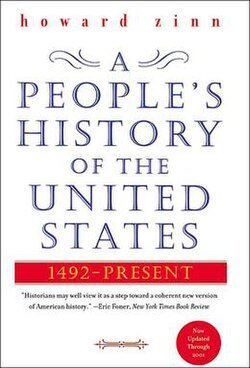
Why Read A People’s History of the United States?
A People’s History of the United States is the most widely read and most politically transformative work of American history ever written for a popular audience — a book that has sold over three million copies since its publication in 1980 and fundamentally altered how millions of Americans think about their country’s past by insisting that the standard narrative of American progress is incomplete without the counter-narrative of conquest, slavery, exploitation, and resistance that runs alongside it. Howard Zinn wrote history as a form of advocacy: not to distort the facts but to insist that which facts you choose to emphasize, and whose perspective you choose to centre, are never politically neutral choices.
The book covers American history from Columbus’s arrival in 1492 through the early 21st century, organized around a simple but radical reorientation of historical perspective: rather than asking “what did the great men do?”, Zinn asks “what happened to everyone else, and what did they do about it?” Each chapter takes a major period or theme of American history — the conquest of indigenous peoples, African slavery, the class conflicts of the industrial era, the labour movement, the suffragette struggle, the civil rights movement, the Vietnam War — and retells it from the perspective of those who were most directly affected by the decisions of those in power.
Zinn’s method is the selective use of primary sources — the testimony of slaves, the letters of soldiers, the manifestos of labour organizers, the speeches of indigenous leaders — to construct a counter-narrative that challenges the triumphalist account of American history taught in most schools. He does not claim to be writing objective history; he explicitly argues that all history involves selection and emphasis, and that the selection and emphasis of conventional American historiography systematically favours the powerful at the expense of the powerless. A People’s History is simultaneously a work of history and a work of argument about what history is for.
Who Should Read This
A book for anyone who wants to understand the full story of American history — including the parts that conventional accounts leave out, minimize, or reframe. Essential for advanced students of American history and political science; professionals in policy, law, journalism, and social work who want historical context for contemporary inequality; CAT/GRE aspirants who need advanced-level argumentative historical prose; and any reader who has wondered whose voices are missing from the American history they learned in school.
Key Takeaways from A People’s History of the United States
The founding of the United States — from the colonial period through the Revolution and the Constitution — involved systematic dispossession and violence against indigenous peoples that is inseparable from the nation’s origins. The founding documents that celebrate liberty and equality were written by men who owned slaves, dispossessed indigenous peoples, and designed political institutions that protected the property of the wealthy. Understanding this contradiction does not invalidate the ideals — but it demands that those ideals be taken seriously as aspirations rather than accomplished facts.
African American slavery was not a peripheral feature of early American economic and political life but its foundational institution — the source of the agricultural surplus that financed early American development, the system whose maintenance shaped the Constitution’s compromises, and the experience whose legacy continues to structure American racial inequality today. The resistance to slavery — from slave rebellions to the Underground Railroad to the eventual Union Army service of two hundred thousand Black soldiers — was constant, organized, and effective.
The history of American economic development is simultaneously a history of class conflict — between workers and employers, between the propertyless and the propertied — that is largely absent from conventional American historical narratives. The eight-hour workday, child labour laws, and collective bargaining rights were won through organized working-class resistance, not granted by benevolent elites. The violent suppression of strikes and unions by government and private force is one of the most systematically omitted chapters in standard American history education.
Ordinary people — not presidents, generals, or founding fathers — have been the primary agents of American social progress. The abolition of slavery, women’s suffrage, the eight-hour workday, civil rights legislation, and the end of the Vietnam War were all achieved primarily through sustained collective action by ordinary people whose names do not appear in most history books. History is made from below as much as from above — and this insight is both Zinn’s most important historiographical claim and his most politically motivating one.
Key Ideas in A People’s History of the United States
The book opens with Columbus — not the heroic discoverer of conventional American mythology, but the man whose journals describe, with his own words, the physical beauty and generous nature of the Arawak people he encountered, followed immediately by his plan to subjugate them. This opening move establishes Zinn’s method and his argument simultaneously: the primary sources tell a different story from the textbook account, and the difference is not accidental. The erasure of indigenous experience from the founding narrative of American history is not a neutral omission but a political choice — one that serves the interests of those who benefited from the conquest.
The chapters on slavery are among the book’s most important and most carefully documented. Zinn draws on the testimony of enslaved people — narratives, letters, and the records of slave traders and plantation owners — to construct an account of slavery that centres the experience of the enslaved rather than the institutions of the enslavers. The resistance to slavery — from daily acts of subversion (working slowly, feigning illness, breaking tools) through the organized rebellions of Nat Turner and Denmark Vesey to the Underground Railroad and the eventual Union Army service of two hundred thousand Black soldiers — is documented in detail that standard accounts of the Civil War typically omit.
The labour history chapters cover the class conflicts of the Gilded Age, the great strikes of the railroad and steel industries, the rise and violent suppression of the Industrial Workers of the World, the New Deal’s partial accommodations to labour demands, and the post-World War II shift in American class politics. Zinn’s argument is that the economic dynamism celebrated in conventional American historiography was achieved through the systematic exploitation of workers whose demands for basic rights were met with government-sanctioned violence as often as with legislative accommodation.
The chapters on 20th-century American foreign policy — the Spanish-American War, the Philippine War, World War I, the Cold War, Vietnam, and the interventions in Latin America — apply the same method to international relations: documenting the gap between the official justifications for American military and political intervention and the economic and strategic interests that Zinn argues were the actual drivers. His account of the Vietnam War draws on the Pentagon Papers, the testimony of veterans, and the documented record of civilian casualties to construct an account that challenges the official narrative of a defensive war against communist aggression.
Core Frameworks in A People’s History of the United States
Zinn builds his counter-history on six interlocking analytical frameworks — from the methodological principle of “history from below” through the founding contradiction, class conflict and labour, the suppression of dissent, foreign policy interests vs. ideals, and the Civil Rights Movement and its limits.
Conventional historical narrative centres the actions and decisions of political and military leaders because these are the people whose decisions most visibly shaped institutional structures. Zinn argues this centring is not neutral: it systematically makes visible the agency of the powerful and invisible the experience of the powerless, and treats the choices of elites as the primary motors of history while treating ordinary people as passive recipients of those choices. “History from below” — telling the story through the testimony of slaves, workers, indigenous peoples, women, and dissenters — insists that those decisions are made in a context shaped by the resistance and demands of ordinary people, and that this context is essential to understanding both why elites make the decisions they do and what the actual human consequences of those decisions are.
The Declaration of Independence’s claim that “all men are created equal” was written by Thomas Jefferson, who owned over two hundred enslaved people and never freed them. The Constitution’s protections for liberty and property were designed in part to protect the property rights of slaveholders and to prevent the majority of Americans (women, non-propertied men, enslaved people, indigenous peoples) from participating in the political system the Constitution established. Zinn’s argument is not that the founding ideals are worthless — he regards them as genuinely powerful aspirations — but that the gap between the ideals and the reality of who they applied to is the central contradiction of American political history, and that understanding this contradiction is essential for evaluating both the achievements and the failures of American democracy.
American economic history is typically told as a story of entrepreneurial dynamism and rising prosperity. Zinn’s counter-narrative documents the organized violence with which employers and governments responded to labour organizing: the Homestead Strike (1892), the Pullman Strike (1894), the Ludlow Massacre (1914), and dozens of less-remembered episodes in which workers were killed, imprisoned, or deported for demanding basic rights. The eight-hour workday, the weekend, child labour laws, workplace safety regulations, and collective bargaining rights — the foundations of 20th-century middle-class prosperity — were won through sustained, often violent struggle against employers who resisted them at every step, not through the natural development of enlightened American capitalism.
American political culture celebrates free speech and political dissent as foundational values — yet the historical record documents systematic suppression of dissent whenever it threatened significant economic or political interests. The Alien and Sedition Acts (1798), the suppression of anti-war speech during World War I (the Espionage Act imprisoned Eugene Debs for a speech opposing the draft), the Red Scares of the 1920s and 1950s, the FBI’s COINTELPRO program targeting civil rights and anti-war organizations in the 1960s and 1970s — all represent episodes in which the stated commitment to free expression yielded to the interests of those in power. Political freedom is not a given condition but an ongoing achievement that requires constant struggle against the tendency of power to protect itself.
Conventional accounts present US military and political intervention abroad as motivated primarily by the defence of democracy and human rights against aggression, tyranny, and communism. Zinn documents the gap between these stated motivations and the consistent pattern of American support for authoritarian governments that protect American economic interests, the willingness to overthrow democratically elected governments whose economic policies threatened American corporations (Iran 1953, Guatemala 1954, Chile 1973), and the systematic understatement of the human costs of American military operations. This is not an argument that American foreign policy has never served democratic values — Zinn acknowledges that defeating Nazi Germany served those values — but that the consistent pattern cannot be explained by democratic ideals alone.
Zinn’s account of the Civil Rights Movement centres the grassroots organizing — SNCC, the sit-ins, the Freedom Rides, the local organizers whose work preceded and sustained the nationally visible leadership of Martin Luther King Jr. — rather than the legislative landmarks. This centering argues that the movement’s achievements were the product of sustained collective action by ordinary people, not the enlightened policy choices of sympathetic politicians. The limits Zinn emphasizes are equally important: formal legal equality — the Civil Rights Act (1964), the Voting Rights Act (1965) — did not eliminate economic inequality, housing segregation, or the structural disadvantages that centuries of slavery and Jim Crow had produced. The movement achieved formal equality; economic justice remained largely unrealized.
Core Arguments
Zinn advances four interlocking arguments that together constitute both a counter-history of the United States and a theory of what history is for — from the political nature of all historical writing through the agency of ordinary people, the human costs of war, and the unfinished character of American democracy.
Zinn’s most fundamental methodological argument — stated in the introduction and demonstrated throughout — is that historical writing is never politically neutral. The choice of which events to include and which to omit, whose perspective to centre and whose to marginalize, which causal explanations to emphasize — all of these are political choices, and the conventional American historical narrative makes these choices in ways that systematically favour the perspective of those in power. Zinn is explicit that his own narrative also makes political choices — in favour of the perspective of the powerless — and he argues that this is not a distortion of history but a corrective to the systematic distortion in the other direction. This intellectual honesty about his own method is the book’s most important methodological contribution.
The book’s most practically important historical argument is that the social and political achievements Americans most value — abolition, women’s suffrage, labour rights, civil rights — were won through sustained collective action by ordinary people who faced organized resistance from elites, not granted by enlightened leaders responding to the natural development of democratic values. This argument has direct political implications: if social progress requires organized popular action rather than elite benevolence, then the appropriate response to contemporary injustice is organized action, not petitions to sympathetic leaders. It is simultaneously a historical claim and a call to political engagement.
Across multiple chapters — on the Civil War, World War I, World War II, Korea, and Vietnam — Zinn argues that the manufacture of popular consent for war has repeatedly served the interests of economic and political elites at the cost of the lives of ordinary working people and the civilian populations of the countries where the wars were fought. This argument is most carefully documented in the Vietnam chapters, where the gap between official justifications and the actual conduct and consequences of the war is most fully exposed by primary source evidence. Zinn’s argument is not pacifist — he acknowledges the necessity of fighting fascism — but that the costs of war consistently fall on those with the least power to avoid them, while the benefits accrue disproportionately to those with the most.
The book’s unifying thesis — implicit in every chapter and stated periodically throughout — is that American history is best understood not as the gradual realization of democratic ideals but as an ongoing struggle between the democratic aspirations articulated in the founding documents and the concentrated economic and political power that has consistently resisted the full realization of those aspirations. This framing both acknowledges the genuine power of American democratic ideals and insists that those ideals have been realized only partially and only through struggle — and that the struggle is unfinished. It is the most important single argument in the book for understanding contemporary American political conflicts.
Critical Analysis
A balanced assessment of a book that has sold over three million copies and genuinely transformed American historical consciousness — its irreplaceable contributions and the limitations that its most serious academic critics have identified and that honest readers should hold alongside its considerable achievements.
Zinn’s extensive use of primary sources — the testimony of enslaved people, the letters of soldiers, the manifestos of labour organizers, the speeches of indigenous leaders, the documents of government suppression — gives the counter-narrative a concrete evidential foundation that ideological assertion alone could not provide. The most powerful passages in the book are those where the primary source speaks directly, and the contrast between official accounts and the testimony of those affected is most visible. This density of primary evidence is what distinguishes Zinn from mere polemicism.
The book has performed genuine historiographical service by bringing to wide attention episodes and movements — the Philippine War, the Ludlow Massacre, the Lowell mill strikes, SNCC’s grassroots organizing — that were absent from mainstream American historical consciousness at the time of publication. This recovery of marginalized history is the book’s most durable contribution: even readers who dispute Zinn’s interpretive framework will find episodes and voices here that expand their historical knowledge.
Zinn’s explicit acknowledgment that he is writing history with a political purpose — that he is making the same kind of selective, value-laden choices that all historians make, but being transparent about it — is both intellectually honest and methodologically important. It invites readers to be critical of his selections rather than accepting them as neutral facts. This transparency about the politics of historical writing is a more sophisticated methodological position than the false objectivity of conventional historiography.
By consistently choosing the most damning evidence of elite misconduct and the most heroic evidence of popular resistance, Zinn’s narrative sometimes produces a counter-distortion that is as incomplete as the account it challenges — elite figures appear almost uniformly venal and self-serving; popular movements appear almost uniformly righteous and effective. The complexity of historical actors, the genuine achievements of American democratic institutions, and the internal conflicts within popular movements are sometimes flattened in the service of the argument. The book is most valuable as a corrective; it is not sufficient as a complete account.
Zinn’s tendency to explain historical events primarily through the lens of class interest and economic power — to treat racial ideology, religious conviction, and national sentiment as epiphenomena of material interest — sometimes produces explanations that are incomplete. Racism, for example, is not reducible to economic interest; it has its own logic and its own history that Zinn’s framework does not fully account for. Historians including Michael Kazin (himself a historian of the American left) have made this criticism, and it deserves attention from any reader engaging seriously with the book.
A People’s History is most valuable as a corrective to the triumphalist narrative of conventional American history — it is essential reading precisely because it recovers what conventional accounts omit. As a complete account of American history, it has the same limitations as any single-perspective account: it is partial, argumentative, and stronger on what it includes than what it excludes. The appropriate response is to read Zinn alongside other accounts, not instead of them — the combination produces a fuller picture than either alone.
Impact & Legacy
Extraordinary and Sustained Popular Impact: A People’s History of the United States was published in 1980 and initially sold modestly before word-of-mouth and adoption as a teaching text — first in universities, then in some secondary schools — produced the sustained sales that have made it one of the bestselling works of American history ever written. It has sold over three million copies, has been continuously in print through multiple revised editions, and has been cited as formative by public figures ranging from Matt Damon (who read from it in Good Will Hunting) and Bruce Springsteen to Bernie Sanders and Noam Chomsky.
Impact on American Historical Consciousness: The book helped establish and popularize a tradition of “history from below” in American public historical consciousness — making the perspectives of indigenous peoples, slaves, workers, women, and dissenters central to the popular understanding of American history rather than marginal to it. The American historical profession today gives far more attention to these perspectives than it did in 1980, partly because of the demand that books like A People’s History created. This is the book’s most lasting institutional achievement.
Serious Academic Critique: The book’s critics — from academic historians who find its methodology selective to conservatives who find its politics objectionable — are numerous and vocal. The academic critique is the more substantive: historians including Sean Wilentz and Michael Kazin have argued that Zinn’s framework is too simple, his use of evidence too selective, and his treatment of the complexity of American political history too schematic. These criticisms are legitimate and should be read alongside the book, not instead of it. Engaging seriously with both the book and its critics is the most productive approach to the historical and methodological questions it raises.
Position Within the Readlite History Series: A People’s History fits within the Readlite history series as the most politically argumentative and methodologically self-conscious text — the one that most directly addresses the question of what history is for. Guns, Germs, and Steel (B69) and The Silk Roads (B70) provide structural and geographic accounts of how civilizational inequality developed; A People’s History provides the ground-level American account of how that inequality has been lived, resisted, and partially overcome. Together with Why Nations Fail (B63), the three books constitute the most complete popular-level account available of the interplay between structural forces and human agency in shaping historical outcomes.
For Exam Preparation: A People’s History is the most politically argumentative text in the Readlite history series and thus among the most demanding for analytical reading comprehension practice. Its combination of historical narrative, political argument, and primary source evidence — and its explicit acknowledgment of its own argumentative purpose — provides direct practice for the critical reading skills (distinguishing evidence from argument, identifying the author’s perspective and its implications, evaluating the scope and limits of an argument) that the most demanding CAT and GRE passages require.
Love This Book? Master Every Book.
Stop struggling with reading comprehension. Our proven system transforms how you read—whether for CAT, GRE, GMAT, SAT, or personal growth.
Best Quotes from A People’s History of the United States
The cry of the poor is not always just, but if you don’t listen to it, you will never know what justice is.
To be neutral, to be passive in a situation is to collaborate with whatever is going on.
Civil disobedience is not our problem. Our problem is civil obedience. Our problem is that people all over the world have obeyed the dictates of leaders…and millions have been killed because of this obedience.
If those in charge of our society — politicians, corporate executives, and owners of press and television — can dominate our ideas, they will be secure in their power.
I am supposing, or perhaps only hoping, that our future may be found in the past’s fugitive moments of compassion rather than in its solid centuries of warfare.

Test Your Understanding
Think you’ve mastered A People’s History of the United States? Challenge yourself with 15 questions on history from below, the founding contradiction, the labour movement, the suppression of dissent, foreign policy interests vs. ideals, and Zinn’s own methodological framework. Score 80%+ to prove your mastery.
A People’s History of the United States FAQ
Is A People’s History reliable? Should I trust its facts?
The book’s facts are generally reliable — Zinn was a trained academic historian who drew on documented primary and secondary sources and whose factual claims have been tested extensively since 1980. What is contested is not the accuracy of individual facts but the selection, emphasis, and framing of those facts. Critics argue that Zinn’s consistent selection of the most damning evidence of elite misconduct and the most heroic evidence of popular resistance produces an account that is systematically partial — accurate in its parts but misleading in its whole. The appropriate response is not to distrust Zinn’s facts but to read them alongside other accounts. A People’s History is essential reading; it is not sufficient reading.
What makes this book “advanced” level reading?
Three features make A People’s History genuinely advanced reading. First, its length — 729 pages covering American history from 1492 to the early 2000s — requires sustained engagement with a complex historical argument across an enormous chronological and thematic range. Second, its argumentative complexity — the book is simultaneously a work of history and a work of argument about what history is for, and tracking these two registers simultaneously requires sophisticated critical reading. Third, its primary source density — Zinn’s extensive quotation of historical documents requires the reader to evaluate evidence rather than simply absorb narrative. For CAT and GRE preparation, the most valuable practice comes from working through Zinn’s argumentative passages and asking: what is the claim, what is the evidence, and what assumptions connect them?
How should I read A People’s History alongside conventional American history?
A People’s History is most valuable as a corrective and supplement, not as a replacement for conventional American historiography. It is best read alongside — not instead of — accounts that give more attention to the institutional history of American democracy, the complexity of the founding generation, the genuine achievements of American economic development, and the internal conflicts within the popular movements Zinn celebrates. The most productive reading approach is to treat A People’s History as systematically answering the question “what does this standard account leave out?” — using it to identify the gaps and omissions in whatever conventional history you have already read.
What is the book’s argument about the American founding?
Zinn’s argument about the American founding is not that the founding ideals are worthless or that the founding generation was uniquely evil — it is that the founding documents articulate ideals of liberty and equality that were immediately contradicted by the specific institutional choices the founders made. The Declaration of Independence asserts that all men are created equal — but the Constitution counted enslaved people as three-fifths of a person for representation purposes, prohibited Congress from ending the slave trade for twenty years, and required the return of escaped slaves. Zinn’s argument is that the gap between the founding ideals and the founding reality is the central contradiction of American political history — and that taking the ideals seriously requires acknowledging and confronting this contradiction.
How does A People’s History fit with Guns, Germs, and Steel and Why Nations Fail on the Readlite list?
The three books address the history of power and inequality from complementary but distinct angles. Guns, Germs, and Steel (B69) explains the deep geographical and biological causes of the global inequality that European conquest established — why some civilizations had the technological and organizational capacity to conquer others. Why Nations Fail (B63) explains why some nations have developed inclusive institutions that distribute prosperity broadly while others maintain extractive institutions that concentrate it among elites. A People’s History complements both by documenting the specific American experience of the contradictions between democratic ideals and the power structures that have resisted their full realization — providing the ground-level historical narrative of how the inequality that Diamond and Acemoglu diagnose at a structural level has been lived, resisted, and partially overcome by ordinary people.








