

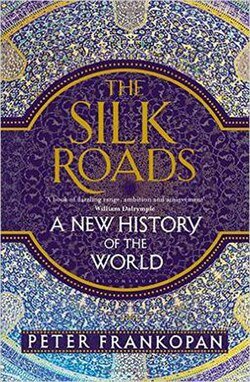
Why Read The Silk Roads?
The Silk Roads is the most important reorientation of world history written in the 21st century — a 636-page revisionist masterwork by Oxford historian Peter Frankopan that relocates the center of human history from the Atlantic world (Europe and its colonies) to the ancient trade routes connecting the Mediterranean with Central Asia, Persia, India, and China. Published in 2015 to enormous critical and commercial success, it became an international bestseller in over thirty countries and is now widely taught as an essential corrective to the Eurocentric bias that dominates conventional world history education — the assumption that the story of civilization is primarily the story of Greece, Rome, and Western Europe.
Frankopan’s central argument is that the ancient Silk Roads — the networks of overland and maritime trade routes connecting the Eastern Mediterranean with Central Asia, the Indian subcontinent, and East Asia — were not a minor curiosity in world history but the central artery of human civilization for most of recorded history. The great empires, religions, philosophies, technologies, and cultural achievements of human history were not primarily the products of European development but of the exchange, competition, and conflict along and around these routes — in Persia, Mesopotamia, Central Asia, India, and China, the regions that Frankopan collectively calls “the heart of the world.”
The book covers the full sweep of world history from ancient Persia to the post-9/11 wars in Afghanistan and Iraq — organized not chronologically around European empires but geographically around the Silk Road regions and the successive waves of peoples, religions, empires, and ideas that moved through them. It is a work of sustained historical revisionism: not the revision of specific facts but the revision of the frame through which world history is understood. By placing Central Asia, Persia, and the trade routes at the center, it makes the familiar strange and the unfamiliar familiar — the Sogdian merchants, the Abbasid Caliphate, the Mongol Empire, and Tamerlane all become central rather than peripheral figures.
Who Should Read This
A book for serious students of world history who want to understand the full sweep of human civilization from a non-Eurocentric perspective — who suspect that the standard European-centered narrative of world history is incomplete and want the most scholarly and most readable alternative available. Essential for advanced students of history, international relations, and political science; professionals in international business, diplomacy, and policy who need to understand the deep historical roots of contemporary geopolitics; CAT/GRE aspirants who need advanced-level historical prose; and anyone who wants to understand why the regions we call the “Middle East” and Central Asia were, for most of human history, the center of the world rather than its periphery.
Key Takeaways from The Silk Roads
The center of world history is not Western Europe but the Eurasian heartland — the arc of territories from the Eastern Mediterranean through Persia and Central Asia to India and China — where the great majority of the world’s population lived, where the major religious and philosophical traditions originated, where the most productive agricultural land was concentrated, and where the most consequential exchanges of goods, ideas, and diseases occurred for most of recorded history. Europe’s rise to global dominance is a recent historical phenomenon — roughly the last five centuries — and understanding it requires understanding the far longer history of the civilizations it displaced.
Trade — the movement of goods, people, ideas, religions, and diseases along the Silk Roads — is the primary driver of civilizational change throughout history. The great empires that controlled the Silk Road nodes were wealthy and powerful not primarily because of military conquest but because of their ability to tax, facilitate, and profit from the trade that flowed through their territories. The rise of Islam, the Mongol conquests, the Crusades, the Black Death, and the Age of Discovery can all be understood as, in significant part, chapters in the history of competition for control of trade routes.
The rise of Islam in the 7th century CE is best understood not primarily as a religious revolution but as an economic and political one. The Arabian Peninsula’s location at the intersection of major trade routes gave the early Islamic state immediate access to enormous wealth; the speed and extent of Islamic expansion is explained not just by religious conviction but by the extraordinary economic opportunity that control of the Silk Road trade routes represented. The Islamic Golden Age — in mathematics, astronomy, philosophy, medicine, and technology — was itself largely a product of the wealth generated by Silk Road trade.
The contemporary competition for control of Central Asia and the Middle East — including the wars in Afghanistan and Iraq that followed 9/11 — is the latest chapter in a history of great-power competition for the resources and trade routes of the Eurasian heartland that stretches back thousands of years. The same territories contested by Rome and Parthia, by the Byzantine and Sassanid Empires, by the Mongols and the Abbasid Caliphate, and by the British and Russian empires in the “Great Game” are being contested today — for the same fundamental reasons of geographic and resource advantage.
Key Ideas in The Silk Roads
The book opens with a geographic argument: the regions that standard Western histories treat as peripheral — Persia, Mesopotamia, Central Asia, the Arabian Peninsula — were, for most of human history, the center of the world. They were the most densely populated regions on Earth, the locations of the most productive agricultural systems, the origin points of the world’s major religious traditions (Judaism, Christianity, Islam, Zoroastrianism, Buddhism all originated in or near these regions), and the nodes through which the most valuable trade goods — silk, spices, gold, slaves — flowed from East to West and West to East. The story of civilization, from this vantage point, is primarily a story of competition for control of these routes and the wealth they generated.
Frankopan’s treatment of the ancient world relocates the center of gravity from Athens and Rome (the standard Western curriculum’s foundation) to Persia and the Fertile Crescent. The Achaemenid Persian Empire — which at its peak controlled a territory stretching from Egypt to northwestern India and which administered a population larger than any previous empire in history — was more culturally sophisticated, more religiously tolerant, and more administratively advanced than contemporary Greece, yet it appears in most Western histories primarily as the antagonist of the Persian Wars. Frankopan restores Persia’s central historical importance and traces how the competition between the Greek and Persian worlds shaped the ancient world more fundamentally than the events at Marathon or Thermopylae.
The treatment of Islam’s rise is among the book’s most revisionist contributions. Standard histories tend to emphasize the religious dimension of the Islamic expansion in the 7th and 8th centuries and to treat the Islamic Golden Age as a period when Arab Muslims preserved Greek learning before passing it back to European scholars. Frankopan argues this account inverts the historical reality: Islam rose partly because of the extraordinary economic opportunity that control of Silk Road trade represented; the Islamic Golden Age was not primarily a preservation project but a period of original intellectual and scientific achievement; and the Islamic world’s connection to China, India, and sub-Saharan Africa made it the center of global learning rather than merely a relay station between ancient Greece and medieval Europe.
The later chapters trace the successive waves of disruption that affected the Silk Road networks — the Mongol conquests (which destroyed the cities of Central Asia and Persia but paradoxically opened the routes more thoroughly than before), the Black Death (which spread along the Silk Roads from Central Asia to Europe, killing one third of the European population), the Age of Discovery (primarily a European attempt to bypass the Ottoman Empire’s control of the land-based Silk Roads), and the colonial era (which subordinated the Silk Road heartland to European political and economic control for the first time in history).
Core Frameworks in The Silk Roads
Frankopan builds his revisionist account on six interlocking analytical frameworks — from the Silk Road as the spine of world history through the trade-religion-power triangle, Eurasian heartland geopolitics, the Black Death as a Silk Road event, the Age of Discovery as bypass operation, and the contemporary New Silk Roads competition.
The Silk Roads were not a single route but a network of overland and maritime connections along which silk, spices, gold, silver, horses, slaves, ideas, religions, and diseases moved between the major civilizational centers of the Eurasian world. The wealth generated by this trade funded the great empires, supported the cities and courts that produced the great intellectual and artistic achievements of antiquity and the medieval period, and created the incentive structures that drove both cooperation and competition between civilizations. By placing the Silk Roads at the center, Frankopan’s framework makes legible patterns of historical causation that are invisible from a Europe-centered perspective: why the Mongol Empire is one of the most important events in world history; why the Black Death originated in Central Asia; why the Age of Discovery is better understood as a Silk Road bypass operation than as a European discovery of the unknown.
The major religious traditions that emerged from or were amplified by the Silk Road regions — Zoroastrianism, Judaism, Christianity, Buddhism, Islam — spread along trade routes because merchants carried their beliefs as they carried their goods, and because rulers of trade-route nodes found religious patronage and conversion politically advantageous (it established relationships of trust with trading partners who shared the same faith). The Islamic expansion of the 7th and 8th centuries is the clearest example: the Arabic world’s conversion to Islam was accompanied by political unification of the Arabian Peninsula, which in turn enabled the military expansion that brought the major Silk Road nodes under Islamic control. The wealth generated by controlling these routes funded the Islamic Golden Age — the explosion of intellectual and scientific achievement that produced algebra, optics, astronomy, medicine, and philosophy that far outstripped anything produced in contemporary Europe.
The Eurasian heartland — roughly the territory of modern Central Asia, Iran, Afghanistan, and the Caucasus — sits at the intersection of the major trade and communication routes connecting Europe with Asia. Whoever controls this territory has historically been positioned to tax and regulate the most valuable trade flows in the world, to project military power in multiple directions, and to access the agricultural and mineral resources of the world’s largest continental landmass. The succession of empires that have competed for this territory — Persian, Greek, Roman, Parthian, Sassanid, Arab, Mongol, Timurid, Ottoman, Safavid, British, Russian, American — is itself the evidence for the thesis. The book’s final chapters explicitly connect this historical pattern to the contemporary competition for Central Asian oil and gas resources and the post-9/11 wars.
The bubonic plague that became the Black Death originated in the rodent populations of Central Asia — the same region through which the Silk Road trade routes passed. It was carried westward along the trade routes, reaching the Black Sea ports in the 1340s and from there spreading by ship to the Mediterranean and northward through Europe. The Black Death is therefore both a consequence of the Silk Road connections that linked Eurasian civilizations (without those connections, the plague would have remained a regional Central Asian phenomenon) and a transformative event in the history of those civilizations. Frankopan’s treatment of the Black Death as a Silk Road event reframes it from a European catastrophe to a global historical turning point — and connects it directly to the trade networks that made medieval Eurasian civilization possible.
The standard narrative presents European oceanic exploration as heroic discovery driven by intellectual curiosity and the desire to spread Christianity. Frankopan’s reframing: it was primarily a commercial response to the Ottoman Empire’s control of the land-based Silk Road routes, which allowed the Ottomans to tax the trade goods (spices, silk, porcelain) that European merchants needed from Asia. By finding direct maritime routes to Asia — around Africa (Vasco da Gama, 1498) or westward (Columbus, 1492) — European traders hoped to bypass the Ottoman toll system and capture the profit margins that Ottoman taxation was extracting. The Age of Discovery was not the expansion of European civilization into an empty world but the rerouting of existing trade flows around a political obstacle.
The book’s final chapters trace how 20th and 21st century competition for Central Asian oil and gas resources recapitulates the ancient pattern of great-power competition for control of the Eurasian heartland. The British and Russian empires’ “Great Game” in Central Asia in the 19th century; American support for Afghan mujahideen against the Soviet Union in the 1980s; the post-9/11 wars in Afghanistan and Iraq — all are presented as episodes in a continuous history of competition for the resources and strategic position of the Eurasian heartland. Understanding contemporary geopolitics requires the thousand-year perspective this book provides. China’s Belt and Road Initiative, Frankopan argues in his 2018 follow-up, is best understood as an attempt to restore the centrality of the Eurasian land routes that connected China with the Mediterranean world for most of the past two thousand years.
Core Arguments
Frankopan advances four interlocking arguments that together constitute a complete revisionist account of world history — from the exceptionalism of Europe’s rise through the political economy of religion, the centrality of the Mongol Empire, and the need for long historical perspective in contemporary geopolitics.
The book’s foundational revisionist argument is that European global dominance — the political, economic, and cultural supremacy of European and European-derived civilizations that has characterized the past five centuries — was not the natural culmination of a superior civilization but a historical exception: a specific outcome produced by specific historical contingencies (the Ottoman Empire’s control of the Silk Roads, the development of ocean-going ships, the biological advantage in epidemic disease we encounter in Diamond) that enabled European civilizations to bypass, exploit, and eventually colonize the civilizations that had been at the center of the world for the previous fifteen centuries. Understanding European dominance as an exception rather than a culmination changes how we evaluate both the past (the civilizations that European historians have treated as peripheral were actually central) and the future (the current rise of China, India, and the Middle East is a restoration of historical norms rather than a disruption of them).
One of the book’s most consistent and most provocative arguments is that the major religious traditions — particularly Islam and Christianity — are best understood historically as political and economic forces rather than primarily as spiritual ones. The spread of Islam along the Silk Roads was driven as much by the commercial and political advantages it offered to merchants and rulers as by the spiritual power of its message. The Crusades were driven as much by the desire to control the trade routes and resources of the Holy Land as by religious devotion. The Christian missions of the colonial era were intertwined with commercial and political expansion in ways that cannot be separated. Frankopan does not deny the spiritual significance of religious traditions, but his historical analysis consistently shows that religious developments are inseparable from the commercial and political contexts in which they occur.
Frankopan’s treatment of the Mongol Empire — which he presents as one of the most consequential events in world history rather than a barbaric interruption of civilizational progress — is one of the book’s most important revisionist contributions. The Mongol conquests of the 13th century destroyed the great cities of Central Asia and Persia (Samarkand, Merv, Nishapur, Baghdad) and killed tens of millions of people. But the Pax Mongolica — the period of relative stability across the Mongol domains — also opened the Silk Roads more thoroughly than they had been for centuries, enabling the extraordinary cross-cultural exchange documented in Marco Polo’s travels and the simultaneous spread of the bubonic plague westward from Central Asia. The Mongol Empire’s legacy — simultaneously catastrophic and cosmopolitan — is essential for understanding both the Black Death and the cultural exchanges that preceded the European Renaissance.
The book’s concluding argument — that the contemporary competition for Central Asian oil and gas resources and the post-9/11 wars are episodes in a continuous history of great-power competition for the Eurasian heartland — is both historically illuminating and practically important. Without the thousand-year perspective Frankopan provides, the wars in Afghanistan and Iraq appear as responses to specific contemporary threats. With that perspective, they appear as the latest iteration of a pattern of great-power competition for the strategic position and resources of the Silk Road heartland — a pattern that has organized world history from the Achaemenid Persians to the present. The conflicts of the early 21st century are not unprecedented; they are the latest chapter in a story stretching back three thousand years.
Critical Analysis
A balanced assessment of a book that permanently changes how its readers understand world history — its genuine intellectual achievements and the limitations that honest readers should hold in mind alongside the sweep and ambition of its revisionist argument.
The simple act of placing Central Asia, Persia, and the trade routes at the center of the narrative — rather than Western Europe — is enormously illuminating. Events, peoples, and processes that appear peripheral in a Europe-centered history become central; events that appear central become derivative. This perspectival shift alone is worth the book’s 636 pages, and Frankopan executes it with the scholarly command of someone who has spent decades mastering the history he is recounting. For any reader whose education was shaped by a Western-centric curriculum, the reorientation is both disorientating and revelatory.
The book covers thirty-five chapters of world history from ancient Persia to 2015, drawing on primary and secondary sources in a remarkable range of languages and traditions. The scholarship is thorough, the narrative is compelling, and the synthesis of archaeological, documentary, and art-historical evidence is genuinely impressive for a work addressed to a general audience. Frankopan’s academic credentials — a professional Oxford historian with a specialist background in Byzantine history and the Crusades — give the synthesis a scholarly authority that most popular history lacks.
The book’s explicit connection between deep history and contemporary geopolitics — showing that the regions currently in geopolitical conflict (Afghanistan, Iraq, Iran, Central Asia) have been at the center of world history for millennia — is both intellectually valuable and practically important for anyone trying to understand the contemporary world. The framework it provides for understanding China’s Belt and Road Initiative, Russian geopolitics, and Middle Eastern conflicts is more illuminating than most contemporary political analysis.
At 636 pages covering three thousand years of history, The Silk Roads is a substantial commitment, and the density of historical detail varies significantly across chapters. The earlier chapters (on ancient Persia, the Hellenistic world, and early Islamic civilization) are among the most revisionist and most illuminating; some later chapters (on the colonial era and the 20th century) cover more familiar ground with less transformative effect. Readers who find the momentum faltering in the middle sections can usefully skip to the chapters that most interest them without losing the book’s central argument.
The argument that almost everything in world history can be explained through the lens of Silk Road trade and competition for the Eurasian heartland occasionally overstretches. Some events that Frankopan incorporates into the Silk Road narrative have more complex or more local explanations that his frame does not fully accommodate. The book’s revisionist energy sometimes produces analyses that replace one form of determinism (Eurocentric cultural determinism) with another (geopolitical and commercial determinism).
The book’s coverage of the 19th and 20th centuries — the British Empire, the two World Wars, the Cold War — is well-informed but less distinctively revisionist than the earlier material. Readers already familiar with British imperial history and Cold War geopolitics covered in the later chapters will find these sections less intellectually transformative than the ancient and medieval material that constitutes the book’s most original contribution.
Impact & Legacy
Extraordinary Commercial and Critical Success: The Silk Roads was published in the United Kingdom in 2015 and became an immediate bestseller — spending over two years on the UK bestseller list, reaching the top ten in countries as diverse as Germany, Italy, Japan, China, and Brazil, and eventually selling over three million copies worldwide. It was translated into over thirty languages and was named a book of the year by numerous publications in multiple countries. For a work of academic-level world history, this commercial success was extraordinary — a reflection of the timeliness of its revisionist message in a world increasingly aware of the inadequacy of Eurocentric historical education.
Impact on Popular Historical Understanding: The book has been widely adopted in undergraduate world history and international relations courses as a corrective to Eurocentric survey histories; it has influenced a generation of readers in Europe and North America to think of the history of Asia, the Middle East, and Central Asia as integral to world history rather than peripheral to it; and it has directly influenced the framing of debates about contemporary geopolitics, particularly around China’s Belt and Road Initiative, which Frankopan addressed in The New Silk Roads (2018).
Frankopan’s Distinctive Position: Frankopan’s positioning within the academic and public intellectual worlds is distinctive — he is a professional Oxford historian with a full scholarly publication record (his previous book was a specialist study of the First Crusade that won the Runciman Award) who has chosen to write for a mass audience. The combination of scholarly rigour and popular accessibility that The Silk Roads achieves is rare and has set a standard for revisionist popular history writing. His follow-up, The Earth Transformed (2023), applies the same geographic and ecological lens to the relationship between climate and human history across six thousand years.
Position Within the Readlite History Series: The Silk Roads fits within the Readlite history series as the most comprehensive non-Eurocentric alternative to standard world history education. Guns, Germs, and Steel (B69) explains the deep biological and geographic roots of civilizational inequality. Sapiens (Harari) provides the broadest narrative of the full human story. The Silk Roads provides the specific historical mechanism — trade routes, commercial exchange, geopolitical competition for the Eurasian heartland — through which civilization developed and spread. Read together, the three books constitute the most complete popular-level account of why the world is organized as it is and how it got that way.
For Exam Preparation: The Silk Roads is among the most demanding reading comprehension texts on the Readlite list — 636 pages of advanced-level narrative history weaving together political, economic, religious, and cultural analysis across three thousand years and multiple civilizational traditions. The sustained analytical argument running through all this material — that trade routes and geopolitical competition for the Eurasian heartland are the primary drivers of world history — provides direct practice for the advanced reading comprehension skill of tracking a thesis across a long and complex text, which the most challenging CAT and GRE passages require.
Love This Book? Master Every Book.
Stop struggling with reading comprehension. Our proven system transforms how you read—whether for CAT, GRE, GMAT, SAT, or personal growth.
Best Quotes from The Silk Roads
The roots of the modern world, then, lie in the east, and not in the west. The civilisations that shaped the world were not in Athens or Rome, but in Persia, in Mesopotamia, in Central Asia.
The story of the Silk Roads is the story of the world. It is a history of trade, but also of religion, war, disease, exploration and empire.
For millennia, it was the east that defined the world economy — not Europe. It is there that we need to look to understand the past, and perhaps also the future.
Exchange and trade, more than conquest, drove the spread of culture, religion, and technology across the ancient world.
Wealth flowed not from the countries that possessed it, but through the countries that sat astride the routes that connected producers with consumers.
Test Your Understanding
Think you’ve mastered The Silk Roads? Challenge yourself with 15 questions on the Eurasian heartland thesis, the trade-religion-power triangle, the Age of Discovery as Silk Road bypass, the Black Death as a Silk Road event, and the Mongol Empire’s paradoxical legacy. Score 80%+ to prove your mastery.
The Silk Roads FAQ
What exactly are the “Silk Roads” and how important were they historically?
The Silk Roads were not a single road but a network of overland and maritime trade routes connecting the Mediterranean with Central Asia, the Indian subcontinent, and East Asia — routes along which silk, spices, gold, silver, horses, glass, cotton, paper, porcelain, and a vast array of other commodities moved between the major civilizational centers of the Eurasian world. They were historically important not just as conduits for goods but as channels through which religions (Buddhism, Christianity, Islam, Manichaeism, Zoroastrianism all spread along them), ideas (mathematical and scientific knowledge, philosophical traditions, artistic techniques), and diseases (the Black Death most catastrophically) moved between civilizations. For most of the period between roughly 500 BCE and 1500 CE, the Silk Road nodes — Persia, Mesopotamia, Central Asia, northern India — were the wealthiest, most populous, and most culturally sophisticated regions in the world.
Why does Frankopan call his approach a “new history of the world”?
The novelty is perspectival rather than factual — Frankopan is not discovering new historical events but reframing the significance of known ones by changing the vantage point from which they are viewed. Standard world history education treats Greece and Rome as the foundations of civilization, medieval Europe as the crucible of modernity, and the Age of Discovery as the beginning of the global world. The Silk Roads argues that this perspective is distorted by the historical accident of European global dominance in the past five centuries — and that seen from the vantage point of the Silk Road heartland, the history of civilization looks dramatically different. The ancient Persians appear more important than the ancient Greeks; the Islamic Golden Age appears more important than the European Dark Ages; the Mongol Empire appears more consequential than the Renaissance. This perspectival shift is the book’s central intellectual contribution.
How does The Silk Roads relate to Guns, Germs, and Steel and Sapiens?
All three books address the same fundamental question — how did the world we inhabit come to be the way it is? — but from different analytical frameworks and at different levels of explanation. Guns, Germs, and Steel (Diamond, B69) explains the deep biological and geographic roots of civilizational inequality — why the distribution of domesticable species and continental axis orientation gave Eurasian civilizations a head start. Sapiens (Harari) explains the cognitive and cultural developments that made Homo sapiens uniquely capable of civilizational complexity. The Silk Roads focuses on the specific historical mechanisms through which civilization developed and spread — trade routes, commercial exchange, geopolitical competition — and argues that these mechanisms were centered in the Eurasian heartland rather than Western Europe. The three books are best read together: Diamond provides the biological foundation; Harari provides the cognitive and cultural framework; Frankopan provides the specific historical trajectory.
What is the significance of Islam’s rise as Frankopan presents it?
Frankopan’s treatment of Islam’s rise in the 7th century is one of the book’s most revisionist contributions. Rather than explaining the extraordinary speed and extent of Islamic expansion primarily through religious conviction — the traditional framing — he argues that Islam’s rise is inseparable from the economic and political opportunities created by the Silk Road trade routes. The Arabian Peninsula sat at the intersection of major trade routes connecting the Mediterranean, East Africa, India, and Central Asia, and the political unification of Arabia under the early Islamic state gave it immediate access to the wealth flowing through these routes. The subsequent Islamic conquests brought the most productive agricultural land and the most important Silk Road nodes under Islamic political control — generating the wealth that funded the extraordinary intellectual and scientific achievements of the Islamic Golden Age. Frankopan is not reducing Islam to economics but insisting that its historical significance cannot be understood without the economic and geopolitical context that made its expansion possible.
Does The Silk Roads explain China’s current rise and the Belt and Road Initiative?
Not directly — The Silk Roads covers history up to 2015, and Frankopan’s more direct engagement with the contemporary Belt and Road Initiative is in his follow-up book, The New Silk Roads (2018). But the historical framework he develops is essential for understanding what China is attempting: it is, in Frankopan’s reading, an attempt to restore the centrality of the Eurasian land routes that connected China with the Mediterranean world for most of the past two thousand years — routes that were marginalized by the Age of Discovery and European oceanic commerce but that China now has the economic and political capacity to reactivate. The Belt and Road Initiative looks different — and more historically grounded — when understood against the backdrop of the two-thousand-year Silk Road history that Frankopan provides.








