

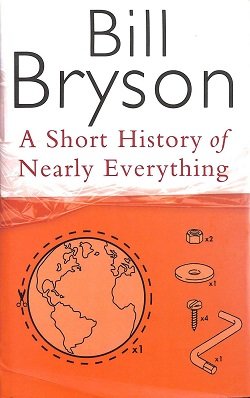
Why Read A Short History of Nearly Everything?
A Short History of Nearly Everything is the most enjoyable popular science book ever written — a sweeping, witty, profoundly humbling account of how scientists figured out how the universe works, from the Big Bang to the emergence of complex life, told through the human stories of the scientists who did the figuring out. Published in 2003, it won the Royal Society Aventis Prize for Science Books and the support of virtually every science reader who encountered it — not because it is the most technically rigorous science book available but because it is the most successful at communicating the astonishment that the scientific understanding of the universe genuinely warrants.
Bill Bryson — best known as a travel writer — wrote this book because he realized, while reading a popular science book on a plane, that he had no idea how any of the things he knew about the universe had actually been discovered. Nobody had told him that the history of science is simultaneously a history of extraordinary human ingenuity, bitter personal rivalry, frequent catastrophic error, magnificent luck, and a handful of moments of genuine revelation that transformed humanity’s understanding of its place in the cosmos.
The book is organized roughly chronologically and topically — from cosmology (the Big Bang, the size and age of the universe) through geology (continental drift, deep time) to chemistry (atoms, elements) to biology (cells, evolution, genetics) to palaeontology and human origins. Each chapter weaves together the scientific content with the human story of its discovery — the rivalries, the failures to recognize genius, the extraordinary accidents, and the often-overlooked contributions of people who were ahead of their time. Bryson’s gift is making the science and its discoverers simultaneously vivid, funny, and genuinely important.
Who Should Read This
A book for anyone who has ever wanted to understand how the universe works but found standard science textbooks too dry, too abstract, or too intimidating — which is most people. It is the ideal starting point for science literacy, the perfect companion for anyone taking science courses who wants the human context that textbooks strip away, and one of the most pleasurable reading experiences available in non-fiction. Essential for science beginners and students who want the history and human drama behind the discoveries; general readers who want comprehensive science literacy in a single readable volume; CAT/GRE aspirants building intermediate-level science history reading comprehension; and anyone who wants to understand how we know what we know about the universe we live in.
Key Takeaways from A Short History of Nearly Everything
The universe is incomprehensibly large, incomprehensibly old, and has been understood by a small number of human beings working with limited tools over a remarkably short period. The fact that we know the age of the universe to within 1%, the size of an atom, the structure of DNA, and the mechanism of continental drift — all from evidence available on and near a single small planet — is one of the most astonishing facts in the history of human intelligence. The purpose of the book is to communicate this astonishment, and it succeeds.
The history of science is not a smooth accumulation of knowledge by cooperative geniuses — it is a messy, competitive, often tragic human story full of simultaneous discovery, priority disputes, unrecognized genius, premature death, and the systematic exclusion of women, minorities, and outsiders from scientific recognition. Understanding this human context does not diminish the achievements of science; it makes them more remarkable by showing how unlikely and hard-won they actually were.
The Earth is profoundly, almost incomprehensibly old — 4.5 billion years — and the complexity of life it harbours is the product of an evolutionary process operating over timescales that dwarf recorded human history. The geological evidence for deep time, the fossil record of evolution, and the genetic evidence for common ancestry are among the most thoroughly verified findings in the history of science — yet they remain poorly understood and frequently misrepresented in popular culture.
Atoms are both the foundation of all matter and almost entirely empty space — and the fact that solid objects feel solid is a product of electromagnetic forces rather than the presence of actual matter in most of the volume of most objects. The counterintuitive nature of atomic physics — that a person sitting in a chair is not resting on solid material but on electromagnetic repulsion between electron clouds — is one of the most instructive demonstrations of the gap between human perceptual experience and scientific reality.
Key Ideas in A Short History of Nearly Everything
The book opens with a thought experiment about scale — if you condensed the entire history of the Earth into a twenty-four-hour clock, modern humans would appear only in the last few seconds before midnight, and recorded human history in the last millisecond. This scale perspective is Bryson’s primary tool for communicating scientific reality: the size of the universe, the age of the Earth, the smallness of atoms, the rarity of conditions that support life — all require the reader to abandon human-scale intuitions that make the world feel familiar.
The chapters on cosmology establish the foundational context: the Big Bang (approximately 13.8 billion years ago), the expansion of the universe, the scale of distances between objects in space, and the remarkable fact that virtually everything we can observe originated from a hot, dense singularity smaller than a proton. Bryson makes this accessible through the human story of how cosmologists arrived at these conclusions — from Hubble’s observation of galactic redshift to Penzias and Wilson’s accidental discovery of the cosmic microwave background radiation, which provided the strongest direct evidence for the Big Bang.
The geology chapters are among the book’s most narratively rich. The story of how scientists established the age of the Earth — from the first geological observations that the Earth was far older than biblical chronology allowed, through the Victorian debate between geologists and physicists (Lord Kelvin’s erroneous calculation of a much younger Earth), to the eventual triumph of radiometric dating — is a master class in how scientific consensus forms across disciplines over decades. The story of Alfred Wegener’s continental drift hypothesis — proposed in 1912 and dismissed by the geological establishment for fifty years before being vindicated by the plate tectonics revolution of the 1960s — is the book’s most powerful case study in the sociology of scientific resistance to correct but disruptive ideas.
The biology and evolution chapters bring the narrative down to the scale of cells, genes, and the mechanisms of inheritance. Bryson’s account of the discovery of DNA’s structure — the intertwining of Watson and Crick’s competition with Rosalind Franklin’s crucial X-ray crystallography data, and the systematic underattribution of Franklin’s contribution — is one of the book’s most important social history passages, documenting the exclusion of a key figure from recognition in one of the 20th century’s most significant discoveries.
Core Frameworks in A Short History of Nearly Everything
Bryson structures his account around six foundational scientific domains — each one a self-contained framework for understanding a layer of reality, from the cosmological scale through the geological, atomic, biological, biochemical, and human dimensions of the universe.
The Earth is approximately 4.5 billion years old — a figure established through radiometric dating of meteorites and ancient rock formations, converged upon by multiple independent techniques (uranium-lead, potassium-argon, rubidium-strontium dating). Deep time — the recognition that the Earth’s history spans periods dwarfing any human comprehension — was one of the most intellectually transformative discoveries of the 19th century and is the prerequisite for understanding evolution, plate tectonics, and the Earth’s biological complexity. Bryson communicates this through the narrative of how geologists accumulated evidence for an old Earth against the resistance of religious orthodoxy and, more surprisingly, of physicists: Lord Kelvin’s estimate of a young Earth, based on the incorrect assumption that the Sun’s energy came from gravitational contraction rather than nuclear fusion, was a serious scientific challenge to the geological evidence for decades.
Alfred Wegener proposed in 1912 that the continents were once joined and had drifted apart — based on the fit of continental coastlines, the matching of geological formations across the Atlantic, and the distribution of fossils. The geological establishment rejected his hypothesis for fifty years, partly because Wegener could not propose a mechanism for continental movement and partly because he was an outsider (a meteorologist proposing a geological theory). The eventual vindication of Wegener’s hypothesis by the plate tectonics revolution of the 1960s — driven by evidence from ocean floor mapping, paleomagnetism, and seismology — is one of the clearest historical demonstrations of how correct scientific ideas can be suppressed by professional consensus and eventually vindicated by the accumulation of incontrovertible evidence.
Atoms are extraordinarily small (a million atoms placed side by side would span the width of a human hair) and almost entirely empty — if the nucleus of a hydrogen atom were the size of a tennis ball placed at the centre of a major stadium, the electron would orbit at a distance equivalent to the stadium’s outer walls, with nothing but empty space in between. The solidity of everyday objects is not the solidity of matter — it is the electromagnetic repulsion between electron clouds, which prevents atoms from occupying the same space. This counterintuitive reality — that everything you touch or sit on is almost entirely empty space — is both scientifically accurate and genuinely astonishing, and one of the most effective illustrations in the book of how radically scientific reality differs from perceptual experience.
Life on Earth is approximately 3.8 billion years old, and the complexity of contemporary organisms is the product of an unbroken chain of evolutionary modification operating over this entire period. Natural selection — the mechanism by which heritable variations that improve reproductive success become more common in populations over generations — is both simple as a principle and extraordinarily powerful as a generator of complexity. Bryson traces the history of evolutionary thinking from Lamarck through Darwin to the modern synthesis, and the accumulated evidence (fossil record, comparative anatomy, molecular genetics) that together constitute one of the most thoroughly verified theories in the history of science. The account of Rosalind Franklin’s contribution to the discovery of DNA’s structure is the book’s most important social history contribution — documenting the systematic exclusion of a key figure from recognition in one of the 20th century’s most consequential discoveries.
The human body contains approximately 37 trillion cells — each one a marvel of biochemical complexity, performing thousands of coordinated chemical reactions per second. It also harbours approximately the same number of microbial cells — bacteria, archaea, and fungi — that constitute the microbiome: an ecosystem without which normal immune function, digestion, and metabolic regulation would be impossible. Bryson’s account communicates both the extraordinary complexity of the human body and its relative fragility — the conditions required to sustain human life are remarkably narrow, and the history of life on Earth is substantially a history of species that did not survive changes in those conditions. Five mass extinction events have wiped out the majority of species living at the time; the background rate of extinction is a constant pressure on all living lineages.
Bryson consistently weaves the human stories behind scientific discoveries into the scientific content — the bitter priority dispute between Newton and Leibniz over calculus; the simultaneous discovery of natural selection by Darwin and Wallace; the unacknowledged contribution of Rosalind Franklin to the DNA structure discovery; the decades-long rejection of Wegener’s continental drift; the accidental discovery of the cosmic microwave background by Penzias and Wilson (who initially thought the signal was pigeon droppings in their antenna). These human stories illuminate how science actually works: not as the smooth accumulation of knowledge by disinterested rational agents but as a deeply human activity shaped by ambition, rivalry, accident, and social context — a reality that enriches rather than diminishes the achievement of science.
Core Arguments
Bryson advances four arguments that together constitute the book’s purpose — arguments present on every page but never stated baldly, communicated instead through the accumulated weight of the scientific and human stories the book tells.
The book’s motivating argument — never stated baldly but present on every page — is that the scientific understanding of the universe is the most extraordinary achievement in the history of human intelligence, and that most people are not aware of this because the human stories behind the discoveries have been stripped away and replaced by dry recitation of results. Bryson’s project is to restore the astonishment — to make the reader feel, viscerally, the improbability and magnificence of what scientists have accomplished — by telling the human stories alongside the scientific content. The book is an argument for science not through abstract praise but through detailed demonstration of what science has actually achieved.
A recurrent theme — made explicit in the chapters on evolution, extinction, and the conditions required for complex life — is that human existence is the product of an extraordinary sequence of contingencies: the right distance from the Sun, the right planetary size to retain an atmosphere, the right axial tilt for stable seasons, the right moon for tidal stability, the right asteroid strike to end the Cretaceous, the right evolutionary path through a thousand extinction events that wiped out most lineages. Human existence is not the inevitable product of natural law but an improbable outcome of a historical process that could have gone differently at a thousand points. This perspective is both humbling and — Bryson suggests — a reason for something like gratitude, or at least for taking seriously the improbability of our continued existence.
The book consistently documents how scientific institutions have failed to recognise contributions from women, outsiders, and those without institutional affiliation. Rosalind Franklin’s contribution to the DNA structure is the most famous example, but Bryson documents many others: the exclusion of women from professional scientific societies throughout the 19th and early 20th centuries; the dismissal of amateur scientists whose observations predated those of professionals; the priority disputes in which institutional power determined attribution more than actual precedence. This social critique is integrated into the scientific narrative rather than imposed on it — and it is one of the most important ways the book enriches the standard account of scientific progress.
The book’s concluding chapters make a case — implicit in the whole geological and biological narrative — for the extraordinary fragility of the conditions that support life on Earth. Five mass extinction events have wiped out the majority of species living at the time; the current rate of species extinction is comparable to a mass extinction event; the conditions that support human civilization are being eroded by human activity. Bryson does not lecture — the book’s tone is consistently celebratory rather than admonitory — but the weight of geological and biological evidence he has presented makes the fragility argument inescapable by the time the reader reaches the final chapters.
Critical Analysis
A balanced assessment of the book that defined popular science writing for a generation — its genuine achievements and the limitations that honest readers should hold in mind alongside its extraordinary accessibility and scope.
Bryson’s tone — combining genuine intellectual enthusiasm with self-deprecating wit, warm admiration for the scientists he describes, and honest acknowledgment of what he does not understand — is the book’s greatest asset. It communicates scientific content without condescension, makes complexity accessible without oversimplification, and generates the reader’s enthusiasm by demonstrating Bryson’s own. This is an extraordinarily difficult tone to sustain across 544 pages, and Bryson does it.
The consistent integration of human narrative into scientific content is both the book’s most distinctive feature and its most educationally valuable — it shows how science actually works, how discoveries are made and contested and eventually accepted, and how the human qualities of scientists shape the process of knowledge accumulation. Readers remember the Wegener story, the Franklin story, the Penzias and Wilson story — and through those stories, the science.
The book genuinely covers nearly everything — from particle physics to palaeontology, from cosmology to human evolution — and does so without becoming superficial. Each domain receives enough treatment to convey genuine understanding rather than mere acquaintance with vocabulary. This breadth makes it uniquely valuable as a single-volume introduction to scientific literacy that no more specialized book can replicate.
Published in 2003, the book reflects the state of scientific knowledge at that time. Claims about the microbiome (dramatically advanced since 2003), certain aspects of genetics, and some cosmological figures have been superseded by subsequent research. The broad scientific framework remains accurate, but readers wanting the most current state of specific fields will need to supplement with more recent reading.
The book covers so much ground that some areas receive relatively shallow treatment — particle physics, quantum mechanics, and the mathematics of cosmology are necessarily simplified in ways that sacrifice some accuracy. Readers wanting genuine depth in any specific area will find the book an excellent starting point but will need specialized follow-up reading to achieve real understanding.
The book’s attention to the social history of science — particularly the exclusion of women and outsiders — is valuable but selective. Bryson focuses on the most famous cases without providing a systematic account of the social structures that produced and maintained these exclusions, leaving the social critique somewhat impressionistic rather than structural.
Impact & Legacy
Immediate Recognition as a Landmark: A Short History of Nearly Everything was published in May 2003 and was immediately recognized as a landmark popular science book — winning the Royal Society Aventis Prize, the Descartes Prize, and the Aventis Junior Prize in the same year. It sold over two million copies in its first two years, has been continuously in print since, and has been translated into over forty languages. It is consistently recommended by science teachers, science communicators, and science readers as the single best introduction to scientific literacy for readers with no scientific background.
Impact on Science Communication: By demonstrating that the history and human drama of scientific discovery are as compelling as any narrative genre, and that accessibility and intellectual substance are not in conflict, it raised the standard for popular science writing and helped create the expectation — now widespread — that science books for general audiences should tell human stories alongside scientific content. Many of the most successful popular science books of the past twenty years follow the template Bryson established.
Impact on Science Education: The book has been widely used as supplementary reading in secondary and undergraduate courses — providing the historical and human context that standard textbooks strip away. The approach of teaching science through its history, rather than as a body of established facts, is both more engaging for students and more epistemically honest — it shows how knowledge is actually produced rather than presenting it as if it descended from authority. This pedagogical contribution may be the book’s most lasting legacy.
Position Within the Readlite History Series: A Short History of Nearly Everything is the most comprehensive and most accessible science history book in the Readlite series — the ideal starting point for scientific literacy before engaging with more specialized titles. Sapiens (Harari) covers the human dimension of the same story, and Homo Deus (B67) projects that story forward. The Selfish Gene (Dawkins) provides greater depth on the evolutionary and genetic mechanisms Bryson introduces. The recommended reading sequence for the science history strand is A Short History of Nearly Everything first (for the broad scientific foundation), then Sapiens (for the human story that emerges from that foundation), then specialized titles in specific domains of interest.
For Exam Preparation: A Short History of Nearly Everything is excellent intermediate-level reading comprehension practice in science history nonfiction. Its consistent movement between scientific content and historical narrative, its use of analogy and scale comparison to make abstract concepts vivid, and its multi-disciplinary scope (physics, geology, biology, chemistry, palaeontology) all provide direct practice for the science passage reading comprehension skills that CAT and GRE examinations consistently test.
Love This Book? Master Every Book.
Stop struggling with reading comprehension. Our proven system transforms how you read—whether for CAT, GRE, GMAT, SAT, or personal growth.
Best Quotes from A Short History of Nearly Everything
Not one of your pertinent ancestors was squashed, devoured, drowned, starved, stranded, stuck fast, untimely wounded, or otherwise deflected from its life’s quest of delivering a tiny charge of genetic material to the right partner at the right moment in order to perpetuate the only possible sequence of hereditary combinations that could result — eventually, astoundingly, and all too briefly — in you.
We are each so atomically numerous and so vigorously recycled at death that a significant number of our atoms — up to a billion for each of us, it has been suggested — probably once belonged to Shakespeare.
The world is far more imaginative than we are. The universe is not required to be in perfect harmony with human ambition.
It is a slightly arresting notion that if you were to pick yourself apart with tweezers, one atom at a time, you would produce a mound of fine atomic dust, none of which had ever been alive but all of which had once been you.
Consider the fact that for 3.8 billion years, a period of time older than the Earth’s mountains and rivers and oceans, every one of your forebears on both sides has been attractive enough to find a mate, healthy enough to reproduce, and sufficiently blessed by fate and circumstances to live long enough to do so.
Test Your Understanding
Think you’ve mastered A Short History of Nearly Everything? Challenge yourself with 15 questions on deep time, continental drift, atomic physics, evolution, the Rosalind Franklin story, and the sociology of scientific discovery. Score 80%+ to prove your mastery.
A Short History of Nearly Everything FAQ
Do I need a science background to read this book?
No — the book is explicitly written for readers with no science background, and is widely considered the best available introduction to scientific literacy for general readers. Bryson himself describes his starting point as a person who knew very little about science and wanted to understand how scientists had figured out the universe, and the book is written from this position of friendly incomprehension that gradually achieves genuine understanding. Technical terminology is introduced gently and explained clearly; mathematical concepts are communicated through analogy and scale comparison rather than equations; and the human stories behind the discoveries make the science accessible through narrative rather than through formal explanation.
What is the best way to approach such a long book covering so many subjects?
The book rewards sequential reading — it is organized with an implicit logic that moves from the very large (cosmology) through the very small (atoms) to the very old (geology) to the very complex (biology) to the very recent (human evolution) — and the cumulative effect of following this sequence is greater than any individual chapter can provide. That said, each chapter is largely self-contained. The chapters on continental drift (the Wegener story), the discovery of DNA (the Franklin story), and the scale of atomic physics are the most frequently cited as the most memorable — good starting points for readers who want to sample before committing to the full book.
How does A Short History of Nearly Everything compare to Cosmos by Carl Sagan?
Both books are landmark popular science works that communicate scientific content through narrative and human story, but they differ significantly in scope, tone, and emphasis. Cosmos (1980) is more focused on physics and cosmology — Sagan’s particular domains of expertise — and is more explicitly philosophical and reverential in its treatment of the universe. A Short History of Nearly Everything is broader in scope (covering geology, biology, chemistry, and palaeontology that Cosmos does not address) and more consistently focused on the human stories of scientific discovery. Cosmos is more visionary; A Short History is funnier and more humanly specific. Both are essential popular science reading and complement each other well.
What are the five most important things the book explains?
The five most intellectually important topics the book covers are: (1) Deep time — the age of the Earth and the scale of geological history; (2) The mechanism of evolution by natural selection and the evidence that supports it; (3) Continental drift and plate tectonics — how the surface of the Earth has changed over geological time; (4) The atomic structure of matter — and why the solid world is almost entirely empty space; (5) The sociology of scientific discovery — how science actually works as a human activity, including its failures of attribution and recognition. These five topics constitute the foundational scientific literacy the book is most effective at communicating, and they are the topics most frequently tested in science reading comprehension passages in competitive examinations.
How does A Short History of Nearly Everything fit with other science and history books on the Readlite list?
A Short History of Nearly Everything is the most comprehensive and most accessible science history book in the Readlite series — the ideal starting point for scientific literacy before engaging with more specialized titles. Sapiens (Harari) covers the human dimension of the same story — how Homo sapiens emerged from the biological history Bryson describes and built the civilizations that define us. Homo Deus (B67) projects that story forward. The recommended reading sequence for the science history strand is A Short History of Nearly Everything first (for the broad scientific foundation), then Sapiens (for the human story that emerges from that foundation), then specialized titles in specific domains of interest.








