

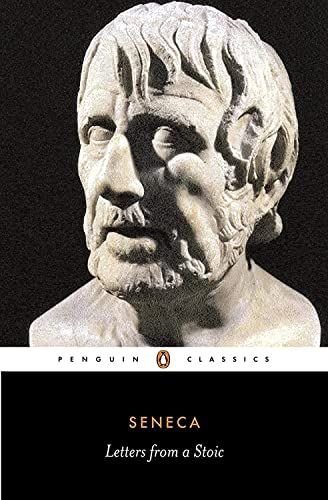
Why Read Letters from a Stoic?
Letters from a Stoic — known in Latin as Epistulae Morales ad Lucilium — is one of the great works of ancient prose, and the most conversational, witty, and immediately engaging of all Stoic texts. Written by Seneca in the final years of his life as a series of letters to his friend Lucilius, the collection covers everything from the proper use of time to the fear of death, from the emptiness of wealth to the nature of true friendship. Unlike the compressed aphorisms of Marcus Aurelius or the technical rigor of Epictetus, Seneca writes the way a brilliant friend talks — discursively, with humor and self-awareness, always returning from the philosophical to the urgently personal.
Seneca wrote these 124 letters between 62 and 65 CE, when he had withdrawn from Nero’s court and was living in partial retirement. Each letter begins with a small observation — a crowd at the baths, a visit to a country house, the noise of a gymnasium next door — before expanding into sustained philosophical reflection. Seneca writes as a man who knows he is mortal and is actively, urgently trying to use the time remaining well.
What makes Letters from a Stoic distinctive is Seneca himself — a figure of extraordinary contradiction. He was the wealthiest man in Rome, an advisor to one of history’s worst emperors, and a philosopher who preached the irrelevance of material wealth. He was fully aware of this contradiction, and his letters are more honest about it than his critics give him credit for: he writes not as a man who has achieved wisdom but as one who is working toward it and failing as often as succeeding. This honesty gives the letters a human texture that the more composed Marcus Aurelius sometimes lacks.
Who Should Read This
This is a book for anyone who finds philosophy most useful when it arrives with literary pleasure. Seneca is the most stylistically accomplished of the three great Roman Stoics, and his letters can be read for the quality of the prose alone. Essential for students of classical literature and philosophy, CAT/GRE aspirants who need practice with essay-form argumentative prose, leaders and high-performers looking for a more discursive companion to Marcus Aurelius, and anyone who wants ancient wisdom on the perennial questions of time, wealth, and mortality.
Key Takeaways from Letters from a Stoic
Time is the only truly finite resource, and most people give it away with far less thought than they give to money. Seneca opens with an argument that still lands with full force: we let time be stolen from us and given to purposes unworthy of its value. “Omnia, Lucili, aliena sunt, tempus tantum nostrum est” — everything is foreign to us, Lucilius; time alone is ours.
Wealth, comfort, and status are dangerous precisely because they are pleasant, and pleasure tends to become dependency. Seneca’s argument is subtle: the person who cannot live without their wealth is a slave to it. Genuine freedom requires the ability to hold external goods lightly — using them without being used by them.
True friendship is one of philosophy’s most important practical concerns. Seneca distinguishes sharply between friendships of utility or pleasure and the friendship of virtue — in which two people are genuinely invested in each other’s moral improvement. A friend is someone you can trust completely, with whom no topic needs to be hidden.
Read deeply rather than widely — a single great author read with attention is worth more than a hundred authors skimmed. The constant accumulation of inputs without time for digestion produces restlessness rather than wisdom. “Distringit librorum multitudo” — a multitude of books is a distraction.
Key Ideas in Letters from a Stoic
Letters from a Stoic is organized as correspondence, not as a treatise, which means its ideas emerge through dialogue, example, and sustained reflection rather than through systematic argument. Seneca’s method is consistently the same: begin with something concrete and particular — a crowd, a journey, a physical sensation — and use it as a launch point for philosophical reflection that circles back, by the end of each letter, to a practical conclusion or a memorable maxim.
The collection’s central preoccupation is time — specifically, the recognition that most people do not use it as the irreplaceable resource it is. Letter I, the most famous in the collection, makes this argument with full rhetorical force: people carefully guard their money and property while allowing their time to be squandered without complaint. Seneca’s prescription is characteristically Stoic — not a time-management system but a philosophical reorientation toward what actually deserves attention.
Death occupies the collection almost as much as time, and the two topics are inseparable for Seneca. His argument is that the person who has learned to think clearly about death is liberated from the anxiety that distorts most human decision-making. To practice dying — what Seneca calls meditatio mortis — is not morbid but practically freeing: it removes the leverage that fortune holds over a person and allows genuine choice.
A third major concern is the relationship between philosophy and ordinary life. Seneca is consistently critical of philosophy practiced for display. Philosophy, for Seneca, is medicina animi — medicine for the soul — and its value is entirely practical. A philosophy that does not make you live better is worthless regardless of its logical sophistication.
Key Figures in Letters from a Stoic
Seneca’s letters are populated by philosophers, statesmen, and exemplars — ancient figures whose lives and ideas he deploys to sharpen his arguments.
The recipient of all 124 letters and a senior Roman administrator — procurator of Sicily — who was himself philosophically inclined and had been a student of Epicureanism. His background as an Epicurean allows Seneca to engage regularly with Epicurean ideas, which makes the text more philosophically generous than a purely Stoic manifesto would be.
The founder of Epicureanism — Stoicism’s philosophical rival — whom Seneca quotes more than any other philosopher, often approvingly. Where the schools agree (on the importance of friendship, the dangers of wealth, the need to prepare for death), Seneca acknowledges the agreement without sectarian embarrassment. This intellectual generosity is one of the most appealing qualities of the text.
The founder of Stoicism (c. 334–262 BCE), whose foundational claim — that virtue is the only true good and that everything external is indifferent — is the bedrock on which Seneca’s arguments about wealth, death, and reputation are built. Seneca operates entirely within this tradition while extending and humanizing it.
The Roman Emperor under whom Seneca served as tutor and chief advisor before withdrawing from court around 62 CE. Nero’s presence haunts the letters without being named. The gap between Seneca’s philosophical ideals and his proximity to one of history’s most notorious tyrants is the central biographical tension of the text.
The Roman statesman (95–46 BCE) who chose suicide over surrender after Caesar’s victory — the Stoic exemplar of principled death above compromise. Seneca invokes Cato repeatedly as the supreme Roman model of Stoic virtue, a man whose death was a philosophical act. His example is particularly resonant given that Seneca himself eventually faced exactly this choice.
The wealthy Roman patron of the arts whose later life of luxury and anxiety Seneca uses as a negative exemplar — a man of extraordinary gifts who was destroyed by his addiction to comfort and his terror of death. Seneca quotes his desperate, undignified late writings as evidence that wealth, unchecked by philosophy, produces not happiness but an intensified fear of losing what one has accumulated.
Core Arguments
Seneca’s letters develop four interlocking arguments that together constitute a practical philosophy of how to live well under constraint.
Seneca’s opening argument — developed across the first several letters and returned to throughout — is that time is the only genuinely scarce resource and that most people mismanage it catastrophically. The specific failure he identifies is not idleness but misdirection: time given to the wrong people, the wrong purposes, and the wrong pleasures. His prescription is to begin immediately — not when conditions are better, not after current obligations are discharged — because the person who waits for the right moment to begin living well will never begin.
One of Seneca’s most practically challenging arguments is his recommendation of voluntary discomfort — periodic episodes of simple living, reduced food, cold water, rough clothing — not as permanent asceticism but as a philosophical exercise. The person who has voluntarily experienced poverty is no longer afraid of it. This removes fortune’s leverage and produces genuine independence of mind that no accumulation of security can provide.
Seneca is consistently and sharply critical of philosophy practiced for intellectual performance rather than personal transformation. Philosophy is not a subject but a practice — “philosophia non in verbis sed in rebus est” — and its test is not the quality of the arguments produced but the quality of the life lived. This argument against performative intellectualism is the collection’s most direct and most enduring.
Seneca argues across multiple letters that the fear of death is the root cause of most human unfreedom — it underlies the desperate pursuit of wealth, the craving for status, the tolerance of humiliation, and the inability to live according to one’s values. His prescription — meditation on death, active contemplation of mortality — is not a counsel of despair but a liberation technique. The person who has genuinely made peace with death is free in a way that external circumstances cannot compromise.
Critical Analysis
A balanced assessment examining both the literary and philosophical achievement of Seneca’s letters and the genuine complications that accompany them.
Seneca is the finest prose stylist of the Roman Stoics — his Latin is celebrated as the most elegant of the Silver Age, and in good English translation the wit, rhythm, and rhetorical precision survive remarkably well, making the letters a pleasure to read quite apart from their philosophical content.
Seneca’s willingness to quote and agree with Epicurus, to acknowledge the limits of Stoic doctrine, and to engage with objections rather than dismiss them makes the letters philosophically richer and more honest than a strictly sectarian text would be.
The gap between Seneca’s teachings and his life is not a flaw in the text but a source of its honesty. Seneca writes as someone struggling toward ideals he has not achieved, and this struggle is more instructive than a text written from the position of achieved wisdom.
The Penguin Classics edition — by far the most widely read — contains only 40 of the 124 surviving letters, selected by the translator. Readers should be aware that this is a curated introduction, not the complete work, and that the selection shapes the reading experience significantly.
Seneca can be rhetorically insistent in ways that shade into lecturing — his prose style is oratorical and occasionally repetitive, and readers who prefer the compressed urgency of Marcus Aurelius may find the longer letters self-indulgent.
Seneca’s enormous wealth, his complicity in Nero’s court, and the gap between his teachings and his conduct were noted by ancient critics and remain legitimate biographical concerns. While the text’s philosophical value does not depend on its author’s personal virtue, the contradiction can be distracting and limits the moral authority with which some arguments land.
Literary & Cultural Impact
Two Millennia of Continuous Influence: Letters from a Stoic has been continuously read and cited since antiquity — Seneca was among the most widely quoted authors in the medieval period, and his letters were central texts in Renaissance humanism, read and annotated by Petrarch, Erasmus, and Montaigne. Montaigne, whose Essays are arguably the greatest work of philosophical personal writing in Western literature, explicitly modeled his project on Seneca and quoted him more than any other ancient author. The influence runs through the entire tradition of the personal essay from Montaigne to the present day.
In the Contemporary Stoic Revival: Seneca plays a role complementary to Marcus Aurelius — where Marcus offers compressed daily discipline, Seneca offers discursive philosophical companionship. Ryan Holiday’s popularization of Stoicism draws extensively on both, and Seneca’s letters are consistently recommended as the most enjoyable entry point into ancient philosophy for readers who find Marcus too terse and Epictetus too technical. The letters have been used in leadership development, therapy contexts, and prison philosophy programs — anywhere that the question of how to live well under constraint is urgent and practical.
For Competitive Exam Preparation: Letters from a Stoic is superb practice for argumentative essay-form reading comprehension. Each letter has a clear discursive structure — opening observation, developing argument, illustrative example, concluding maxim — that maps directly onto the structure of CAT and GRE RC passages. The rhetorical techniques Seneca uses (anaphora, antithesis, the well-placed aphorism) are precisely the techniques that appear in the most demanding exam passages, making familiarity with Seneca’s style directly transferable to exam performance.
Love This Book? Master Every Book.
Stop struggling with reading comprehension. Our proven system transforms how you read—whether for CAT, GRE, GMAT, SAT, or personal growth.
Best Quotes from Letters from a Stoic
Omnia, Lucili, aliena sunt, tempus tantum nostrum est. (Everything is foreign to us, Lucilius; time alone is ours.)
Nusquam est qui ubique est. (One who is everywhere is nowhere.)
Dum differtur vita transcurrit. (While we delay, life passes.)
Recede in te ipse quantum potes. (Withdraw into yourself as much as you can.)
Philosophy calls for simple living, not for doing penance, and the simple life need not be a crude one.
Test Your Understanding
Think you’ve mastered Letters from a Stoic? Challenge yourself with 15 questions on Seneca’s key arguments, Stoic ideas, and major themes. Score 80%+ to prove your mastery.
Letters from a Stoic FAQ
What is Letters from a Stoic about?
Letters from a Stoic is a collection of philosophical letters written by the Roman Stoic philosopher Seneca to his friend Lucilius in the final years of his life. The letters cover the full range of Stoic concerns — the proper use of time, the fear of death, the corrupting effects of wealth, the nature of true friendship, the relationship between philosophy and daily life — in the form of discursive, personal, and often witty reflections that begin with a concrete observation and expand into sustained philosophical argument.
How does Letters from a Stoic differ from Marcus Aurelius’s Meditations?
Meditations is a private journal — compressed, repetitive, written for no audience — while Letters from a Stoic is addressed correspondence, written with a reader in mind and therefore more rhetorically crafted, more discursive, and more willing to develop and sustain an argument across multiple pages. Seneca is also more self-aware about his own contradictions, more intellectually generous toward other philosophical schools, and — many readers find — more immediately enjoyable as prose. If Meditations is a daily exercise, Letters from a Stoic is a philosophical conversation.
Is Seneca a hypocrite? Does it matter?
This is the most frequently raised objection to Seneca, and he raised it against himself. He was Rome’s wealthiest man, he served a tyrant, and he preached simplicity from a position of extraordinary privilege. What can be said in his defence is that he did not claim to have achieved the wisdom he described — his letters consistently position him as a fellow traveller toward virtue rather than an arrived sage — and that the practical and philosophical value of his arguments does not logically depend on his personal virtue. Whether you find the hypocrisy disqualifying or humanizing is a matter of temperament.
Which edition or translation should I read?
The Robin Campbell translation (Penguin Classics, 1969) is the most widely recommended for general readers — it captures Seneca’s wit and rhetorical energy in idiomatic English without sacrificing accuracy. Margaret Graver and A.A. Long have produced a complete scholarly translation (University of Chicago, 2015) that is the academic standard and excellent for serious study. The Penguin edition contains 40 selected letters; the Graver/Long edition contains all 124. For a first reading, the Penguin selection is ideal.
Why should I read Seneca alongside Marcus Aurelius?
The two authors are the most practically useful Roman Stoics and complement each other precisely because they are so different. Marcus gives you discipline and urgency in compressed form; Seneca gives you argument, nuance, and literary pleasure. Marcus shows you what Stoic practice looks like in private; Seneca shows you what it looks like as sustained philosophical conversation. Together they cover the full range of what Stoicism offers, and reading both provides a more complete picture of the tradition than either alone can offer.








