

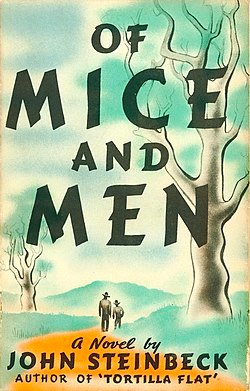
Why Read Of Mice and Men?
Of Mice and Men is one of the most economical tragedies in American literature — 112 pages that leave a bruise far larger than their length should allow. John Steinbeck wrote it as an experiment in what he called the “play-novelette”: a form tight enough to be staged without adaptation, lean enough to carry no fat, and precise enough that every sentence does the work of three. The result is a book that most readers finish in a single sitting and think about for years.
Set in the Salinas Valley of California during the Great Depression, the novella follows two itinerant ranch workers — George Milton, small and sharp, and Lennie Small, enormous and mentally disabled — who travel together at a time when men travelled alone. They share a dream: to save enough money to buy a small farm of their own, where Lennie can tend rabbits and they will answer to no one. What is original is that George and Lennie actually believe in theirs, and that belief is simultaneously the most human thing about them and the thing that makes their story unbearable.
The title comes from Robert Burns: “The best-laid schemes o’ mice an’ men / Gang aft agley” — the best plans of mice and men often go wrong. Steinbeck takes Burns’s irony and loads it with the full weight of a class system, a disability, a society’s casual cruelty, and the specific vulnerability of those who dare to hope when hope is the one luxury they cannot afford. It is a tragedy in the classical sense: the outcome is inevitable, and we watch it arrive knowing we cannot stop it.
Who Should Read This
This is one of the most accessible entry points into serious American literature — the prose is direct, the story moves fast, and the emotional impact is immediate. CAT and GRE candidates will find it exceptionally useful for tone, character motivation, and thematic inference questions, as Steinbeck’s symbolic layering is dense beneath a surface that appears simple. Beyond exam prep, it speaks directly to anyone who has ever held a dream that the world treated as naive, or watched someone they love destroyed by forces neither of them could control.
Key Takeaways from Of Mice and Men
Dreams are not luxuries — they are necessities, and denying people access to them is its own form of violence. The farm George and Lennie dream of is economically modest almost to the point of absurdity, yet it is permanently out of reach for men in their position. Steinbeck’s argument is that the Depression did not merely destroy livelihoods — it systematically destroyed the imagination of a better life, which is a different and deeper wound.
Companionship in a world designed for solitude is both a gift and a vulnerability. Every other ranch hand travels alone. What looks like weakness to the world around them is the only thing that gives their lives coherence. The novel argues that human connection is not a sentiment; it is a survival strategy.
The systems that fail the vulnerable are not designed with malice — they are simply not designed with the vulnerable in mind at all. Lennie is destroyed by a social architecture that has no mechanism for protecting someone of his nature — no language for his needs, no institution capable of his care. The tragedy is structural, not personal.
The most devastating acts of love can look identical to the most devastating acts of violence. George’s final decision is not cruelty — it is the only form of protection still available to him. Steinbeck frames it with a mercy that makes it more, not less, devastating than a simple act of violence would be.
Of Mice and Men Plot Summary
George and Lennie are on the move again. They have left their last job after Lennie, who cannot help touching soft things and does not know his own strength, grabbed a woman’s dress and refused to let go. She screamed. They ran. Now they are walking through the hills toward a ranch near Soledad, California, where they have work lined up. George is small, quick, and carries the practical intelligence for both of them. Lennie is enormous, gentle, and mentally disabled in a way the novel never labels but renders with precision. George tells the dream aloud each night like a ritual: the farm, the land, the rabbits Lennie will tend. They both know it by heart. Lennie makes George tell it anyway.
At the ranch, they fall in with a cast of marginalised men: Candy, the ageing swamper who has lost his hand to a machine and knows he will be turned out when he can no longer work; Crooks, the Black stable hand who lives alone in the harness room, separated from the other workers by the ranch’s casual segregation; Slim, the skilled mule driver whose authority is entirely natural and unresented; and Curley, the boss’s son, a small aggressive man who picks fights with large men to compensate for his stature. Curley’s wife — never named — is young, bored, lonely, and caged by a marriage she entered for the wrong reasons, her Hollywood dreams dissolved into this dusty ranch.
The dream briefly becomes possible. Candy, facing his own obsolescence, offers his life savings to be included in the farm plan. For one evening, the farm feels real — a specific property with a specific price, within actual reach. Then Lennie, alone in the barn with Curley’s wife, strokes her hair — she has offered it, not understanding his compulsion — and when she cries out in fright he holds tighter, as he always holds tighter when something tries to escape, and he breaks her neck. He does not understand what he has done. He goes to the riverbank, the place George told him to go if he ever got into trouble, and waits.
George knows before anyone tells him. He takes Carlson’s Luger. He finds Lennie at the river and tells the dream one last time — the farm, the rabbits, the land where they will belong to themselves. He tells Lennie to look across the river. He shoots him in the back of the head. Slim understands. The other men do not. The novel ends with Curley walking away satisfied, and Slim and George moving off together, George having just performed the most loving and most terrible act the novel can imagine.
Of Mice and Men Characters
Steinbeck’s small cast is assembled with precision — each figure a distinct form of social exclusion, each illuminating the others’ situations.
The novel’s moral centre — a small, quick-witted man who has tethered his life to someone who makes his life harder in almost every practical sense. He complains about Lennie constantly and would not abandon him for anything. His final act is the novel’s most precise expression of what it means to love someone when the world offers no good options.
One of literature’s most carefully rendered figures of innocence — someone who perceives the world through sensation and affection rather than social consequence. Incapable of malice and incapable of understanding the damage his incapacity causes. Steinbeck never uses his disability for cheap pathos; Lennie’s tragedy is not that he is different but that the world has no place for his difference.
Steinbeck’s portrait of expendability — an ageing worker who knows his usefulness is almost finished and that the ranch will discard him when he stops producing. His eagerness to join the dream is a desperate attempt to secure a future in a world that does not plan to provide him one. His dog’s death foreshadows his own anticipated fate with bleak precision.
The novel’s most explicit portrait of social exclusion — a Black man living in enforced solitude, forbidden from the bunkhouse by the casual racism of the ranch. His brief, guarded openness to Lennie — the one man incapable of understanding why Crooks should be kept apart — is the novel’s most quietly devastating scene.
Never named — Steinbeck’s deliberate statement about her status in this world. She married Curley believing she was destined for something larger and found herself instead on a dusty ranch, bored and despised. She is not a villain; she is the novel’s fourth marginalised figure, whose loneliness intersects fatally with Lennie’s, with consequences neither intended.
The novel’s figure of natural authority — a man so skilled and self-possessed that his judgment is accepted by everyone without question. His quiet understanding of George’s act at the novel’s end — “You hadda, George. I swear you hadda” — functions as the closest thing to absolution the novel allows. His witness matters because he is the only one capable of truly seeing.
Major Themes
Steinbeck builds his thematic argument through the precise intersection of four marginalised lives in a single community.
The farm George and Lennie dream of is not extravagant — it is a few acres, a garden, some animals, and the right to belong to themselves. In the wealthiest nation on earth, during a Depression created by failures of capital and governance, this modest dream is entirely unreachable for men of their class and circumstance. Steinbeck’s argument is not that the American Dream is corrupt but that it is available only to those who need it least.
The ranch hands’ astonishment at George and Lennie’s friendship reveals how thoroughly isolated itinerant labour has made them. Loneliness is not incidental in this world — it is the design. Men who travel alone are easier to manage, easier to dismiss, less likely to organise or resist. George and Lennie’s refusal of that isolation is, in this context, a quiet act of resistance.
Steinbeck does not romanticise Lennie’s disability or use it for easy sympathy. He renders it precisely: its specific cognitive patterns, its social consequences, its devastating interaction with a world that has no institutional response except violence or abandonment. The novel asks what a society owes to those it cannot accommodate — and answers with the silence of having no answer. That silence is the tragedy’s foundation.
The novel’s four most sympathetic figures are a mentally disabled man, an ageing discarded worker, a Black man in enforced isolation, and a young woman with no name. Every one of them is marginalised by a system that runs perfectly well without their welfare in mind. Steinbeck arrays these figures not for pity but for argument: that the measure of a social order is what it does with those it cannot use.
Critical Analysis
A balanced assessment of the novella’s formal mastery and its honestly acknowledged complexities.
The novella’s brevity is not a limitation but a formal achievement. Every character, scene, and object carries symbolic weight — Candy’s dog, Curley’s glove, the dead mouse in Lennie’s pocket — and Steinbeck wastes nothing. The form mirrors the content: a world that allows its inhabitants no excess.
The novel builds its tragedy with such careful structural logic that the ending feels both shocking and entirely inevitable — the mark of classical tragedy at its most controlled. Steinbeck plants every element of the conclusion in the first twenty pages, which means re-reading reveals a precision that first reading cannot fully register.
By placing four distinct forms of social exclusion — disability, age, race, gender — in a single small community, Steinbeck creates an argument about systemic injustice that is more complex than any single-axis reading could produce. The characters illuminate each other’s situations without the novel having to state its thesis directly.
Despite Steinbeck’s sympathy for her situation, Curley’s wife remains somewhat schematically rendered — she functions more clearly as a symbol of trapped female aspiration than as a fully psychologically inhabited individual. Her namelessness, while deliberate and pointed, also enacts the very erasure it is meant to critique.
Some critics argue that the novel’s tragic machinery is so perfectly constructed that it forecloses any sense of agency for its characters. The inevitability that makes it dramatically powerful can read as a kind of structural fatalism — a world so rigged that resistance is not merely futile but literally unimaginable.
While Steinbeck’s rendering of Lennie is careful and unsentimental, the use of cognitive disability as the engine of a tragedy has been critiqued by disability scholars as perpetuating a narrative pattern that reduces disability to its consequences for others rather than examining it on its own terms.
Literary & Cultural Impact
Immediate Success and Stage Adaptation: Of Mice and Men was published in February 1937 and became an immediate bestseller, selected by the Book of the Month Club and adapted for the Broadway stage within the year — a production that won the New York Drama Critics’ Circle Award for Best Play. Steinbeck himself adapted the stage version, confirming his original intention that the novella function simultaneously as theatre. It contributed significantly to his Nobel Prize in Literature, awarded in 1962.
Most Taught, Most Banned: The novel became one of the most taught texts in American schools and one of the most frequently banned — challenged and removed from curricula across the country for its language and thematic content. The banning is itself a form of testimony: books that make institutions uncomfortable are usually the ones that most accurately describe them.
Literary Legacy: The novella established a template for the American tragedy of marginalised men — a lineage that runs through Arthur Miller’s Death of a Salesman, Ken Kesey’s One Flew Over the Cuckoo’s Nest, and Cormac McCarthy’s work. The image of George and Lennie by the river — the dream told one final time, the act of terrible mercy — has entered the American imagination as an emblem of what happens to those who hope too specifically in a world that cannot afford to keep its promises.
Love This Book? Master Every Book.
Stop struggling with reading comprehension. Our proven system transforms how you read—whether for CAT, GRE, GMAT, SAT, or personal growth.
Best Quotes from Of Mice and Men
Guys like us, that work on ranches, are the loneliest guys in the world. They got no family. They don’t belong no place.
I got you to look after me, and you got me to look after you, and that’s why.
A guy needs somebody — to be near him. A guy goes nuts if he ain’t got nobody.
Maybe ever’body in the whole damn world is scared of each other.
We gonna get a little place. We’ll have a cow. And we’ll have maybe a pig an’ chickens… an’ down the flat we’ll have a little piece of alfalfa —
Test Your Understanding
Think you’ve mastered Of Mice and Men? Challenge yourself with 15 questions on themes, characters, and key takeaways. Score 80%+ to prove your mastery.
Of Mice and Men FAQ
What is Of Mice and Men about?
It follows George Milton and Lennie Small, two itinerant ranch workers in Depression-era California, who share a dream of owning their own land. The novella traces their arrival at a new ranch, their relationships with the other workers there, and the tragedy that unfolds when Lennie’s inability to understand his own strength results in the death of the boss’s daughter-in-law.
Is it useful for competitive exam preparation like CAT or GRE?
Very much so. The novella is short enough to read quickly and dense enough to reward close analysis — exactly the combination that makes it ideal for RC preparation. Steinbeck’s symbolic layering, his use of foreshadowing, and his construction of dramatic inevitability are all techniques that appear in high-level comprehension and inference questions.
What are the main themes?
The central themes are the inaccessibility of the American Dream for the dispossessed, friendship and companionship as structural anomalies in an isolating economic system, disability and the social failure to accommodate difference, and the intersection of multiple forms of marginalisation — age, race, gender, disability — in a single community.
Why does George kill Lennie at the end?
George kills Lennie to spare him a far more violent death at the hands of the mob — Curley has promised to shoot Lennie in the stomach, “slow.” George’s act is one of mercy and protection: the only form of care still available to him. By killing Lennie himself, and by telling the dream as he does it, George ensures that Lennie dies at peace, in the presence of the one person who loves him, moving toward the world they always imagined.
Why does Of Mice and Men still matter today?
The systemic conditions Steinbeck describes — precarious labour, the unavailability of the Dream to those who need it most, the social invisibility of the disabled and the aged, the structural loneliness of economic atomisation — have not been resolved. If anything, the gig economy, the erosion of social safety nets, and the persistence of racial and class exclusion have made the novel’s argument more, not less, applicable. It remains one of the most honest accounts of what America does to those it cannot use.








