
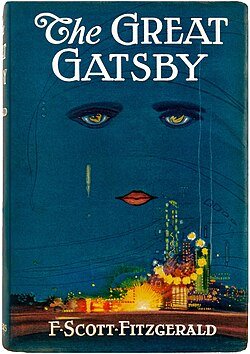
Why Read The Great Gatsby?
The Great Gatsby is the definitive autopsy of the American Dream — and it was written by a man who loved the Dream even as he saw through it. F. Scott Fitzgerald understood glamour and corruption as two faces of the same coin, and he rendered both with a prose style so precise and luminous that the novel reads simultaneously as a celebration and a eulogy. It is one of the most technically perfect novels in the English language.
Set on Long Island and New York City in the summer of 1922, the novel is narrated by Nick Carraway, a Yale-educated bond salesman from the Midwest who rents a modest house next door to the extravagant mansion of Jay Gatsby — a man of mysterious origins and almost mythological social reach. Gatsby has rebuilt himself from nothing into wealth and spectacle, driven by a single obsession: to recapture the love of Daisy Buchanan, the beautiful, careless woman he lost five years earlier. What unfolds is a story about reinvention, desire, class, and the violence of romanticised illusion.
The novel’s genius lies in Fitzgerald’s structural restraint. Gatsby is never fully explained — he is always seen obliquely, through rumour, performance, and other people’s projections. This ambiguity is the point: Gatsby is not a person but a symbol, and like all symbols he cannot survive contact with reality. The green light at the end of Daisy’s dock, the eyes of Doctor T. J. Eckleburg, the Valley of Ashes — Fitzgerald’s imagery is so perfectly loaded that a century of readers has found in it the full weight of American aspiration and its inevitable reckoning.
Who Should Read This
This novel is indispensable for anyone serious about literary reading and competitive exam preparation. CAT and GRE candidates will encounter its themes and prose structures repeatedly in reading comprehension passages — Fitzgerald’s irony, symbolism, and narrative unreliability are precisely the tools that RC questions test. Beyond exams, it rewards students of American history, cultural critics, writers, and anyone who has ever wanted something so badly they built an entire identity around it.
Key Takeaways from The Great Gatsby
The American Dream is not a promise — it is a mythology that demands believers. Gatsby does not simply want wealth; he wants the social legitimacy that old money confers and that new money, however spectacular, can never quite purchase. The Dream collapses not because Gatsby fails to achieve it, but because achieving it was never the point — the longing was.
Romantic obsession confuses the person with the idea of the person. Gatsby does not love Daisy — he loves the symbol he has made of her, the embodiment of everything he was denied. His incredulous “Can’t repeat the past? Why of course you can!” is the most heartbreaking line in the novel precisely because Gatsby believes it completely.
The past is not merely unchangeable — it is actively dangerous when treated as a destination. The novel’s closing lines articulate Fitzgerald’s central argument: nostalgia is not sentiment, it is a trap, and Gatsby’s tragedy is that he never understood the difference between memory and possibility.
Wealth does not dissolve class — it simply creates new fault lines. Tom Buchanan’s contempt for Gatsby exposes the invisible architecture of “old money” versus “new money”, a distinction that has nothing to do with ethics and everything to do with inherited social power. Daisy, ultimately, chooses the safety of that architecture over everything else.
The Great Gatsby Plot Summary
Nick Carraway arrives in West Egg, Long Island, in the spring of 1922 to try his hand in the bond business. He rents a small house next door to the opulent mansion of Jay Gatsby, who throws legendary parties every weekend for hundreds of guests, most of whom he does not know and who do not know him. Across the bay in the more fashionable East Egg live Tom and Daisy Buchanan — Nick’s cousin and her brutally self-assured husband, a former Yale football star with old money, a wandering eye, and a casual cruelty that only the very secure can afford.
The novel’s engine ignites when Gatsby, through carefully engineered coincidences, arranges to meet Daisy again through Nick. It emerges that Gatsby and Daisy had a love affair five years earlier, before Gatsby left for the war and Daisy — unable or unwilling to wait — married Tom. Gatsby has since constructed his entire identity — his mansion, his parties, his mysterious wealth, his invented biography — as infrastructure for a single ambition: to recapture Daisy and the life he believes she represents. The reunion, staged in Nick’s modest garden on a rainy afternoon, is at once tender and faintly absurd.
The affair resumes, and for a brief summer the green light at the end of Daisy’s dock seems to mean something achievable. But the dream begins to corrupt under the pressure of reality. Tom, who is himself conducting a flagrant affair with Myrtle Wilson in the grey industrial district Fitzgerald calls the Valley of Ashes, senses Gatsby and Daisy’s intimacy and begins to investigate Gatsby’s origins. A confrontation in a New York hotel room strips away Gatsby’s reinvented persona, and Daisy — faced with choosing between the known safety of Tom and the romantic danger of Gatsby — begins to waver.
The novel’s final sequence is swift and brutal. Driving Gatsby’s car back from New York, Daisy strikes and kills Myrtle Wilson. Daisy does not stop — and Gatsby, characteristically, covers for her. Myrtle’s husband, told by Tom that it was Gatsby’s car, shoots Gatsby dead in his pool before killing himself. At Gatsby’s funeral, attended only by Nick, Gatsby’s father, and a single party guest, the vast social world that consumed Gatsby’s hospitality is entirely absent. The novel ends with Nick’s famous meditation on the green light — on the boats against the current, on the dream that recedes the closer one gets to it.
The Great Gatsby Characters
Each character embodies a distinct position in Fitzgerald’s anatomy of wealth, class, and illusion.
The novel’s moral compass and its most complex problem — simultaneously attracted to and repulsed by the world he observes. His detachment makes the tragedy visible; his complicity makes it possible.
Born James Gatz, the son of unsuccessful North Dakota farmers, Gatsby has reinvented himself so completely that even his name is a fiction. A man of extraordinary romantic imagination and equally extraordinary self-deception.
Beautiful, charming, and constitutionally unable to bear the weight Gatsby places on her. Her voice, which Nick says is “full of money,” marks her as Fitzgerald’s symbol of the seductive but ultimately hollow promise of wealth and social grace.
Physically imposing, intellectually shallow, casually racist, and entirely confident in his right to take whatever he wants. He represents the American aristocracy at its ugliest — a class that has confused inherited privilege with personal merit.
A professional golfer and Daisy’s old friend who is cool, self-possessed, and, as Nick eventually discovers, fundamentally dishonest — a detail Fitzgerald places in the novel to complicate Nick’s own claims to moral clarity.
Tom’s mistress and the novel’s most tragic minor figure — a woman of genuine vitality who has mistaken Tom’s attention for social elevation, and who pays for that mistake with her life.
Major Themes
Fitzgerald weaves several interlocking themes through his portrait of Jazz Age America.
Fitzgerald’s novel is literature’s most precise diagnosis of how the American Dream poisons those who pursue it most fervently. Gatsby’s dream is about the transformation of self that money is supposed to enable — the erasure of origin and the achievement of belonging. The novel’s devastating argument is that the Dream is designed to be unreachable: it depends on perpetual desire, not fulfilment.
The geography of the novel — West Egg versus East Egg, the Valley of Ashes below them both — is Fitzgerald’s spatial argument about the American class system. New wealth can mimic old wealth’s appearance but never acquire its social ease. Tom Buchanan’s contempt for Gatsby is not moral; it is taxonomic — the instinctive hostility of an established class toward an interloper who threatens the fiction that its position is deserved rather than inherited.
Gatsby’s tragedy is fundamentally temporal — he is not trying to build a future but to reclaim a past that was probably never as perfect as he remembers it. Fitzgerald’s famous closing image of boats against the current encodes the novel’s argument that the human longing to return — to innocence, to lost love, to unrealised potential — is both universally felt and permanently futile.
Tom and Daisy are Fitzgerald’s study in the particular carelessness of the very rich — people who smashed up things and creatures and then retreated back into their money or their vast carelessness. The novel argues that wealth insulates its holders from accountability in ways that make their moral failures structurally catastrophic for everyone around them.
Critical Analysis
A balanced assessment of the novel’s extraordinary literary achievements and its acknowledged limitations.
Fitzgerald’s style is among the most carefully wrought in American fiction — every image is load-bearing, every sentence earns its place. The novel’s extraordinary compression (under 200 pages) makes its emotional and symbolic reach feel almost physically impossible.
The use of Nick as an unreliable narrator who is simultaneously inside and outside the action creates a layered reading experience. Fitzgerald uses Nick’s blind spots as productively as his observations.
The green light, the eyes of Doctor T. J. Eckleburg, the Valley of Ashes — the novel’s symbolic system is so coherent and evocative that it has entered the broader cultural vocabulary as shorthand for ideas far beyond the text itself.
Both Daisy and Jordan are ultimately defined by their function in the novel’s symbolic economy rather than as fully realised individuals. Daisy in particular has been critiqued for being too thoroughly a symbol — her choices feel schematic rather than psychologically inhabited.
While Nick’s unreliability is artistically intentional, it creates a novel whose moral architecture is genuinely difficult to stabilise. Readers have read it as a condemnation of Gatsby, a celebration of him, and everything between.
The novel’s engagement with American social hierarchy almost entirely brackets the racial dimensions of that hierarchy — a significant omission in a novel set in 1922 America, when race was structurally inseparable from both class and the Dream Fitzgerald is anatomising.
Literary & Cultural Impact
A Slow Resurrection: The Great Gatsby sold modestly on publication in 1925 and Fitzgerald died in 1940 believing it a comparative failure. Its rehabilitation came largely through the Second World War, when the US government distributed cheap paperback editions to American troops, and through its subsequent adoption into the American high school canon — a placement that has made it one of the most widely read novels in US history.
Cultural Afterlife: The novel has been adapted for film five times, most notably Baz Luhrmann’s maximalist 2013 version. Its imagery — the green light, the billboard eyes, the Valley of Ashes — has been absorbed into advertising, political rhetoric, and cultural criticism. The green light remains perhaps the most versatile symbol in American literary culture, usable for almost any argument about aspiration and its limits.
Why It Keeps Accumulating: Post-2008 financial crisis readings found in Gatsby an eerily accurate portrait of speculative wealth and its human costs. The novel does not settle — it accumulates. Each new generation finds in it the precise shape of its own disillusionment, which is the truest measure of a classic’s enduring relevance.
Love This Book? Master Every Book.
Stop struggling with reading comprehension. Our proven system transforms how you read—whether for CAT, GRE, GMAT, SAT, or personal growth.
Best Quotes from The Great Gatsby
So we beat on, boats against the current, borne back ceaselessly into the past.
Can’t repeat the past? Why of course you can!
They were careless people, Tom and Daisy — they smashed up things and creatures and then retreated back into their money or their vast carelessness.
Her voice is full of money.
I was within and without, simultaneously enchanted and repelled by the inexhaustible variety of life.
Test Your Understanding
Think you’ve mastered The Great Gatsby? Challenge yourself with 15 questions on themes, characters, and key takeaways. Score 80%+ to prove your mastery.
The Great Gatsby FAQ
What is The Great Gatsby actually about?
At its surface, it is about Jay Gatsby’s obsessive pursuit of his lost love Daisy Buchanan in 1920s Long Island. At its core, it is a critique of the American Dream — the belief that wealth and reinvention can erase the past and purchase belonging — and a study of what happens when that belief meets reality.
Is it useful for competitive exam preparation like CAT or GRE?
Highly so. The novel’s prose is dense with irony, symbolism, and narratorial ambiguity — precisely the techniques that appear in the most challenging RC passages. Understanding how Fitzgerald uses Nick’s unreliability, how he loads imagery with thematic weight, and how he builds argument through structure rather than statement are skills that transfer directly to comprehension and inference questions.
What are the main themes?
The central themes are the corruption of the American Dream, the immobility of the class system despite apparent social mobility, the danger of nostalgic obsession, and the moral carelessness of inherited wealth. These themes are delivered not through argument but through symbol, character, and narrative structure.
Why is the green light so significant?
The green light at the end of Daisy’s dock is Gatsby’s most visible symbol of his dream — close enough to see, too far to touch. Fitzgerald uses it to represent all human aspiration toward an idealised future that perpetually recedes. In the novel’s final pages, it expands from Gatsby’s personal symbol into a universal statement about the human condition and the nature of hope itself.
Why does the novel matter today?
The 2008 financial crisis, the rise of new-money tech billionaires, the persistence of class resentment beneath the rhetoric of meritocracy — The Great Gatsby maps these dynamics with an accuracy that makes it feel less like historical fiction than like contemporary diagnosis. Its argument that wealth does not dissolve social hierarchy but merely rearranges it is, if anything, more legible now than in 1925.








