

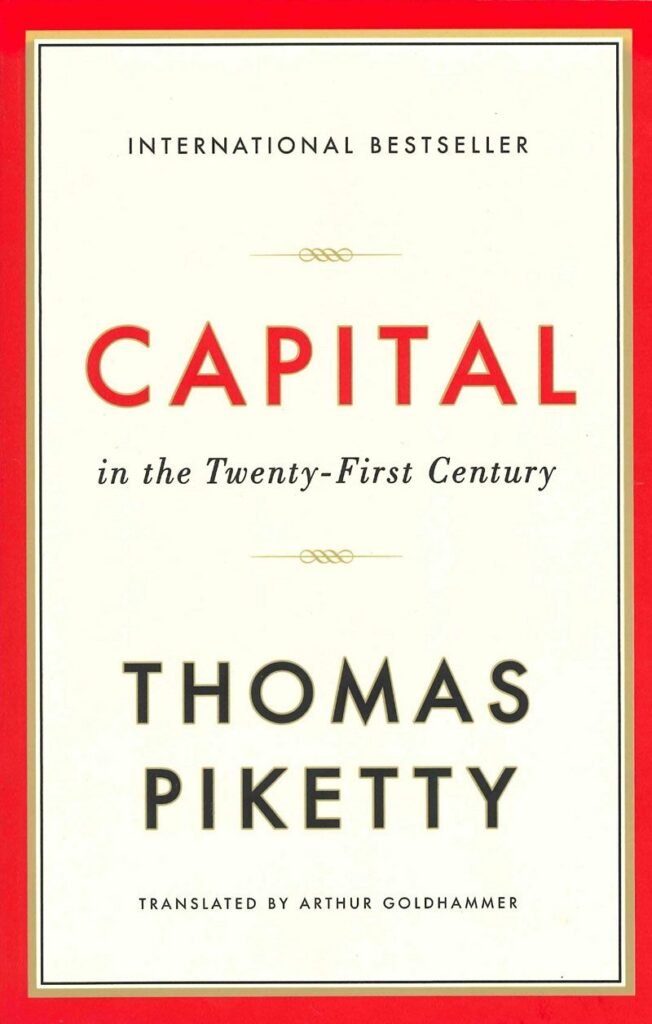
Why Read Capital in the Twenty-First Century?
Capital in the Twenty-First Century is the most consequential work of economics published in the 21st century. Thomas Piketty — a French economist who spent fifteen years assembling the most comprehensive historical dataset on wealth and income ever compiled — arrives at a conclusion that is as simple as it is disturbing: when the rate of return on capital consistently exceeds the rate of economic growth, inequality is not an accident of capitalism but its default destination, and the relative equality of the mid-20th century was the historical exception, not the rule.
The book draws on tax records, estate data, and national accounts from over twenty countries spanning three centuries to trace how wealth has been distributed, concentrated, and reconcentrated across time. Piketty’s central formula — r > g, where r is the return on capital and g is the rate of economic growth — provides a simple mathematical expression for a structural tendency that he argues operates whenever it is not actively counteracted by war, depression, or redistributive policy. The implication is that advanced economies, absent deliberate intervention, are on a trajectory back toward the levels of concentrated wealth last seen in the Belle Époque of 19th-century Europe.
This is a book that operates simultaneously as economic history, empirical social science, and political philosophy — and it generated a debate proportionate to its ambition, drawing responses from economists, politicians, and public intellectuals across the ideological spectrum. For competitive exam aspirants at the Master level, it is the most demanding and most rewarding book on the reading list: its argumentative density, its use of historical data, its engagement with competing theories, and its policy implications are precisely the kind of material that distinguishes the highest-scoring candidates in CAT, GRE, and GMAT verbal sections.
Who Should Read This
Capital in the Twenty-First Century is essential for anyone serious about understanding the political economy of the modern world — economists, policy students, historians, journalists, and any educated citizen who wants to engage with the debate about inequality, taxation, and the future of democracy with more than slogans. Particularly valuable for Master-level CAT and GRE aspirants, economics and public policy students, and MBA candidates seeking depth in macroeconomic and political economy discussions that increasingly dominate business and policy conversations.
Key Takeaways from Capital in the Twenty-First Century
Piketty’s central formula — r > g — states that when the annual rate of return on capital (historically 4–5%) exceeds the rate of economic growth (historically 1–2% in mature economies), capital owners accumulate wealth faster than the economy grows, producing ever-greater concentration of wealth. This is not a bug of capitalism but a structural feature that operates whenever growth is slow and capital returns are high.
The relative equality of the mid-20th century — the period from roughly 1914 to 1980 that many take as the baseline of a “normal” capitalist economy — was in fact a historical anomaly produced by the destruction of wealth in two World Wars, the Great Depression, and the deliberate redistributive policies that followed. As these extraordinary shocks recede and their policy legacies erode, Piketty argues we are returning toward the structural inequality of the 19th century.
Inherited wealth is reasserting its dominance over earned income as the primary mechanism of elite reproduction. In economies where r > g operates over time, the share of total wealth held by the top decile and top centile grows steadily — meaning that being born into wealth matters more and more relative to being talented, educated, or hardworking. This has profound implications for meritocracy as a social ideal and social mobility as a practical reality.
Piketty’s primary policy proposal — a progressive global wealth tax — is simultaneously his most important recommendation and his most politically utopian. Without international coordination to prevent capital flight, no single nation can effectively tax wealth. The proposal highlights a fundamental tension in modern political economy: the problems of global capital require global solutions that the current architecture of nation-states cannot provide.
Key Ideas in Capital in the Twenty-First Century
Piketty begins by establishing his empirical methodology and distinguishing it from most economics: he is interested in distributional questions — who gets what and why — rather than aggregate growth. His data, drawn from tax records, estate registries, and national accounts across France, Britain, the United States, Germany, and other countries stretching back to the 18th century, constitutes the most comprehensive historical record of wealth distribution ever assembled. This empirical foundation is what gives the book its authority and what distinguishes it from purely theoretical treatments of inequality.
The book’s analytical core is the relationship between three variables: the capital/income ratio (β), the rate of return on capital (r), and the rate of economic growth (g). Piketty shows that β has followed a U-shaped curve in major economies — high in the 19th century (capital worth 6–7 years of national income), sharply reduced in the 20th century by war and policy, and rising again since the 1970s back toward 19th-century levels. He then shows that r has historically been remarkably stable at 4–5% across centuries and countries, while g fluctuates significantly and in mature economies tends to settle around 1–2%. The mathematical consequence — r > g — is that capital’s share of total income tends to rise over time, concentrating wealth among those who own capital.
The book’s historical narrative is structured around the concept of patrimonial capitalism — the 19th-century world, best captured in the novels of Jane Austen and Honoré de Balzac, where inherited wealth was the dominant form of social capital and where the income from a fortune dwarfed anything one could earn through labor, however distinguished. Piketty argues that this world, temporarily disrupted by the catastrophes of 1914–1945, is gradually reasserting itself. The children of today’s wealthy will, on current trajectories, inherit more relative to their contemporaries than any generation since the Belle Époque.
The final sections address meritocracy, the rise of the “supermanager,” and policy responses. Piketty documents the emergence since the 1980s (primarily in the United States and United Kingdom) of extraordinarily high compensation for corporate executives — a phenomenon he argues is not explained by marginal productivity theory but by the power of executives to influence their own pay. He then turns to policy: arguing that progressive income taxes, inheritance taxes, and ideally a progressive global wealth tax are the tools available to counteract r > g and preserve democratic governance against the political power of concentrated wealth.
Core Frameworks
Piketty builds his analysis on six interlocking frameworks — moving from mathematical relationships to historical patterns to policy prescriptions — each grounded in the empirical data at the book’s foundation.
r is the average annual rate of return on capital (profits, dividends, interest, rents); g is the rate of growth of the economy. When r > g — which Piketty shows has been true for most of recorded history except the exceptional mid-20th century — capital owners accumulate wealth faster than the economy as a whole grows. Over decades and centuries, this produces a rising capital/income ratio and a rising share of income going to capital owners at the expense of labor income.
β = s/g, where s is the national savings rate and g is the growth rate. In slow-growing economies with positive savings rates, β rises over time — meaning the total stock of capital grows larger relative to annual income. Piketty shows β was around 600–700% in Europe in 1910, fell to 200–300% by 1950, and has been rising since — now approaching 400–500% and continuing upward. This U-shaped curve is one of the book’s most striking empirical findings.
The First Law states that α = r × β, where α is capital’s share of national income. If β is 600% and r is 5%, capital owners receive 30% of national income. The Second Law states that in the long run, β = s/g. Together, these laws show that slow growth and positive savings rates mechanically produce high concentrations of wealth and high capital income shares — turning the structural tendency toward inequality into an accounting identity.
Piketty describes the social structure of 19th-century Europe as “patrimonial capitalism”: a world where the return on inherited capital so exceeded anything achievable through labor that professional success was largely irrelevant to elite social standing. He uses literary examples (Jane Austen’s Sense and Sensibility, Balzac’s Père Goriot) to show that educated contemporaries understood this perfectly. His argument is that we are gradually returning to this structure as r > g reasserts itself.
Beginning in the 1970s and accelerating in the 1980s, the United States and United Kingdom saw the emergence of extraordinarily high compensation for senior corporate executives — compensation that Piketty argues cannot be explained by marginal productivity but reflects the ability of executives to influence their own pay within weakly governed corporate structures. This “supermanager” phenomenon is distinct from capital income inequality and requires different policy responses than the global wealth tax.
Piketty proposes an annual progressive tax on net wealth — perhaps 0% below €1 million, 1% between €1–5 million, 2% above €5 million — that would require the wealthy to either earn sufficient returns to pay the tax or gradually liquidate holdings, counteracting the automatic tendency toward concentration. The critical qualifier is “global”: without international coordination, capital simply moves to low-tax jurisdictions. Piketty acknowledges this makes the proposal politically utopian while arguing it is economically essential.
Core Arguments
Piketty builds four sustained arguments that together reframe inequality as a structural feature of capitalism rather than an aberration — and connect rising wealth concentration to political as well as economic consequences.
Piketty’s most fundamental argument is that the view of inequality as an aberration — a problem to be fixed by growth, education, or technology — is historically illiterate. The data show that r > g has been the norm across centuries and countries, and that the exceptional equality of the mid-20th century resulted from specific, violent, non-repeatable shocks (two world wars, the Great Depression) and from deliberate political choices (high progressive taxation, strong labor regulation) that have since been partially reversed. Absent deliberate policy intervention, the structural forces driving inequality will continue to operate.
A significant part of the book’s argumentative work is correcting what Piketty calls a distorted baseline: most living economists and policymakers were trained using data from the exceptional mid-20th century and treat its relatively equal distribution as normal. By extending the historical record back to the 18th century and forward to the present, Piketty shows that what felt normal was in fact extraordinary — and that the trajectory since 1980, in most advanced economies, has been toward 19th-century structures rather than away from them.
One of the book’s most politically charged arguments is that as r > g operates over time, the returns to inherited capital increasingly dwarf the returns to human capital — education, talent, and effort. This means that social mobility, already limited in most advanced economies, will continue to decline as the intergenerational transmission of wealth becomes the primary determinant of lifetime economic outcomes. Piketty argues this is not only economically inefficient but politically dangerous — a society in which birth determines destiny cannot sustain genuine democratic values.
The book’s closing political argument connects economic inequality to political power. Piketty argues, drawing on historical evidence, that extreme concentrations of wealth inevitably translate into extreme concentrations of political influence — through campaign finance, media ownership, think tank funding, and the revolving door between finance and government. If the structural tendency toward capital concentration is not counteracted by policy, the formal structures of democracy will increasingly serve the interests of capital owners rather than the broader population. This is not a prediction but a historical observation: it happened before, in the Gilded Age, and the structural conditions for its recurrence are present.
Critical Analysis
A balanced assessment of a landmark work that permanently changed the inequality debate — examining its extraordinary empirical and argumentative achievements alongside its genuine limitations.
The historical dataset Piketty and his collaborators assembled — covering wealth and income distribution across twenty countries over three centuries — is a genuine scientific contribution that gives the book an empirical authority no previous work on inequality possessed.
Despite its length and technical content, the book is organized around a small number of clearly stated, testable propositions — r > g, the U-shaped β curve, the return of patrimonial capitalism — that make its argument unusually precise and therefore unusually disprovable, which is a mark of intellectual honesty.
Piketty integrates economic data, historical narrative, literary evidence (Austen, Balzac, Henry James), and political philosophy into a single coherent argument — a rare achievement that makes the book genuinely illuminating across multiple disciplines simultaneously.
Several economists, most notably the Financial Times’s Chris Giles, raised questions about errors and questionable choices in Piketty’s dataset shortly after publication. While most of Piketty’s core conclusions survived scrutiny, the dispute highlighted that the empirical foundation, while impressive, is not as clean as the book’s confident presentation suggests.
Critics including Lawrence Summers argued that Piketty conflates r > g as a tendency with r > g as an iron mechanism — that in practice, as capital accumulates, returns tend to fall (diminishing marginal returns to capital), which would moderate the concentration dynamic. The theoretical debate remains open.
The global wealth tax proposal requires a degree of international coordination that does not exist and shows little sign of emerging. Critics argue that a book of this empirical ambition deserves more realistic policy engagement, and that the gap between the diagnosis (rigorous) and the prescription (aspirational) is a significant intellectual limitation.
Legacy & Cultural Impact
A Global Phenomenon: Capital in the Twenty-First Century was published in French in 2013 and in English translation in 2014, when it became an immediate global phenomenon — the first economics book to reach number one on the New York Times bestseller list. It sold over 2.5 million copies in its first year and generated a volume of commentary, criticism, and response that exceeded any economics book since John Maynard Keynes’s General Theory. The Economist called it “the most important economics book of the year and possibly of the decade.” Paul Krugman described it as “the most important book of the year” and “possibly the best book on economics since John Stuart Mill.”
Reshaping the Political Debate: The book’s political impact has been substantial and contested. On the left, it provided empirical ammunition for arguments about redistribution, progressive taxation, and the structural roots of inequality that had previously lacked the historical data to be definitive. The Sanders and Corbyn movements drew heavily on Piketty’s framework. On the right, the book was vigorously criticized — the Financial Times data dispute, theoretical critiques from mainstream economists, and arguments about capital’s tendency toward diminishing returns all received extensive coverage. The debate it generated reshaped how inequality is discussed in academic economics, political discourse, and mainstream journalism.
Relevance for Master-Level Exam Aspirants: For Master-level competitive exam aspirants, Capital in the Twenty-First Century represents the ceiling of analytical difficulty on the reading list and the most direct preparation for the highest-difficulty RC passages in CAT and GRE — those that involve dense empirical argument, contested interpretation of data, multiple competing theoretical frameworks, and explicit engagement with policy implications. Engagement with the book also provides direct preparation for MBA programme essays and interviews on macroeconomic trends, as inequality, taxation, and the future of capitalism have become central topics in business school discourse since 2014.
Love This Book? Master Every Book.
Stop struggling with reading comprehension. Our proven system transforms how you read—whether for CAT, GRE, GMAT, SAT, or personal growth.
Best Quotes from Capital in the Twenty-First Century
When the rate of return on capital exceeds the rate of growth of output and income, as it did in the nineteenth century and seems quite likely to do again in the twenty-first, capitalism automatically generates arbitrary and unsustainable inequalities.
The history of inequality is shaped by the way economic, social, and political actors view what is just and what is not, as well as by the relative power of those actors and the collective choices that result.
The past devours the future.
Wealth is so concentrated that a large segment of society is virtually unaware of its existence, so that some people imagine that it belongs to surreal or mysterious entities.
It is possible to have an egalitarian ideal without rejecting the principle of inequality entirely, as long as the social and economic inequalities that do exist are to the benefit of the least advantaged members of society.

Test Your Understanding
Think you’ve mastered Capital in the Twenty-First Century? Challenge yourself with 15 questions on Piketty’s frameworks, key arguments, and central formula. Score 80%+ to prove your mastery.
Capital in the Twenty-First Century FAQ
What is Capital in the Twenty-First Century about?
Drawing on the most comprehensive historical dataset on wealth and income ever assembled, Piketty argues that when the rate of return on capital (r) exceeds the rate of economic growth (g), capitalism structurally produces rising inequality. He shows that the relative equality of the mid-20th century was a historical exception created by war, depression, and deliberate policy — and that since the 1970s, advanced economies have been returning toward the concentrated wealth patterns of the 19th century. His primary policy proposal is a progressive global wealth tax.
How difficult is Capital in the Twenty-First Century to read?
It is rated Master — the most demanding book on the reading list. At 696 pages with substantial economic and historical content, it requires sustained intellectual engagement over many sessions. Readers with some background in economics, history, or political science will find it challenging but manageable; complete beginners may want to read a shorter introductory text on inequality first. The first and last sections (historical narrative and policy discussion) are the most accessible; the central analytical chapters are the most technically demanding.
What does r > g mean?
r > g is Piketty’s central formula, where r is the average annual rate of return on capital (profits, dividends, interest, rents — historically around 4–5%) and g is the rate of economic growth (historically 1–2% in mature economies). When r exceeds g, capital owners accumulate wealth faster than the economy grows — meaning their share of total wealth rises over time. Piketty shows this has been the historical norm and argues it is the structural driver of rising inequality in advanced economies.
What is the global wealth tax and why does Piketty propose it?
Piketty proposes an annual progressive tax on net wealth — total assets minus liabilities — applied globally to prevent capital flight. Without international coordination, wealthy individuals can simply move their assets to low-tax jurisdictions, making national wealth taxes ineffective. The global wealth tax would require international cooperation between governments to share financial information and enforce the tax across borders. Piketty acknowledges this is currently politically utopian but argues it is economically essential to counteract r > g over the long term.
Why is Capital in the Twenty-First Century considered so important?
Because it changed the empirical and theoretical foundation of the inequality debate. Before Piketty, arguments about inequality were often based on limited data, theoretical models, or ideological priors. By assembling three centuries of wealth data from twenty countries, Piketty showed that rising inequality in advanced economies since the 1970s is not an anomaly but a return to historical norms — and that the structural forces driving it (r > g) are mathematical rather than accidental. Whether or not one accepts all his conclusions, the empirical contribution permanently raised the standard of evidence required in this debate.








