

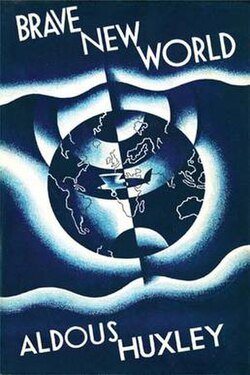
Why Read Brave New World?
Brave New World is the most prescient dystopian novel ever written — not because it predicted surveillance or brutality but because it predicted something far more insidious: a world in which human beings are perfectly happy and perfectly controlled, in which suffering has been eliminated, and in which this achievement constitutes the deepest possible catastrophe. Huxley’s nightmare is not a boot stamping on a human face but a population too contented to notice, or care, that it has surrendered everything that makes life meaningful.
Published in 1932, the novel imagines a future World State where human beings are biologically engineered from birth into fixed social castes, conditioned from infancy to love their destinies, and kept perpetually satisfied through promiscuous sex, mindless entertainment, and a happiness drug called soma. There is no war, no poverty, no disease, and no unhappiness — and also no art, no religion, no genuine love, no family, and no freedom. The World State’s motto — “Community, Identity, Stability” — captures its achievement and its horror simultaneously.
Where Orwell’s 1984 warns against a totalitarianism imposed by fear, Huxley warns against one sustained by pleasure — a distinction that Neil Postman later made famous in arguing that Huxley’s vision is, in the age of mass media and consumer culture, the more accurate prophecy. For reading comprehension preparation, Brave New World offers analytically rich literary fiction with sustained philosophical argument embedded in narrative — particularly relevant to passages on technology, autonomy, and the nature of happiness that appear regularly in advanced CAT and GRE RC sections.
Who Should Read This
Brave New World is essential reading for anyone thinking seriously about technology, freedom, human nature, and the relationship between happiness and meaning. It is particularly valuable for CAT and GRE aspirants preparing for literary fiction and social philosophy passages, for MBA candidates engaging with technology ethics and leadership discussions, and for any reader who has wondered whether a world without suffering might be a world not worth living in.
Key Takeaways from Brave New World
The most dangerous totalitarianism is one that makes its subjects happy. Huxley’s World State does not terrorize — it satisfies. Citizens are engineered to want exactly what the system provides and to find fulfillment in their assigned roles. This makes resistance not merely difficult but literally inconceivable: you cannot rebel against a system that has shaped the very desires by which you evaluate your own life.
Conditioning is more powerful than coercion. The World State does not need telescreens or Thought Police because it has something more effective: the systematic shaping of desire, identity, and aspiration from before birth. Hypnopaedia (sleep-teaching), Pavlovian conditioning, and biological engineering ensure that citizens never want what they cannot have, never question what they are given, and never conceive of alternatives to their contentment.
Art, religion, and suffering are inseparable from meaning. The World Controller Mustapha Mond’s explanation of why the World State has eliminated Shakespeare, God, and genuine emotional experience is the novel’s philosophical climax: these things are incompatible with stability, and stability is the highest value. The Savage’s counter-argument — that he claims the right to be unhappy, to feel passion and loss and the full range of human experience — is Huxley’s own.
Technology without wisdom is the most efficient path to dehumanization. The World State’s defining achievement is the application of industrial efficiency to human beings themselves — the Bokanovsky Process mass-produces people like goods on a factory line. Huxley’s warning is not against technology per se but against the application of instrumental rationality to human life without any counter-weight of philosophy, art, or religion to ask what human beings are for.
Brave New World Plot Summary
The novel opens in the Central London Hatchery and Conditioning Centre, where Director Tomakin is explaining to a group of students how human beings are manufactured. The Bokanovsky Process budding of a single egg can produce up to ninety-six identical human beings; Podsnap’s Technique accelerates the ripening of eggs to produce thousands of individuals per year. Each individual is engineered for a specific caste — Alphas and Betas, the intelligent managers; Gammas, Deltas, and Epsilons, the workers — and conditioned from infancy to love their role and despise those of other castes. The opening tour is Huxley’s efficient exposition of a world so thoroughly engineered that its citizens cannot imagine alternatives.
Bernard Marx, an Alpha-Plus psychologist, is a misfit: something went slightly wrong in his conditioning, leaving him dissatisfied, introspective, and socially awkward in a world where those qualities are pathological. He obtains permission to take the pneumatic and casually promiscuous Lenina Crowne to the Savage Reservation in New Mexico — one of the few areas left outside World State control, where people still age, suffer, give birth naturally, and practise religion. There they encounter John, the son of a World State woman who was accidentally left behind on the reservation, raised on Shakespeare and the spirituality of the Zuni people, longing all his life for the civilized world he has never seen.
Bernard brings John — “the Savage” — and his mother Linda back to London, where John becomes a celebrity sensation: the authentic, unengineered human being that the World State’s citizens can gawk at without any risk of contagion. John is both fascinated and horrified by what he finds: a world of perfect bodies, perfect health, and perfect emptiness. His love for Lenina founders on his Shakespearean romanticism colliding with her cheerful promiscuity. His mother, reunited with soma and the comforts of civilization, dies in a hospital surrounded by Bokanovsky-produced identical children who regard death with the cheerful indifference their conditioning demands — and John’s grief, raw and Shakespearean, is incomprehensible to those around him.
The novel climaxes in a confrontation between John and Mustapha Mond, the World Controller for Western Europe — one of the few men in the World State who has read Shakespeare, knows history, and understands exactly what has been traded away for stability. Their debate about the value of art, religion, suffering, and freedom is Huxley’s most direct philosophical statement. Mond is neither villain nor fool; he has made a considered choice and defends it with full knowledge of what it costs. John claims the right to unhappiness and retreats to a lighthouse to live in isolation — pursued by the media, by crowds treating his suffering as entertainment, and finally by his own inability to sustain a human life entirely outside the system that has made his existence possible.
Brave New World Characters
Each character embodies a different relationship to the World State’s engineered order — from perfect conformity to total rejection — and together they map the full range of responses available to human beings within a system of total conditioning.
An Alpha-Plus who has been slightly mis-conditioned and is therefore uncomfortable with the frictionless happiness around him. Bernard is dissatisfied, self-conscious, and prone to reflection — qualities that are literally pathological in the World State. He is, however, no hero: his dissatisfaction is largely personal vanity rather than genuine moral insight, and when celebrity briefly solves his social problems, he abandons his earlier scruples with embarrassing speed. He serves as a critique of the idea that unhappiness automatically produces wisdom.
Born on the Savage Reservation to a World State woman, raised on Shakespeare and indigenous spirituality, John embodies everything the World State has eliminated: passion, suffering, belief, aesthetic intensity, and a concept of human dignity that cannot be reduced to contentment. His tragedy is that he belongs to neither world — the reservation regarded him as an outsider, and civilization regards him as an exhibit. His final, self-destructive withdrawal represents Huxley’s bleak assessment of the possibilities for authentic human life in a world of total conditioning.
A pneumatic, cheerful, and thoroughly conditioned Beta who is attracted to both Bernard and John but cannot understand why either of them makes things so complicated. Lenina is not a villain — she is a victim of perfect conditioning who genuinely cannot conceive of what she has lost. Her bewilderment at John’s intensity and her casual treatment of their relationship as a pleasant recreational activity illustrate with quiet precision what the elimination of depth does to human connection.
The World Controller for Western Europe and the novel’s most intellectually formidable figure — the one person in the World State who has read the forbidden books (Shakespeare, the Bible, history) and understands both what the old world contained and why it had to be replaced. He is not a conventional villain but a lucid architect of a considered trade-off: stability, happiness, and security purchased at the price of art, religion, passion, and freedom. His debate with John is the novel’s philosophical heart.
An Alpha-Plus writer of hypnopaedic slogans who, like Bernard, has been slightly too well-endowed for his social role and has begun to feel the limitation of a world that has no use for genuine artistic intensity. Where Bernard’s dissatisfaction is self-regarding, Helmholtz’s is aesthetic: he knows he is capable of writing something more powerful than conditioning slogans but has no subject matter adequate to his talent. His eventual exile to the Falkland Islands — among intellectuals and artists — is presented as the best the World State can do with those it cannot entirely condition.
A Beta woman accidentally left behind on the Savage Reservation while pregnant with John, Linda spent decades enduring the reservation’s conditions — aging, illness, social exclusion — while pining for the comforts of civilization. Her return to London represents the World State’s values in their starkest form: she spends her final months in a permanent soma holiday, happily obliterated, dying not with dignity but with the cheerful anaesthesia the system provides. Her death, and John’s grief over it, is the moment where the two worlds collide most devastatingly.
Major Themes
Huxley weaves four interlocking philosophical themes through the novel — each one a different facet of his central question: what does a civilization lose when it successfully eliminates suffering?
The novel’s central philosophical argument, made most explicitly in the Mond-Savage debate, is that happiness purchased through the elimination of choice, depth, suffering, and genuine relationship is not the kind of happiness worth having. The World State has achieved perfect satisfaction of engineered desires — but it has done so by engineering away the desires that make human life genuinely human. Huxley’s question — whether a contented animal is better than an unhappy person — has no easy answer, which is why the novel continues to disturb.
In the World State, everything that was once sacred, private, or genuinely personal has been transformed into a commodity: sex is recreational and universal, emotion is chemically regulated, death is managed by the state, and even grief is socially inadmissible. Huxley extends the logic of industrial capitalism — the reduction of everything to exchangeable units — to human experience itself, asking what remains of meaning, identity, and connection when the market has colonized every dimension of inner life.
The World State is not a failure of technology but its supreme achievement — a civilization that has applied the full power of science to the problem of human unhappiness and solved it, at the cost of everything that makes human beings more than biological machines. Huxley’s warning is directed specifically at the techno-utopian impulse: the belief that the correct application of knowledge and engineering can optimize human life without remainder. The novel asks what the remainder is, and argues that it is everything.
Mond’s explanation of why Shakespeare is forbidden is the novel’s most direct philosophical argument: genuine art requires genuine emotion, and genuine emotion requires the kind of suffering, passion, and depth that the World State has eliminated. God, similarly, is unnecessary when there is soma. Huxley is not arguing for suffering as good in itself but for its functional role in producing the conditions for meaning — for art, for religion, for love in its full rather than recreational form. Remove suffering, and you remove the conditions that make these things possible.
Critical Analysis
A balanced assessment of one of the most prophetically accurate novels of the 20th century — examining its extraordinary philosophical achievements alongside its genuine artistic limitations.
Huxley’s vision of social control through pleasure — through entertainment, consumerism, casual sex, and mood-regulating pharmaceuticals — has proven, in the view of many cultural critics, more accurate than Orwell’s vision of control through fear; the novel reads less like science fiction than like a satirical description of aspects of contemporary consumer culture.
The Mond-Savage debate in the final chapters elevates the novel above mere dystopian thriller into genuine philosophical literature — a sustained engagement with questions about the nature of happiness, freedom, and human dignity that has no easy answers and that Huxley handles with impressive intellectual balance.
Huxley’s world-building is both imaginative and precisely calibrated — every detail (the names, the slogans, the recreational activities, the conditioning techniques) is chosen to illuminate a specific aspect of what has been gained and lost, making the novel as much a work of philosophical argument as of narrative fiction.
John the Savage is more of a philosophical position than a fully realized human being — his Shakespearean intensity occasionally tips into caricature, making it difficult to invest emotionally in a character who functions primarily as a rhetorical device.
The novel’s female characters — primarily Lenina — are defined almost entirely through their relationship to male desire and the system’s conditioning of sexuality; they lack the intellectual and moral agency that Bernard and Helmholtz possess, a limitation that reflects both Huxley’s era and the specific satirical targets he chose.
The novel presents its philosophical choices in relatively stark terms — World State contentment versus Savage intensity, stability versus freedom, soma versus suffering — in ways that occasionally feel more polemical than novelistic, leaving little room for the messy, partial, ambiguous alternatives that actual human societies occupy.
Literary & Cultural Impact
From Controversy to Classic: Brave New World was published in 1932 and was immediately recognized as a major work, though it generated more controversy than enthusiasm in its early reception — many critics found its vision too pessimistic, its satire too savage, and its implicit critique of progressive social engineering too threatening. Its reputation has grown continuously since, particularly since the 1960s when its themes — the relationship between pleasure, freedom, and authenticity; the dangers of pharmaceutical mood management; the erosion of genuine connection by consumer culture — became central concerns of Western intellectual life.
Huxley vs. Orwell — Which Prophet Was Right?: The novel has sold over 50 million copies and is one of the most widely taught works of fiction in the English-speaking world. Neil Postman’s Amusing Ourselves to Death (1985) made the comparison between Orwell and Huxley famous: Orwell feared those who would ban books; Huxley feared there would be no reason to ban books because no one would want to read them. In an era of social media, streaming entertainment, smartphone dependency, and widespread antidepressant use, this comparison has become a cultural touchstone — and Brave New World has become less a warning about a possible future than a description of tendencies visibly present in the current one.
The Most Analytically Productive Dystopia for Exam Aspirants: For competitive exam aspirants, Brave New World is one of the most analytically productive fiction texts on the reading list. Its themes — technology and human nature, the relationship between happiness and freedom, the social construction of desire, the role of art and suffering in a meaningful life — appear with high frequency in advanced CAT and GRE reading comprehension passages, particularly those drawn from philosophy, technology ethics, and social criticism. The Mond-Savage debate in particular models the kind of sustained philosophical argument — with two genuinely strong positions in genuine tension — that distinguishes the highest-difficulty RC passages.
Love This Book? Master Every Book.
Stop struggling with reading comprehension. Our proven system transforms how you read—whether for CAT, GRE, GMAT, SAT, or personal growth.
Best Quotes from Brave New World
But I don’t want comfort. I want God, I want poetry, I want real danger, I want freedom, I want goodness. I want sin.
Ending is better than mending.
Universal happiness keeps the wheels steadily turning; truth and beauty can’t.
One believes things because one has been conditioned to believe them.
The greater a man’s talents, the greater his power to lead astray.
Test Your Understanding
Think you’ve mastered Brave New World? Challenge yourself with 15 questions on Huxley’s characters, themes, and the philosophical arguments at the heart of the novel. Score 80%+ to prove your mastery.
Brave New World FAQ
What is Brave New World about?
Brave New World imagines a future World State where human beings are biologically engineered into social castes, conditioned from infancy to love their roles, and kept permanently satisfied through promiscuous sex, mindless entertainment, and a happiness drug called soma. The novel follows Bernard Marx, a dissatisfied Alpha, and John the Savage, an unengineered outsider, as they collide with a civilization that has eliminated suffering, art, religion, family, and freedom in exchange for perfect stability and contentment. Its central question is whether happiness without meaning, freedom, or depth is worth having.
Is Brave New World difficult to read?
It is rated Intermediate — the prose is clear and often witty, and the satirical world-building is accessible. The novel’s opening chapters (the hatchery tour) require some adjustment to the vocabulary of the World State, but Huxley establishes his world efficiently. The most demanding section is the philosophical debate between Mond and John in the final chapters, which rewards slow, careful reading. Most readers find it faster and more entertaining than 1984, though no less disturbing.
What are the main themes in Brave New World?
The novel’s central themes are happiness versus freedom and meaning, the commodification of human experience, the dangers of technological utopianism, the relationship between art and suffering, the social construction of desire through conditioning, and the question of what makes human life genuinely human rather than merely comfortable.
How does Brave New World compare to 1984?
Both are canonical dystopian novels, but their visions of totalitarianism are almost mirror images. 1984 depicts control through fear, pain, surveillance, and the suppression of pleasure. Brave New World depicts control through the provision of pleasure, satisfaction, and engineered contentment. Critics have argued that Huxley’s vision is in many respects the more accurate description of contemporary Western consumer culture, which controls its subjects primarily through distraction and satisfaction rather than terror. Reading both together provides the most complete picture of how freedom can be lost.
Why is Brave New World still relevant today?
Because the specific mechanisms of control it describes — the management of emotion through pharmaceuticals, the reduction of sex to recreation, the replacement of genuine culture with entertainment, the engineering of desire through advertising and conditioning — are not futuristic speculations but recognizable features of contemporary life. The novel’s central question — whether a population too comfortable and entertained to care about freedom has lost something essential — is more urgently relevant in the age of social media, streaming culture, and antidepressants than it was in 1932.








